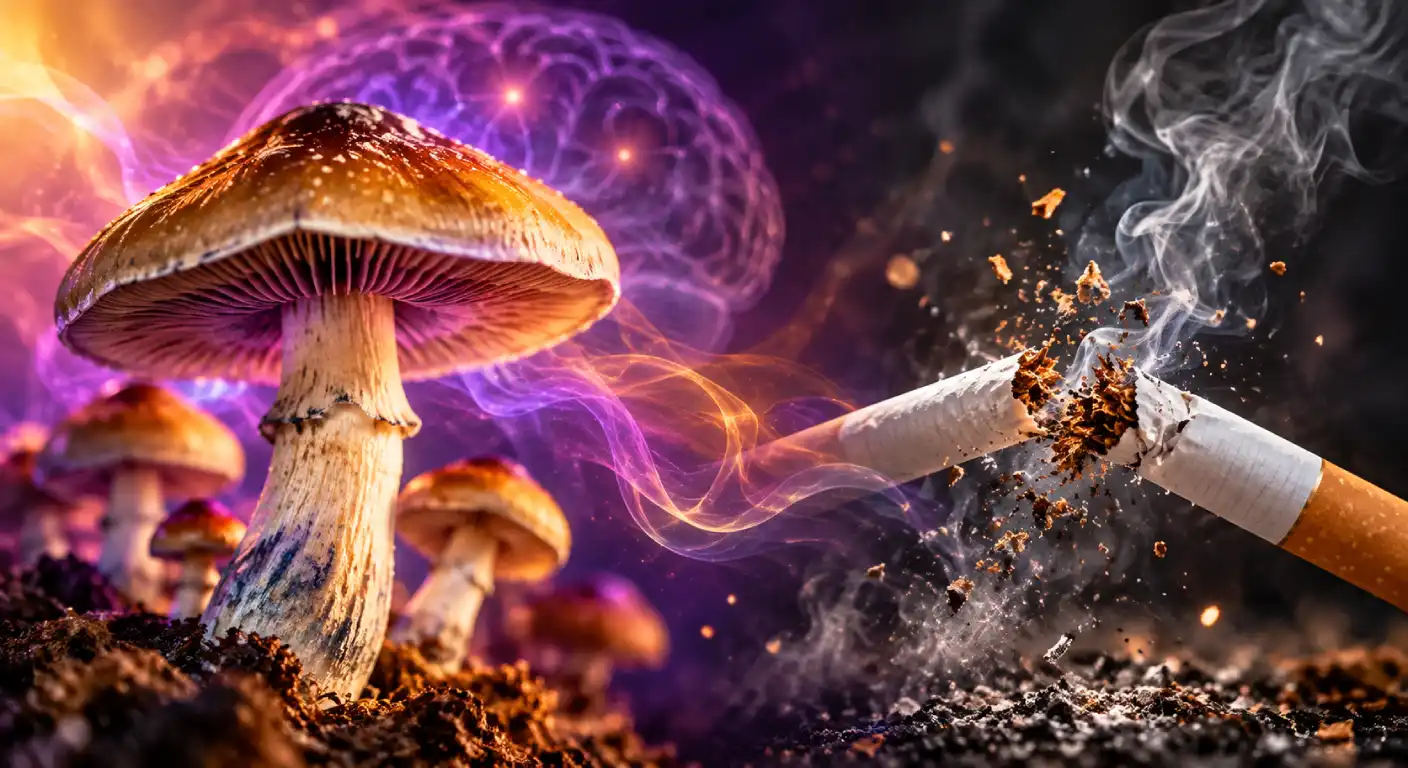
A small pilot trial has given researchers a promising new reason to take psilocybin — the active ingredient in magic mushrooms — seriously as a tool for breaking addiction. And this time, it’s not about depression or anxiety. It’s about cigarettes. The trial was open-label, meaning participants knew which treatment they got, so its results are an early signal rather than proof.
The story, reported by BBC Future, covers a trial led by a team at Johns Hopkins University and published in the medical journal JAMA Network Open, which compared psilocybin against nicotine patches in a group of 82 current smokers. The results were striking.
Can Psilocybin Help People Quit Smoking?
At the end of six months, those who had taken just one dose of psilocybin had more than six times greater odds of being abstinent from cigarettes than those who relied on a nicotine patch. In total, 17 participants in the psilocybin group had stayed off cigarettes at the six-month mark, compared to only four in the nicotine group.
Everyone in both groups also underwent cognitive behavioural therapy (CBT) for smoking cessation, meaning psilocybin wasn’t used in isolation — it was paired with structured psychological support.
What Did the Experience Look Like?
Participants ingested a relatively high dose of pure psilocybin. While under the influence, they lay in a room wearing eye shades and listening to soft music, with their overall experience described as “self-directed.” Trained facilitators were on hand to make sure everyone felt comfortable and prepared before their session.
“I was surprised by the sheer magnitude of the effect,” said Matthew Johnson, the study’s lead author and a professor of psychiatry at Johns Hopkins.
Why Might Psilocybin Help with Smoking Cessation?
Researchers believe psilocybin may help people quit by creating a profound shift in perspective — a kind of mental reset that loosens the grip of deeply ingrained habits. This lines up with earlier research suggesting that people who have a meaningful or “mystical” experience during a psilocybin session are more likely to make lasting behavioural changes.
Over the past decade, research into psychedelic-assisted therapy has expanded dramatically — but this study suggests the potential extends well into the world of addiction treatment too.
Is the Research Conclusive?
Not yet. The findings will need to be replicated in a larger and more diverse study. But they raise what researchers are calling an “exciting” prospect.
“It’s been 20 years since we’ve had a new medication to help people quit smoking,” said Megan Piper, who directs the UW Center for Tobacco Research and Intervention. “We need something novel, and this is definitely a novel approach.”
There are currently relatively few well-controlled studies on psychedelics and addiction. Psilocybin for alcohol dependence has shown promise, and trials are ongoing. Smoking now adds another chapter to that growing story.
The Bigger Picture
Smoking remains one of the leading causes of preventable death globally. If psilocybin research continues to show results like these, it could eventually sit alongside existing cessation tools — not as a standalone cure, but as part of a broader, more personalised approach to quitting.
It’s early. But it’s promising. And for the millions of people who’ve tried patches, gums, and medications without success, that’s worth paying attention to.
Source: BBC Future / JAMA Network Open / Johns Hopkins University. Thanks for reading.
Frequently Asked Questions
According to a 2026 Johns Hopkins University study published in JAMA Network Open, a single dose of psilocybin (the active compound in magic mushrooms) combined with cognitive behavioural therapy gave participants more than six times greater odds of quitting smoking compared to nicotine patches.
Researchers believe psilocybin triggers a significant shift in perspective that helps break habitual patterns of thinking. Participants who reported a profound or "mystical" experience during their session were more likely to remain abstinent from cigarettes in the months that followed.
Psilocybin remains a Class A controlled substance in the UK. However, research into its therapeutic use is ongoing, and regulatory attitudes are gradually evolving as clinical evidence grows.
In the Johns Hopkins trial, 17 out of the psilocybin group had stayed off cigarettes at the six-month mark, compared to just 4 in the nicotine patch group — from a total sample of 82 participants.