⚡Quick Answer
A mushroom grow bag that is not colonising is almost always caused by one of seven fixable problems: temperature too low or too high, contamination, poor inoculation technique, old or poorly stored inoculum, incorrect moisture levels, insufficient air exchange, or simply not enough patience. Most stalled bags can be recovered, and this guide walks through every cause with a clear diagnosis and fix. For the full process from injection to harvest, see our complete grow bag guide.
You inoculated your grow bag days ago. You have been checking it daily. Nothing. No white fuzz creeping across the substrate, no signs of life — just silence inside the bag. Sound familiar?
A grow bag not colonising is one of the most common frustrations in mushroom cultivation research, and the good news is that in the vast majority of cases, the cause is identifiable and either fixable or avoidable next time. In this guide we cover every reason a grow bag stalls during colonisation, how to diagnose exactly which problem you are facing, and what to do about it — specific to UK conditions and the products available from Tripping Store.
📊 Key Stats
- 7–10 Days before first white mycelium is typically visible
- 24–27°C Steady temperature for our grow bags, from inoculation through harvest
- 21–35 Days Full colonisation timeline in our grow bags
- #1 Cause Temperature too low
What Does Normal Colonisation Actually Look Like?
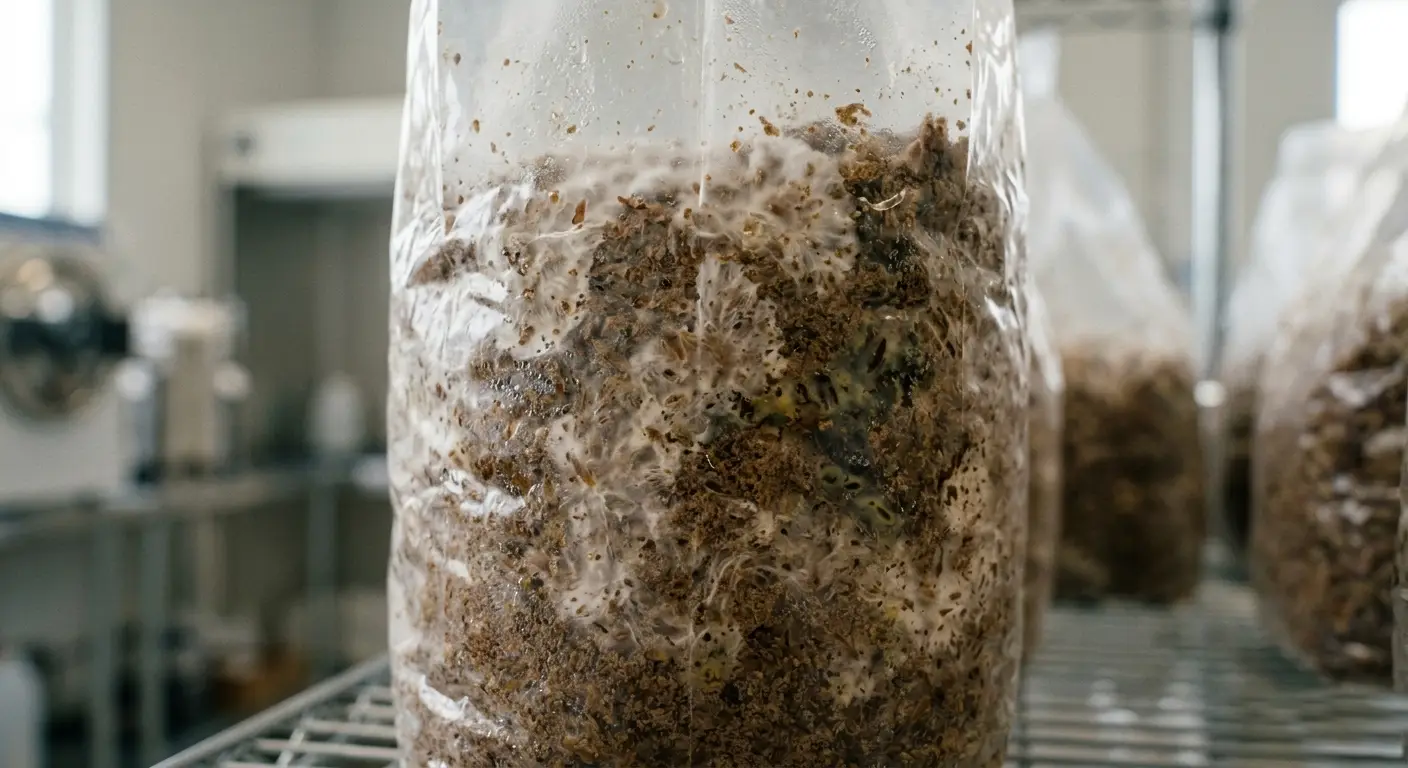
Before troubleshooting, it helps to know exactly what you are looking for and when. Colonisation is the process of mycelium — the white, thread-like root network of a fungus — spreading through and consuming a substrate. In a grow bag, this appears as fluffy white growth that slowly expands outward from the inoculation point.
Normal Colonisation Timeline (Grain or BRF Bags)
Days 1–7
No visible growth — this is normal. The mycelium is establishing itself from your inoculum. Nothing visible does not mean nothing is happening. Do not disturb the bag.
Days 7–10
First signs appear. Tiny white fuzzy specks emerge at or near the inoculation point. These may look like small cotton tufts. This is healthy rhizomorphic or tomentose mycelium beginning to establish.
Days 10–21
Active spread. White growth visibly colonises the substrate in patches, then threads, then a solid white mass. Grain bags will look increasingly white throughout. Some condensation inside the bag is normal.
Days 21–35
Full colonisation. The entire substrate is white to off-white. For all-in-one bags, the block feels consolidated. In a cold UK room, colonisation can take longer than this, which is why a steady 24–27°C matters (see cause 1 below).
⚠️ Important: If you see zero visible growth after 14 days in correct temperature conditions, that is when to investigate. Before 14 days — especially in cooler UK homes — patience is almost always the right answer.
7 Reasons Your Grow Bag Is Not Colonising (And How To Fix Each One)
1. Temperature Is Too Low — The Most Common Cause in the UK
This is the single most frequent reason for slow or stalled colonisation in the UK, and it catches people out every autumn and winter. Mycelium is highly sensitive to temperature. Below approximately 18°C, growth slows to a crawl. Below 15°C, many strains stop colonising entirely.
Signs of this problem: Very slow progress (less than 10% coverage after 2 weeks), growth appears then stalls, condensation on inside of bag without mycelium spread.
Fix: Move the bag to a warmer location. A heated propagator, heat mat under the bag, or a purpose-built incubation space kept at a steady 24–27°C will resolve this within days.
Colonisation Temperature Guide:
- Below 15°C — Colonisation stops or dormant (High risk)
- 15–18°C — Very Very slow
- 18–21°C — Very slow
- 21–24°C — Slow — below the target range
- 24–27°C — Optimal — hold it steady from inoculation through harvest
- Above 27°C — Stress and high contamination risk
2. Contamination Has Taken Hold
Contamination is one of the most visually obvious causes of failure. Mould and bacteria outcompete mycelium by colonising the substrate first.
Signs of this problem: Green, black, orange, or pink patches, unusual odour, slimy texture, fast spreading discolouration.
Fix: Discard the contaminated bag in a sealed bin bag — away from other bags. Do not open inside.
3. Poor Inoculation Technique
Even with a healthy culture, poor technique can slow colonisation significantly.
Signs of this problem: One isolated patch of growth that does not spread.
Fix: Gently shake or redistribute the bag. Use multiple injection points in future.
4. Old or Poorly Stored Inoculum
A culture that is old or has been stored badly may be weak or no longer alive, so it never establishes in the substrate.
Signs of this problem: No growth after 14+ days in correct conditions.
Fix: Use fresh, properly stored inoculum.
5. Moisture Level Is Wrong
Too dry slows growth. Too wet causes contamination.
Signs of this problem: Pooling water or very dry substrate.
Fix: Maintain field capacity — evenly moist, not dripping.
6. Insufficient Air Exchange (FAE)
Mycelium requires oxygen and produces CO₂.
Signs of this problem: Stalled growth after initial progress.
Fix: Ensure filter patch is clear and unobstructed.
7. It Just Needs More Time
Colonisation takes weeks, not days. In our grow bags, first growth usually appears at 7–10 days and full colonisation takes 21–35 days, so a bag that looks slow may be right on schedule.
Signs of this problem: Healthy but slow white growth.
Fix: Keep the bag at a steady 24–27°C and allow the full 35 days before deciding it has stalled.
Quick Diagnosis: What Does Your Bag Look Like?
- No growth yet at 7–10 days → Normal; first growth usually appears around now
- No growth after 14+ days → Non-viable inoculum
- Very slow growth → Temperature too low
- Green/black/pink patches → Contamination
- Slimy yellow/orange → Bacterial contamination
- One patch only → Single inoculation point
- Stalled at 50% → CO₂ buildup or blocked filter