⚖️ UK Legal Notice: This guide is for learning and research only. Psilocybe cubensis spores do not have psilocybin or psilocin in them, so they are legal to buy in the UK for research under a microscope. Growing spores into full mushrooms is against the law under the Misuse of Drugs Act 1971. Always follow UK law. See our 2026 UK Legal Guide for more.
⚡ Quick Answer
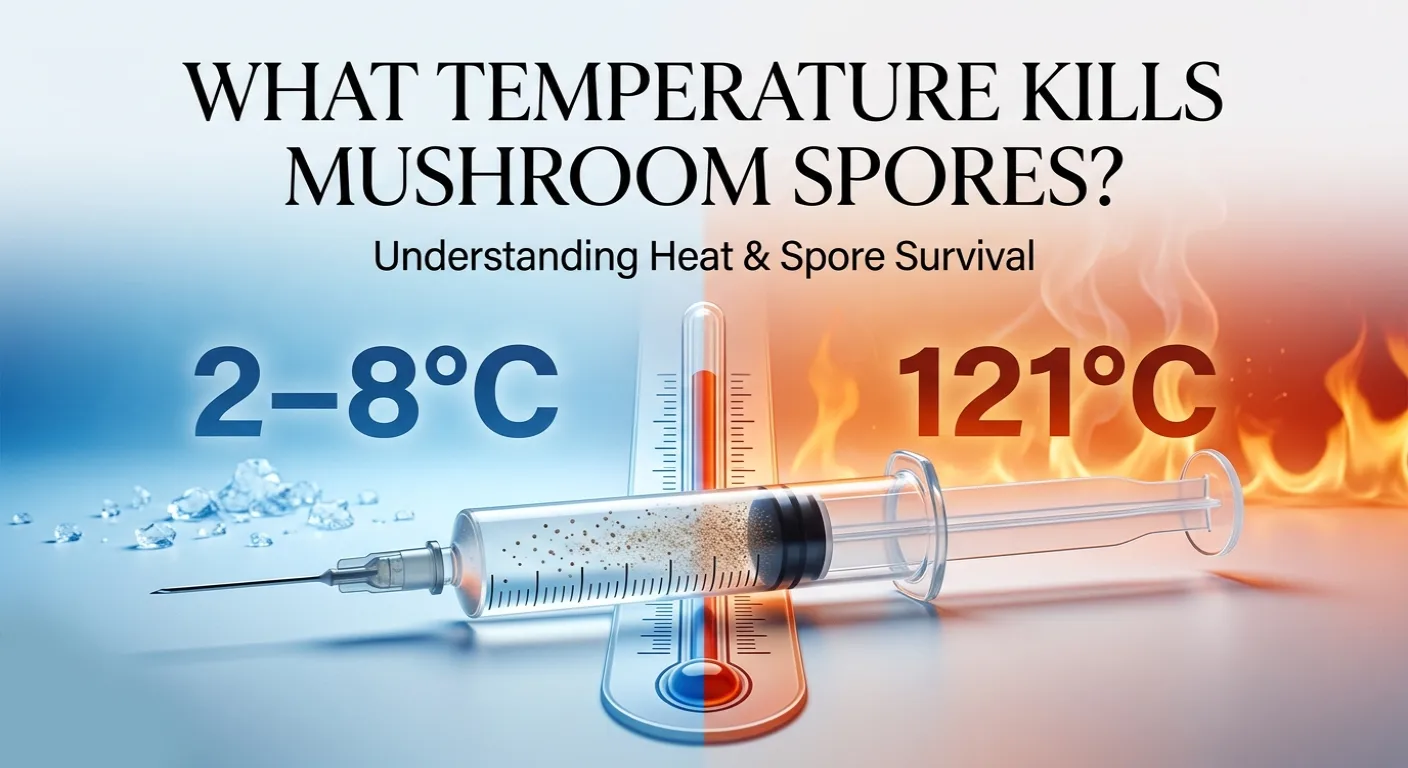
Mushroom spores are killed reliably at around 121°C, held for 15 to 20 minutes, which is why a pressure cooker or lab autoclave is the standard tool for sterilising equipment and agar mixes. Simply boiling water only reaches 100°C, which isn't hot enough to guarantee killing all spores — some are surprisingly heat-resistant. This is completely different from the temperature spores need to stay dormant and safe in storage, which is a cold 2–8°C, not a hot one. This guide explains the difference clearly and why it matters for sterile technique.121°CTemperature that reliably kills spores
15–20minTime needed at that temperature
100°CBoiling point — not hot enough alone
2–8°CStorage temperature to keep spores safe
Jump to a section
1. What Temperature Actually Kills Spores?
2. Why Boiling Water Isn't Enough
3. Killing Spores vs Storing Them
4. When You Actually Need to Kill Spores
FAQ1. What Temperature Actually Kills Spores?
Mushroom spores are considered reliably destroyed at around 121°C, held for 15 to 20 minutes under pressure. This is the standard used in labs and in home mycology setups through a pressure cooker, which can reach higher temperatures than boiling water alone because it traps steam and builds pressure.
ℹ️ Key Fact — Spores are tougher than most living cells. They're built to survive dry conditions, cold, and even some heat, which is exactly why they need a higher, sustained temperature — not just a quick boil — to be fully destroyed.
2. Why Boiling Water Isn't Enough
Boiling water reaches 100°C at normal air pressure — but that's not hot enough to guarantee killing every spore. Some spores are surprisingly heat-resistant and can survive a simple boil, especially if they're only briefly exposed rather than held at that temperature for a long time.| Method | Temperature Reached | Reliable for Killing Spores? |
|---|---|---|
| Boiling water | 100°C | No — not guaranteed |
| Pressure cooker | ~121°C | Yes, held for 15–20 minutes |
| Lab autoclave | ~121°C+ | Yes, held for the recommended time |
| Dry heat (oven) | Varies | Less reliable — usually needs much higher heat and longer time than moist heat methods |
✅ Why Pressure Matters — A pressure cooker doesn't just heat water — it traps steam, which raises the boiling point above 100°C. That extra heat is what makes it reliable for sterilising equipment and agar mixes, unlike an open pot of boiling water.
3. Killing Spores vs Storing Them — Don't Mix These Up
These are two completely opposite temperature questions, and it's an easy mistake to confuse them.
🔥
Killing Spores
Needs high, sustained heat — around 121°C for 15–20 minutes. This is for sterilising tools, surfaces, and agar mixes before use.
❄️
Storing Spores Safely
Needs a cold, stable environment — 2–8°C, in the dark, never frozen. This keeps living spores dormant and viable for months.
⚠️ Common Mistake — Never apply heat to a spore syringe you actually want to keep and use. The high temperature needed to kill spores would destroy the very sample you're trying to study.
4. When You Actually Need to Kill Spores
You'll want to reach spore-killing temperatures in a few specific situations, not for the spores you're actively studying.| Situation | Why Heat Is Used |
|---|---|
| Sterilising agar mix before pouring plates | Removes unwanted bacteria and contaminant spores from the mixture |
| Sterilising glass tools | Ensures nothing from a previous use carries over to the next sample |
| Disposing of contaminated material | Safely destroys unwanted mould or bacterial growth before disposal |
Ready to Start Your Research?
Every TrippingStore spore syringe is prepared under sterile conditions in the UK — giving you a clean, viable starting sample that should never be exposed to heat once it's in your hands.Frequently Asked Questions
QWhat temperature kills mushroom spores?
Around 121°C, held for 15 to 20 minutes, which is why a pressure cooker or lab autoclave is used for reliable sterilisation, rather than simply boiling water.
QDoes boiling water kill mushroom spores?
Not reliably. Boiling water only reaches 100°C, which isn't hot enough to guarantee killing all spores, since some are surprisingly heat-resistant.
QWhy do you need a pressure cooker instead of a normal pot?
A pressure cooker traps steam, which raises the temperature above the normal 100°C boiling point, reaching the roughly 121°C needed for reliable sterilisation.
QIs the temperature that kills spores the same as the storage temperature?
No, they're opposites. Killing spores needs high heat, around 121°C. Storing spores safely needs cold, around 2–8°C. Mixing these up can either destroy a sample you wanted to keep, or fail to properly sterilise equipment.
QShould I ever apply heat to a spore syringe I want to use?
No. Heat high enough to kill spores would also destroy the sample you're trying to study. Spore syringes should only ever be refrigerated, never heated.
QWhy are spores harder to kill than other living cells?
Spores are built to survive tough conditions like dryness and cold, which also makes them more heat-resistant than typical living cells, requiring higher sustained temperatures to destroy.
QDo I need to sterilise my agar mix, and at what temperature?
Yes. Agar mixes should be sterilised in a pressure cooker at around 121°C for 15–20 minutes before pouring plates, to remove unwanted bacteria and contaminant spores.