
⚖️ UK Legal Notice: This guide is for learning and research only. Psilocybe cubensis spores do not have psilocybin or psilocin in them, so they are legal to buy in the UK for research under a microscope. Growing Psilocybe cubensis from spores is illegal under UK law (the Misuse of Drugs Act 1971). Always follow UK law. See our 2026 UK Legal Guide for more.
⚡ Quick Answer
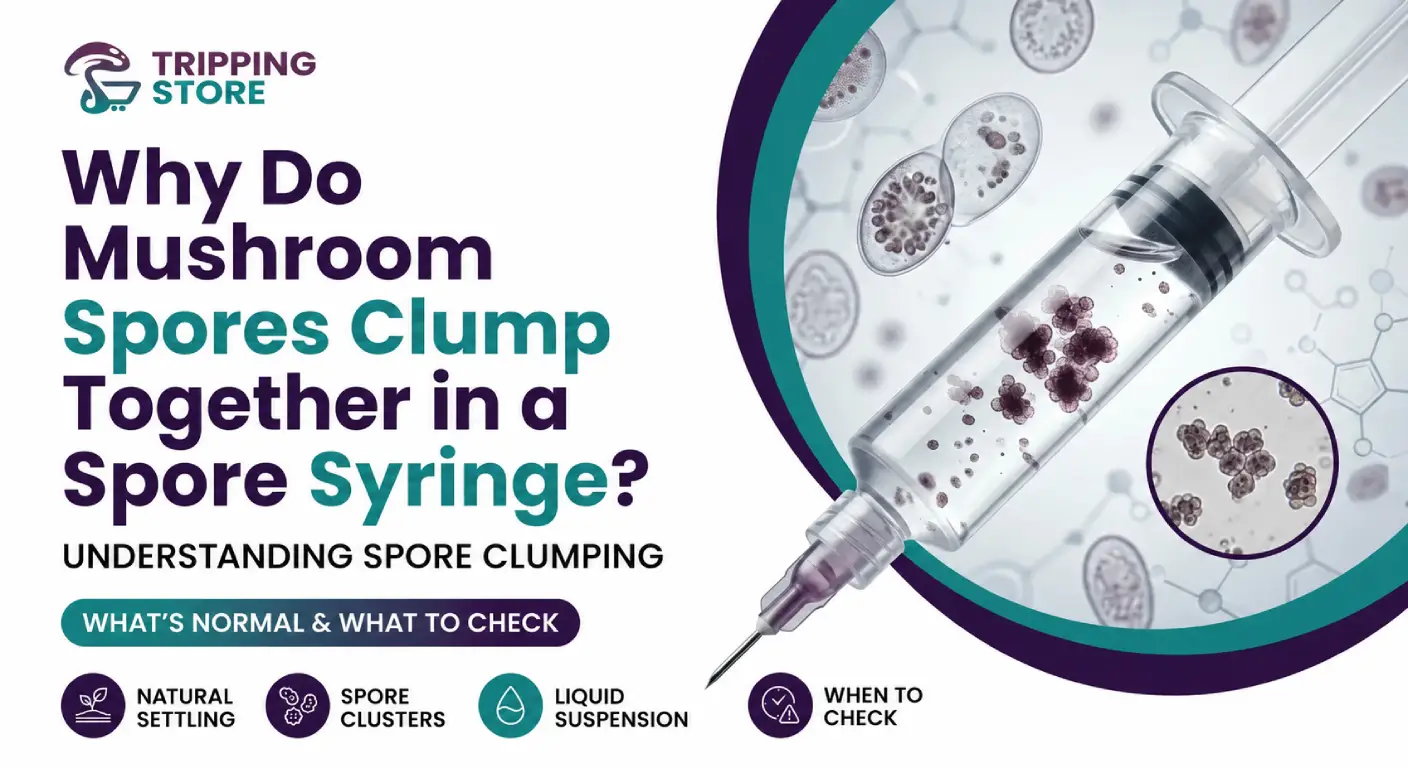
Spore clumping is completely normal and expected — it happens because spores are naturally hydrophobic (water-repelling) or sticky on their surface, meaning they tend to bind to each other rather than staying perfectly separated in water. With millions of spores in a single syringe, some clustering is essentially inevitable, and it becomes more noticeable as a syringe ages and spores settle. A good vigorous shake and flick before use usually spreads them out enough to work with, even if the clumps don't fully break apart. What matters is that the clear liquid around the clumps still contains plenty of usable spores — a clumpy syringe is not the same as a contaminated one. This guide explains why it happens, what's normal, and when clumping might actually be a sign of a problem.NormalClumping is expected, especially over time
Shake & flickHow to break up clumps before use
MillionsOf spores remain in the clear liquid too
AgeMain factor that increases clumping
Jump to a section
1. Why Clumping Happens
2. Normal Clumping vs Something to Check
3. How to Deal With Clumped Spores
4. Reducing Clumping in the First Place
FAQ1. Why Clumping Happens
Spores are microscopic, but they don't stay perfectly separated in water indefinitely. Over time, they naturally settle and stick together, forming visible dark specks or larger clumps.
⏳
Age
The single biggest factor. Older syringes clump more than freshly made ones, since spores have simply had more time to settle and stick together.
🧬
Natural Spore Surface Properties
Spores are naturally hydrophobic (water-repelling) or sticky on their surface. This means they tend to bind to each other rather than staying perfectly separated in water, which is simply how they're built.
🔢
Sheer Density
A standard spore syringe contains millions of spores. With that many present, some clustering together is essentially inevitable, especially in a concentrated suspension.
📦
Preparation Method
Insufficient mixing when the syringe was originally prepared, or spore prints that weren't fully dried before use, can lead to clumps forming early on.
🧪
Solution Thickness
A more concentrated (double-density) suspension naturally has more material in it, which can look clumpier than a thinner, standard-density mix.
ℹ️ Key Fact — Clumping doesn't mean spores have been destroyed or lost. Even a syringe with large visible clumps still has plenty of individual spores dispersed through the surrounding clear liquid.
2. Normal Clumping vs Something to Check
| Sign | Normal Clumping | Worth Checking Further |
|---|---|---|
| Colour | Dark purple-brown specks or clumps | Yellow, green, or unusual colour |
| Smell | Neutral | Sour or off |
| Texture | Firm specks or a solid clump | Stringy or fuzzy texture |
| Behaviour after shaking | Disperses a little, clump may remain | Unusual fizzing or bubbling |
⚠️ When to Be Cautious — Clumping on its own is not a warning sign. It only becomes worth checking further if it's paired with an unusual smell, colour, or texture — see our guide on why spore syringes turn cloudy for the fuller picture on telling normal density apart from contamination.
3. How to Deal With Clumped Spores
1
Shake and flick vigorously — Give the syringe a good shake, and flick it firmly with your fingers to help break up clusters. This won't necessarily dissolve a large clump entirely, but it disperses enough spores through the liquid to work with.
2
Make sure there's an air gap — A syringe filled completely to the top with no air space shakes far less effectively. A small air bubble helps the liquid actually move around inside.
3
Don't worry if the clump doesn't fully break up — Even with a stubborn clump remaining, the surrounding clear liquid still contains plenty of usable spores for slide preparation.
4
Draw from a well-shaken area — After shaking, draw your sample promptly, before everything has a chance to settle back down again.
✅ Good to Know — Clumping tends to get more noticeable the older a syringe gets. If you're seeing more clumps than you used to on a syringe you've had for a while, that's expected, not a sign anything has gone wrong.
4. Reducing Clumping in the First Place
While some clumping over time is unavoidable, a few factors reduce how much you'll see.| Factor | Why It Helps |
|---|---|
| Good preparation with thorough mixing | Reduces early clumping caused by uneven initial distribution |
| Using the syringe within its shelf life | Clumping generally increases the older a syringe gets |
| Correct storage (a clean place in the fridge at 2–8°C, in the dark) | Stable storage conditions slow down the natural settling process |
Ready to Get Started?
Every TrippingStore spore syringe is prepared under sterile conditions in the UK as a double-density suspension, giving you plenty of usable spore material even as natural clumping develops over time.Frequently Asked Questions
QWhy are my spores clumping together in the syringe?
Spores are naturally hydrophobic or sticky, so they tend to bind together rather than staying separated in water. With millions of spores in one syringe, some clumping is expected, especially as it ages.
QWhy do spores stick together instead of spreading out evenly?
It comes down to their natural surface properties. Spores are hydrophobic or sticky by nature, which means they bind to each other more readily than they disperse fully in water.
QIs a clumpy spore syringe still usable?
Yes. Even with visible clumps, the surrounding clear liquid still contains plenty of individual spores that are perfectly usable for slide preparation.
QHow do I break up clumped spores?
Give the syringe a good shake and flick it firmly. This may not fully dissolve a large clump, but it disperses enough spores through the liquid to draw a usable sample.
QDoes clumping mean my syringe is contaminated?
Not on its own. Clumping only becomes a concern if it's paired with a bad smell, unusual colour, or fizzing. Clumping by itself is a normal, expected part of spore syringe ageing.
QWhy does my older syringe clump more than it used to?
Clumping tends to increase the longer a syringe has been made, as spores have more time to settle and stick together. This is expected and doesn't indicate a problem.
QDoes storage affect how much spores clump?
Yes, to some extent. Stable storage in a clean place in the fridge at 2-8°C, in the dark, can slow down the natural settling process compared to inconsistent conditions.