If you're new to looking at mushroom spores under a microscope, the number of strain names can feel confusing. Golden Teacher, B+, PES Amazonian, Penis Envy, Tidal Wave — the list goes on, and every shop says theirs is "the best."
But here is the honest truth most beginners don't hear: under a microscope, the spores of different Psilocybe cubensis strains look essentially identical. They are all ellipsoid, purple-brown, roughly 11–17 by 8–11 micrometres, and they all have a germ pore. So what actually makes a strain "beginner" or "advanced" for microscopy?
It comes down to how many spores drop onto the slide, and how easy they are to verify. This guide explains the real differences, what to expect from each strain, and how to pick the right one for your current skill level.
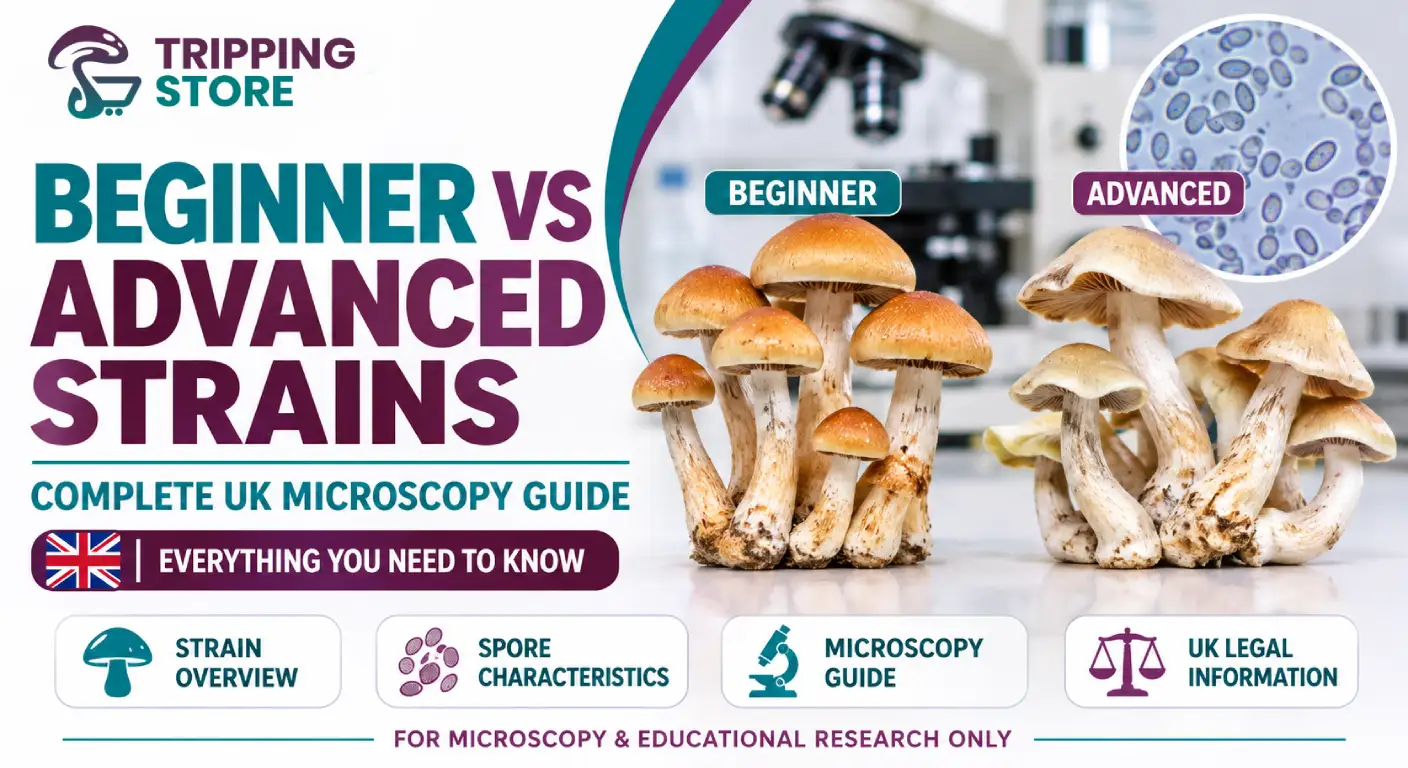
If you're new to spore microscopy, start with a heavy-sporulating strain like Golden Teacher or PES Amazonian. These drop thick, dense deposits, meaning you get plenty of spores on the slide with very little effort. Advanced strains like Penis Envy or Tidal Wave are known for dropping much fewer spores due to their smaller caps. This makes the slide thinner and requires more careful preparation. There is no "best" strain overall — only the best strain for your current level.
1. What Does "Difficulty" Actually Mean?
When people talk about "difficulty" in microscopy, it does not mean the spores are a different shape or size. Because all Psilocybe cubensis strains share the same species-level features, difficulty comes down to three practical things:
- How many spores it drops: This is the biggest factor. Some strains (like PES Amazonian) are heavy sporulators and leave a thick, dense layer of spores on the slide. Others (like Penis Envy) are known for dropping very few spores because they have smaller caps. A thinner drop means you have to be more precise with your slide preparation.
- How well-documented it is: Common strains have thousands of reference photos online. Rarer strains or new crosses have fewer, which makes it harder to double-check what you are seeing.
- Spore pigmentation: Almost all cubensis strains have standard purple-brown spores. The exception is true albino mutations (like APE), which drop clear, colourless spores.
2. Beginner-Friendly Strains
These are the strains most people recommend for their first microscope session. They all share one major advantage: they are heavy sporulators, so you get plenty of material to look at.
Why These Strains Are Easier
- Lots of spores: You will get plenty of material on a single slide, so there is less pressure to get the perfect drop size on your first try.
- Standard features: Spore size, shape, and purple-brown colour match standard cubensis reference photos, so checking your observation is simple.
- Forgiving: Small mistakes — a bubble, a slightly uneven drop, a bit out of focus — don't ruin the whole session when you have a dense slide.
- Widely available: Lots of reference photos exist, so you can double-check what you're seeing.
3. Advanced Strains
Advanced strains aren't "better" — they are just harder to prepare a slide for. They are known for dropping much fewer spores, meaning you need more careful technique to get a good sample.
Why These Strains Are Harder
- Fewer spores: Thinner drops mean fewer spores per view — you might need a few tries to get a good slide.
- Less documentation: Newer or rarer crosses have fewer reference photos online, so checking your observation is harder.
- Colour differences: True albino strains (like APE) have clear spores instead of the standard purple-brown, so comparing them to typical cubensis photos is trickier.
4. Beginner vs Advanced — Side-by-Side
Here's the difference in one table. Remember: these are general patterns, and individual samples can vary.
| Factor | Beginner Strains | Advanced Strains |
|---|---|---|
| Spore drop amount | High — thick, dense deposits | Lower — thin, sparse deposits |
| Slide preparation | Forgiving, easy to focus | Needs careful, precise prep |
| Spore shape & size | Standard (ellipsoid, 11–17µm) | Standard (ellipsoid, 11–17µm) |
| Pigment | Standard purple-brown | Purple-brown, or clear (true albinos like APE) |
| Reference photos online | Plenty | Fewer, more variable |
| Best for | First slides, spore counting, learning | Specific genetic study, experienced users |
5. How to Choose Your Starting Point
Ask yourself these four questions before you buy your first syringe:
Ready to start your microscopy project?
Tripping Store supplies high-density Psilocybe cubensis spore syringes — including Golden Teacher, B+, PES Amazonian, and many more — prepared under sterile conditions in the UK as double-density suspensions for clear, reliable microscopy.