
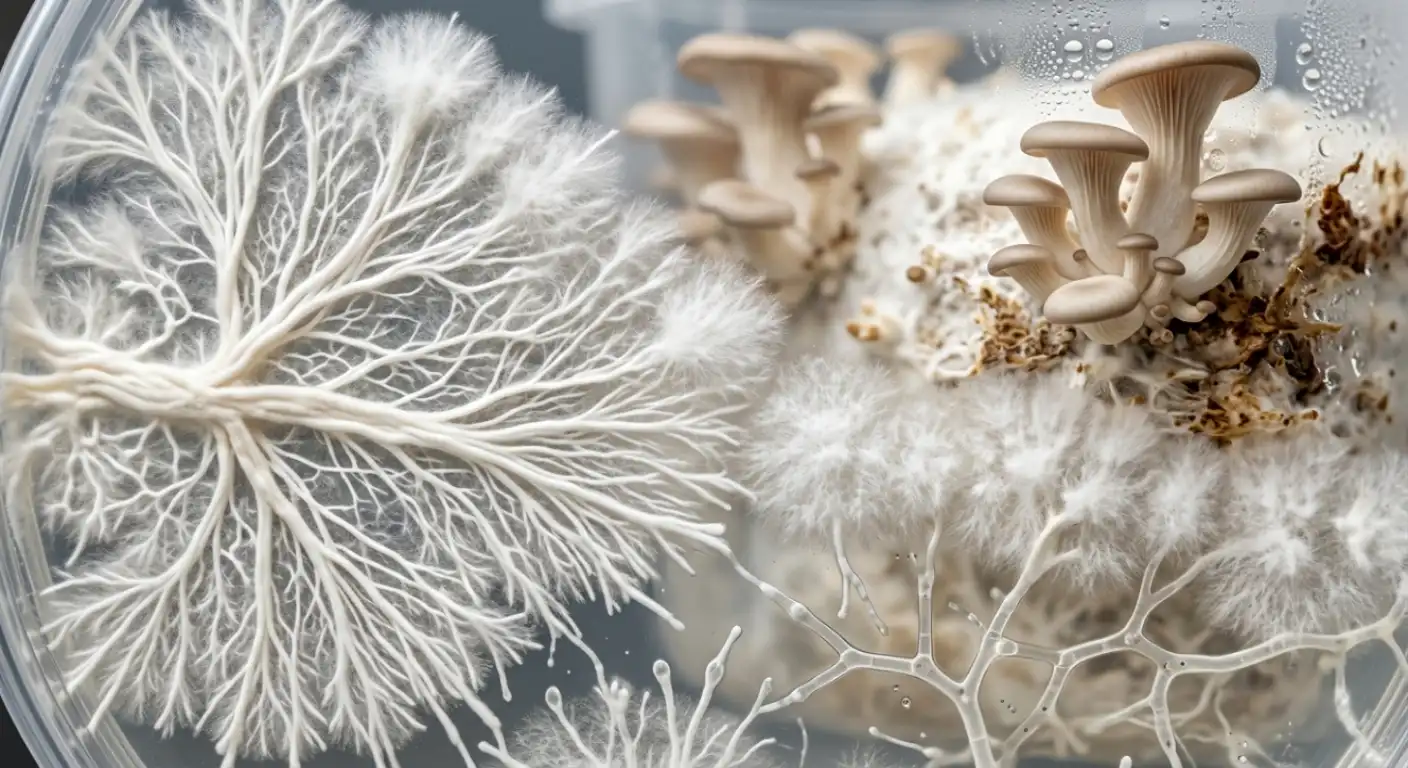
Mycelium grows in two primary patterns: rhizomorphic (thick rope-like strands — the ideal pattern) and tomentose (fluffy, cotton-like growth — common and often healthy). Healthy mycelium is bright white, expands evenly, and smells earthy. Warning signs include grey or yellow discolouration, slimy texture, sour smells, and stalled growth. The four biggest environmental factors controlling growth pattern are temperature, moisture, oxygen, and contamination pressure. Learning to read mycelium is the single most important diagnostic skill in mushroom cultivation research.
Mycelium is the true organism of a fungus. The mushroom you see is just its reproductive structure — the mycelium, growing invisibly through substrate below, is the living, breathing network doing all the work. And like any organism, it communicates its condition constantly through the patterns it makes.
Understanding those patterns is what separates a grower who reacts to problems after they happen from one who spots them early and corrects course. This guide covers every major mycelium growth pattern you will encounter across agar, grain, bulk substrate, and fruiting stages — with clear diagnostics, practical solutions, and the science behind why mycelium behaves the way it does.
What Is Mycelium? The Biology Explained
Mycelium is the vegetative body of a fungus — a dense, branching network of microscopic thread-like cells called hyphae. Each hypha is a single cell wide, growing outward at its tip, secreting enzymes that break down organic matter and absorbing the resulting nutrients. What looks like a patch of white fuzz in a grow bag is actually millions of these cells working in coordinated networks.
While mushrooms are the structures most people associate with fungi, they are simply the fruiting bodies — temporary reproductive organs that the mycelium produces when conditions are right. The mycelium itself can live indefinitely, continuing to colonise new substrate, absorb nutrients, and respond to its environment long after any individual mushroom has come and gone.
In cultivation research, mycelium acts as three things simultaneously:
- A nutrient absorption network — breaking down and metabolising substrate
- A contamination defence system — competing with and suppressing rival organisms
- A biological indicator — its growth pattern tells you exactly what environmental conditions it is experiencing
That third role is what this guide focuses on. Once you learn to read what mycelium is showing you, you gain an early-warning system for almost every problem that can occur in the grow cycle.
The Two Primary Mycelium Growth Patterns
All mycelium growth falls broadly into two visual categories. Understanding them is the foundation of everything else in this guide.
Rhizomorphic mycelium grows in thick, defined rope-like strands that branch outward in organised, searching patterns. Named after rhizomorphs — the root-like structures of some fungi — this pattern indicates strong, vigorous growth.
- Thick, clearly defined individual strands
- Directional growth — actively seeking nutrients
- Fast colonisation speed
- Strong nutrient transport capacity
- Indicates healthy genetics and correct environment
- Preferred for culture selection on agar
Tomentose mycelium spreads as a soft, cloud-like, cottony mass without the defined strand structure of rhizomorphic growth. It is slower and less directional, but not automatically a problem — context matters enormously.
- Soft, fluffy, cotton-wool appearance
- Less directional — spreads more evenly
- Slower colonisation than rhizomorphic
- Common in higher humidity environments
- Can indicate low oxygen (CO₂ build-up)
- Not inherently bad — strain and stage dependent
Most healthy cultures display both growth types at different stages or in different areas of the substrate. Tomentose growth at the centre (where mycelium established first) and rhizomorphic strands at the leading edges is a very common and completely normal pattern. Never judge growth by one area alone.
Healthy vs Unhealthy Mycelium: How to Tell the Difference
The most important diagnostic skill in cultivation is accurately distinguishing healthy mycelium from contamination or stressed mycelium. The table below is your quick reference — but always use smell and context alongside visual observation.
✓ Signs of Healthy Mycelium
- Bright, clean white colour throughout
- Even, consistent outward expansion
- Fresh, earthy mushroom smell
- Gradual thickening and consolidation over time
- Fluffy or rope-like texture (both are fine)
- Clear condensation on bag walls — moisture cycling normally
- Steady daily visible progress in correct temperature
✗ Warning Signs — Investigate Immediately
- Grey, yellow, or green discolouration anywhere in bag
- Slimy, wet, or matted texture — not fluffy
- Sour, chemical, or musty smell (not earthy)
- Pink, red, or black patches — likely contamination
- Stalled growth with no progress for 5+ days at correct temperature
- Visible mould colonies forming separate from mycelium
- Pooling liquid inside the bag
- Mycelium receding rather than advancing
Mycelium Colour Diagnostic Reference
| Colour Observed | Most Likely Cause | Status | Action Required |
|---|---|---|---|
| Bright white | Healthy mycelium | Normal | None — continue monitoring |
| Off-white / cream | Mature mycelium / metabolite secretion | Usually normal | Monitor — common in established cultures |
| Yellow patches | Metabolite secretion or early bacterial | Monitor closely | Check smell — earthy is fine, sour means bacteria |
| Grey / dull white | Stressed mycelium, low oxygen, or early contamination | Investigate | Check temperature, airflow, and smell |
| Green (any shade) | Trichoderma mould contamination | Contaminated | Discard bag sealed — do not open indoors |
| Black patches | Aspergillus or other dangerous mould | Contaminated | Discard immediately — review sterile technique |
| Pink / red | Neurospora (bread mould) — very aggressive | Contaminated | Discard and sanitise entire growing area |
| Orange / slimy yellow | Bacterial contamination | Contaminated | Discard — review moisture levels and sterilisation |
Mycelium Growth Patterns at Each Stage
Mycelium does not behave the same way across all stages of the grow cycle. Understanding what is normal at each stage prevents unnecessary panic — and helps you catch genuine problems faster.
The 4 Environmental Factors That Control Growth Patterns
Mycelium does not grow randomly. Every aspect of its growth pattern — speed, texture, colour, direction — is a direct response to its environment. These four factors have the biggest influence.
Temperature
Keep our grow bags at a steady 24–27°C while they colonise. Below 20°C, growth slows dramatically. Below 15°C it stops. Above this range, mycelium is stressed and contamination risk rises sharply. In UK homes, winter temperatures of 17–19°C are the most common cause of stalled colonisation. A heat mat under the bag solves this.
Moisture
Substrate should be at field capacity — moist throughout but not dripping. Too dry and mycelium cannot establish; too wet and bacteria outcompete it before it gets started. When squeezed, well-hydrated substrate should release only a few drops — not a stream. Pre-sterilised bags from Tripping Store are hydrated to field capacity.
Oxygen & FAE
Mycelium requires oxygen and produces CO₂ as it metabolises. In a sealed bag with no filter, CO₂ accumulates and growth becomes fluffy and slow, then stalls. Filter patches on grow bags allow passive gas exchange — keeping the filter unobstructed is critical. Low oxygen consistently produces tomentose rather than rhizomorphic growth.
Contamination Pressure
Competing organisms — moulds and bacteria — are present in every environment. Mycelium can suppress competitors when it is growing vigorously in correct conditions. But stress it with low temperature, poor moisture, or low oxygen, and contaminants gain the upper hand. Strong mycelium is naturally more contamination-resistant than stressed mycelium.
Using Mycelium as a Diagnostic Tool
Experienced cultivators read mycelium growth the way a mechanic reads engine behaviour — pattern recognition built through repeated observation. Here is the framework for developing that skill systematically.
The 4-Point Observation Method
- Speed — Is growth progressing visibly day by day? Stalled growth for 5+ days in correct temperature is always worth investigating
- Texture — Fluffy (tomentose) or ropy (rhizomorphic)? Both can be healthy — the question is whether it is changing or consistent
- Colour — Use the colour reference table above. White and off-white are always acceptable. Anything else warrants attention
- Smell — Open no bags unless necessary, but if you can smell through the filter, earthy is healthy and sour/chemical is not
Never open a grow bag to smell or inspect the mycelium — doing so introduces contaminants directly. Observe through the bag walls and smell through the filter only. The single most common cause of contamination in otherwise healthy bags is unnecessary opening during colonisation.
Common Patterns and What They Mean
| What You See | What It Means | Action |
|---|---|---|
| Vigorous white growth from all injection points | Healthy colonisation — ideal | None — maintain conditions |
| Growth from one point only, not spreading | Single injection point — limited starting nodes | Gentle shake to redistribute |
| Growth starts then slows at 30–50% | CO₂ build-up or temperature drop | Check filter and ambient temperature |
| Fluffy growth everywhere but very slow | Low oxygen or temperature too low | Improve FAE and raise temperature |
| Excellent colonisation but no pins forming | Fruiting conditions not initiated or overlay | Initiate fruiting conditions promptly and increase FAE |
| Pins form but abort before developing | Humidity fluctuation or CO₂ too high | Stabilise humidity, increase FAE frequency |
| Mycelium growing then turning grey | Stress — check all four environmental factors | Assess temperature, moisture, oxygen |
How Genetics Influence Growth Patterns
Not all mycelium grows the same even under identical conditions — and that is genetics at work. The genetic makeup of a strain influences growth speed, density, rhizomorphic tendency, contamination resistance, and substrate preference.
This is why agar work — growing mycelium on agar plates where patterns are clearly visible — is such a powerful tool for culture refinement. By selecting the most vigorous, rhizomorphic sectors from an agar plate and transferring only those genetics forward, you gradually improve the performance of your culture over generations.
Growers commonly report that different strains of the same species differ in colonisation speed and growth pattern: some lean towards rhizomorphic growth, others towards tomentose. These are cultivators’ observations rather than findings from published studies, and individual cultures vary.
Understanding which strain you are working with sets the correct expectation for growth speed and pattern — preventing unnecessary concern about behaviour that is simply strain-normal.
How to Encourage Strong, Healthy Mycelium Growth
Strong mycelium is built through process discipline, not luck. These are the evidence-based practices that consistently produce the best results.
- Start with a healthy culture — clean, well-stored inoculum from a reputable source gives mycelium the best start
- Maintain temperature at 24–27°C — use a heat mat in UK autumn and winter; consistent warmth is more important than occasional heat
- Use pre-sterilised substrate — all-in-one grow bags from Tripping Store remove moisture and sterilisation variables entirely
- Inoculate at multiple points — 3–4 evenly spaced injection points give mycelium multiple starting nodes, shortening colonisation time significantly
- Never open bags unnecessarily — each opening is a contamination risk; observe through walls only
- Ensure filter patches are unobstructed — a blocked filter creates CO₂ build-up that causes tomentose growth and eventual stalling
- Be patient — UK winter colonisation at 18–20°C can take 4–6 weeks and still be perfectly normal; do not disturb bags that are making steady progress
If you are consistently experiencing slow colonisation in the UK, a mushroom heat mat is the highest-return investment you can make. Raising your bag temperature from 18°C to 24–27°C can shorten colonisation time and significantly reduces contamination risk by keeping mycelium growing faster than competitors.
Tripping Store’s all-in-one grow bags are pre-sterilised, hydrated to field capacity, and fitted with filter patches — giving your mycelium research the cleanest, most reliable starting conditions available in the UK.
Frequently Asked Questions
Healthy mycelium in a grow bag appears as bright white, fluffy or rope-like growth that expands steadily outward from the inoculation point. Both tomentose (cotton-wool-like) and rhizomorphic (defined rope strands) growth can be healthy depending on strain and conditions. A fresh, earthy smell through the filter is a good sign. Light condensation on the bag interior is normal moisture cycling. The key indicators are consistent white colour, steady progress, and an absence of sour or chemical smells.
Rhizomorphic mycelium grows as thick, defined rope-like strands that branch directionally outward — it is fast, strong, and the pattern most associated with vigorous genetics and correct conditions. Tomentose mycelium grows as a soft, fluffy, cotton-wool-like mass that spreads more evenly but less directionally — it is slower and more commonly associated with higher humidity or lower oxygen. Both are found in healthy cultures, and most grows will display both patterns at different stages. Rhizomorphic is preferred on agar for culture selection.
Slow mycelium growth has four main causes in the UK. Temperature is the most common — below 20°C growth slows significantly, and UK homes in winter are frequently too cold for optimal colonisation. Aim for 24–27°C using a heat mat. Poor inoculation — a single injection point rather than 3–4 distributed points — gives mycelium limited starting nodes. Blocked air exchange — a covered or damaged filter patch causes CO₂ build-up that inhibits growth. Non-viable inoculum — an old or incorrectly stored culture with reduced viability. Check temperature first, as it accounts for the majority of slow colonisation cases.
Not necessarily. Yellow patches or liquid droplets on mycelium are often metabolite secretions — exudate produced by the mycelium as a natural by-product of metabolic activity. This is especially common in dense, well-colonised substrate and is typically harmless. The key test is smell — metabolite secretion smells earthy or faintly mushroom-like. If the yellow areas smell sour, chemical, or fermented, that indicates bacterial contamination and the bag should be discarded. Yellow combined with a slimy texture is almost always bacterial.
No — fluffy (tomentose) mycelium is not inherently bad and is very common in healthy cultures. It becomes a concern only when it is the only growth pattern present combined with slow progress, which can indicate CO₂ build-up from insufficient air exchange. Tomentose growth that is advancing steadily, is bright white, and smells earthy is completely healthy. Many strains and growing conditions naturally produce primarily tomentose growth, especially in the early colonisation phase before rhizomorphic strands develop at the leading edges.
Halfway stalls most commonly have three causes. First, CO₂ build-up — as mycelium colonises more substrate, it produces more CO₂, and if the filter patch is blocked or the bag is compressed, gas exchange becomes insufficient. Second, temperature drop — ambient temperature may have fallen since inoculation, particularly relevant in UK homes where heating is reduced at night. Third, moisture imbalance — either too dry in the uncolonised half, or bacterial contamination (wet rot) forming in that area. Check the filter, verify temperature, and inspect the uncolonised substrate visually through the bag wall.
You should avoid opening grow bags during colonisation. Every time a bag is opened, you introduce airborne contaminants — bacteria, mould spores, and other organisms — directly into the substrate. Healthy colonising mycelium provides significant contamination resistance, but this is reduced when you break the sealed environment. Observe through the bag walls using a light source if needed, and smell through the filter patch rather than the opening. Only open a bag when it is fully colonised and you are ready to initiate the next stage under clean conditions.
Colonisation is complete when the substrate is uniformly white throughout with no visible uncolonised areas through the bag wall. For grain bags, individual grains should be fully bound together in a consolidated white mass. For all-in-one bags, the substrate block should feel firm and cohesive. After reaching visual completion, many experienced cultivators wait an additional 5–7 days before initiating fruiting conditions — this allows mycelium to fully consolidate and strengthens contamination resistance significantly before the bag is opened.