Last reviewed: September 2026
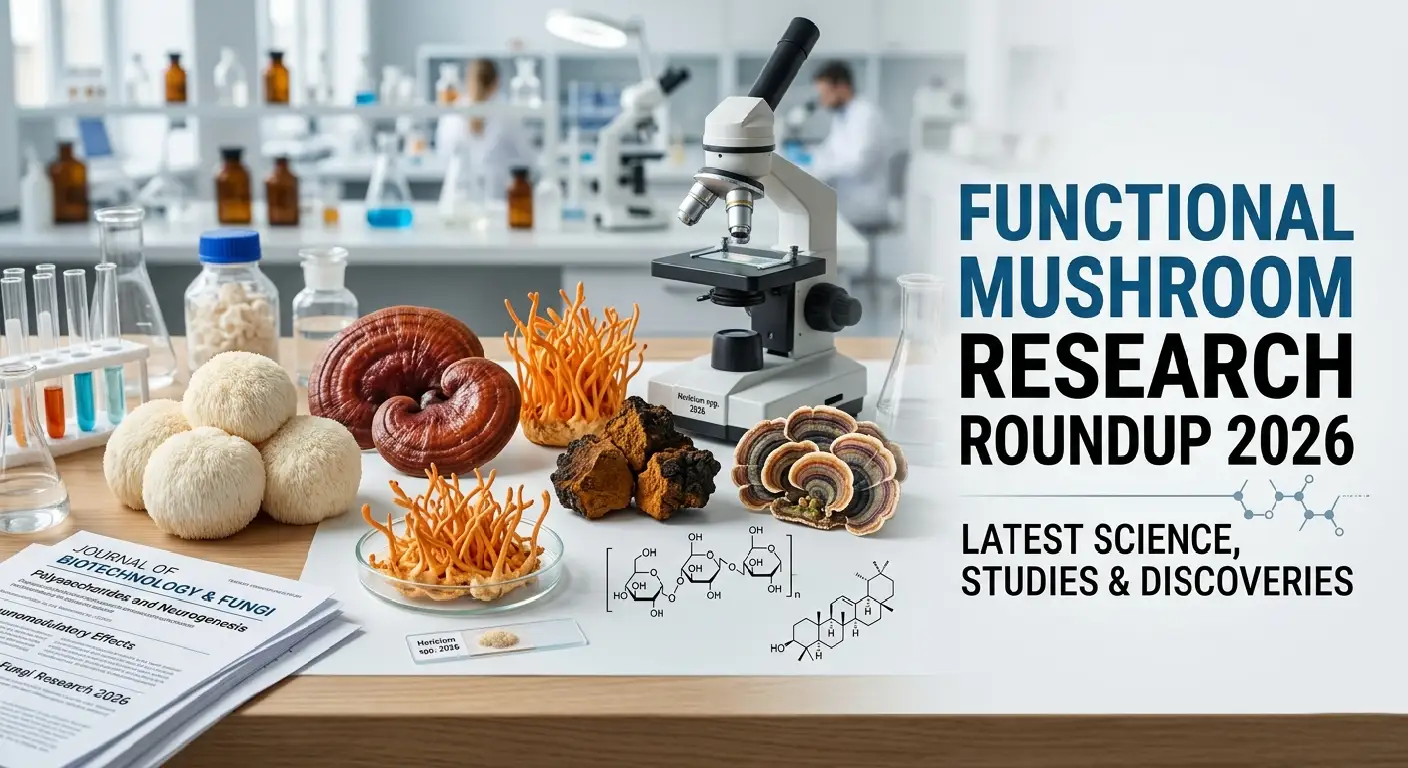
Research into functional mushrooms accelerated significantly from 2024 into 2026. The headline findings: a September 2025 systematic review in Frontiers in Nutrition assessed Lion’s Mane for neuroprotection, cognitive function and gut health, drawing on 5 RCTs, 5 other human studies and 16 laboratory and computer studies. A February 2026 review in Phytotherapy Research delivered the most comprehensive synthesis of Cordyceps militaris evidence to date. A 2025 meta-analysis of 17 trials linked Reishi with small falls in BMI, but rated the evidence very low quality. And Turkey Tail’s PSK and PSP remain among the most studied mushroom compounds in cancer research. This roundup covers every major study — with direct source links, honest limitations, and what each finding actually means for UK consumers.
The functional mushroom space moves fast. New studies are published monthly across PubMed, PMC, and peer-reviewed pharmacology and nutrition journals. The problem is that most consumer-facing articles are written once and never updated — leaving people making decisions based on research that is three to five years out of date.
This guide is different. It focuses specifically on research published in 2024, 2025, and 2026, summarises what each study actually found, explains what it means practically for UK consumers, and links directly to source material so you can read the underlying science yourself. We also include an honest section on what the research does not yet show — because understanding the limits of evidence matters as much as knowing its strengths.
The Four Functional Mushroom Species: At a Glance
Before diving into individual study findings, here is a quick reference snapshot of each species — the key bioactives, primary evidence areas, and evidence strength as of mid-2026.
🦁
🍄
⚡
🦃
Section 1: Lion’s Mane Research 2024–2026
Human research on Lion’s Mane is growing but still small. A 2025 systematic review found five randomised controlled trials in people and concluded that Lion’s Mane shows limited effectiveness in clinical trials, with most studies small and short.
PRISMA Systematic Review: Promising Signs, Limited Human Evidence
A 2025 systematic review by Menon, Jalal et al. followed PRISMA guidelines and analysed peer-reviewed studies published from January 2000 to June 2024. The review covered 26 studies: five RCTs, three pilot clinical trials, one cohort study and one case report in people, plus 15 laboratory studies and one computer analysis. The authors concluded that Lion’s Mane ‘shows limited effectiveness in clinical trials’, and that current research is limited by small sample sizes, short study durations and differences between studies.
Erinacines and NGF: What Preclinical Studies Show
A 2025 systematic review of erinacines (the mycelium-specific bioactives in Lion’s Mane) looked only at preclinical models: cell and animal studies. It describes erinacines as cyathane diterpenoids that raise nerve growth factor (NGF) when given to glial (support) cells, but not in nerve cells on their own. Because the review covered no human studies, it cannot show whether the same happens in people.
Hericenones and NGF: A 2008 Lab Study
Hericenones, compounds found in Lion’s Mane, are also often linked to nerve growth factor (NGF). However, in a 2008 lab study using human brain-derived (astrocytoma) cells, hericenones C, D and E did not increase NGF gene expression, while an ethanol extract of Lion’s Mane did.
Early Alzheimer’s Pilot Trial
A small pilot trial followed people with early Alzheimer’s disease for 49 weeks. The group given erinacine A-enriched Lion’s Mane mycelium improved on a cognitive screening test (the MMSE) and scored better than the placebo group on a measure of everyday activities. This was a small, early-stage study, and larger trials are needed.
Mood: A Mixed Picture
Evidence on Lion’s Mane and mood is mixed. In a small 2010 trial in Japan, 30 women ate cookies containing Lion’s Mane or placebo cookies for four weeks; in the Lion’s Mane group, depression scores and scores on a general-complaints scale that includes anxiety fell compared with their starting scores. A 2023 pilot trial in 41 healthy adults found no significant effect on mood after 28 days, only a borderline, non-significant trend towards lower stress. A study in mice found that Lion’s Mane mycelium reversed stress-related drops in brain chemicals such as serotonin and dopamine, but animal results may not apply to people.
Antioxidant, Anti-Inflammatory, and Gut Health Properties Confirmed
A narrative review published in Nutrients confirmed that Lion’s Mane bioactives (polysaccharides, hericenones, erinacines, and phenolic compounds) exhibit antioxidant effects by scavenging reactive oxygen species and inducing endogenous antioxidant enzymes. It also summarised the mushroom’s potential as a functional food for gut health and immune modulation, and reviewed its neuroregenerative potential across cognitive and neurological disorder models.
Probiotic Enhancement Mechanism Identified (2026)
A 2026 study by Pengpa et al. investigated crude polysaccharide fractions from Hericium erinaceus on multiple probiotic strains. The HEP-80 fraction significantly enhanced the growth of all three tested probiotic strains compared to controls. At 50µg/mL, it increased adhesion of Lactiplantibacillus plantarum by up to 30%, also demonstrating cryoprotective properties that preserved over 70% probiotic survival after 90 days of freeze-dried storage. This moves Lion’s Mane gut-brain research from general microbiome findings to specific probiotic interaction mechanisms.
✅ Lion’s Mane: What the Evidence Shows So Far
- Cognition: one small RCT in 30 people with mild cognitive impairment (Mori 2009) reported improved cognitive scores; the 2025 review judges clinical effectiveness limited overall
- NGF-stimulating mechanism (erinacines) — a 2025 review of cell and animal studies reports that erinacines raise NGF through glial (support) cells
- Gut health: laboratory studies suggest Lion’s Mane polysaccharides can support the growth of probiotic bacteria; in people, the 2025 review found only one small pilot trial, in 13 healthy volunteers (Xie 2021)
- Anti-inflammatory and antioxidant effects: reported mainly in laboratory studies, with little testing in people so far
- Safety: side effects are uncommon but have been reported, including stomach discomfort, diarrhoea and headaches. One case report describes acute respiratory distress syndrome (ARDS) in a man taking Lion’s Mane supplements, though the 2025 review says the cause cannot be entirely attributed to Lion’s Mane without further investigation.
Section 2: Reishi Research 2024–2026
Reishi has a long history of use in traditional medicine. Recent research adds a small 2024 trial and a 2025 meta-analysis, but that meta-analysis rated the overall evidence as very low quality.
GRADE Meta-Analysis: Modest Effects, Very Low-Certainty Evidence
A 2025 systematic review and meta-analysis pooled 17 randomised controlled trials (971 participants) of Ganoderma lucidum supplements, searching EMBASE, PubMed, Web of Science and Scopus up to August 2024. Across all trials, Reishi was linked with small falls in BMI, creatinine and heart rate and a rise in the antioxidant enzyme glutathione peroxidase, but had no significant effect on blood pressure, blood sugar, blood fats including cholesterol, or inflammatory markers. The authors rated the evidence as very low quality for every outcome and said that recommending Reishi supplements is premature.
Fatigue Trial and the Adaptogen Question
An older double-blind trial gave 132 people with neurasthenia (a condition involving long-lasting fatigue) a Reishi polysaccharide extract or a placebo for eight weeks. Fatigue scores fell more in the Reishi group than in the placebo group, and well-being scores rose slightly more. Reishi is often described as an ‘adaptogen’, but in 2008 the European Medicines Agency’s herbal medicines committee said the adaptogen idea needed more clinical study and that the term is not accepted in standard clinical terminology in the EU.
Stress and Fitness: One Trial in Female Students
A 2024 double-blind randomised controlled trial gave Ganoderma lucidum or a placebo to 78 female students in India for 30 days. In one of the two Reishi groups, fitness measures (including heart rate, VO2max and grip strength) improved compared with the placebo group. Anxiety, depression, vitality and well-being also improved within that group, but the study summary does not say whether these changes differed from placebo. Cortisol is not mentioned in the study summary, and one trial on its own cannot confirm an adaptogenic effect.
Gut Microbiome: Prebiotic Effects in a Lab Colon Model
A 2025 laboratory study in the Journal of Functional Foods tested whole-mushroom powders of Reishi, Lion’s Mane, Cordyceps and Turkey Tail, plus two blends, on stool samples from ten healthy donors in a short-term simulated colon. All the powders showed prebiotic potential, including higher production of short-chain fatty acids. This was a lab model, not a trial in people.
✅ Reishi: What the Evidence Shows So Far
- Metabolic markers: a 2025 meta-analysis of 17 trials found small falls in BMI and creatinine, but no clear effect on cholesterol or blood sugar, and rated the evidence very low quality
- Stress and fitness — one controlled trial (78 female students) found fitness gains in one of its two Reishi groups compared with placebo, and mood measures improved within the Reishi group; cortisol is not mentioned in the study summary
- Gut microbiome: a 2025 lab study found Reishi powder had prebiotic effects in a simulated colon (a lab model, not a trial in people)
- Immune effects: small trials in people with cancer report mixed results on immune markers
- Caveat: the 2025 meta-analysis rated the evidence as very low quality for every outcome, because of risk of bias, differences between trials and small numbers of participants
Section 3: Cordyceps Research 2024–2026
Cordyceps militaris received the most significant research update of any functional species in early 2026, with the publication of what is now the most comprehensive synthesis of Cordyceps evidence ever produced.
Most Comprehensive Cordyceps Evidence Synthesis to Date
Yang, Jin, Jiang et al. published a landmark review in Phytotherapy Research (Vol. 40(2), pp. 635–665) covering in vitro studies, in vivo animal models, and human clinical trials across Cordyceps militaris’s full pharmacological range. Key conclusions: C. militaris enhances both innate and adaptive immunity under normal conditions and in immunosuppressed states. The primary active constituents — cordycepin, adenosine, polysaccharides, and carotenoids — each exert distinct immunomodulatory, anti-tumour, antioxidant, anti-diabetic, anti-obesity, and neuroprotective activities. The immunomodulatory effects are the most extensively validated across both preclinical and clinical models.
Ontawong 2024: NK Cell Activity Improved in Healthy Adults
A small 2024 randomised controlled trial by Ontawong et al., published in Scientific Reports, followed 20 healthy adults for eight weeks. NK (natural killer) cell activity rose from the starting level in the Cordyceps group: in men by week 4 and in women by week 8. With only 20 people, this is an early signal rather than proof, but it adds some human data to the immune findings from preclinical research.
Gut Health: Specific Microbiome Mechanisms Identified
The 2025 prebiotic simulation study examined Cordyceps polysaccharides in colonic fermentation models. Findings: polysaccharides modulated gut microbiota composition, stimulated production of short-chain fatty acids (acetate and butyrate), improved intestinal barrier function, and showed immunoregulatory activity in intestinal mucosa. Hot water extracts also inhibited pathogenic bacteria while stimulating beneficial strains including Bacteroides ovatus and Bifidobacterium longum.
✅ Cordyceps: What the 2024–2026 Evidence Confirms
- Immune effects — NK cell activity rose from baseline in a small 2024 RCT (20 healthy adults)
- Exercise performance (VO2max, time to exhaustion) — mixed human evidence: Hirsch 2016 reported a VO2max gain with a mushroom blend containing C. militaris (28 people at the start, 10 at three weeks), but Parcell 2004 found no effect of C. sinensis Cs-4 in 22 cyclists
- Gut microbiome modulation — specific SCFA production and pathogen inhibition mechanisms confirmed in 2025
- Anti-tumour and chemotherapy-sensitising mechanisms — confirmed preclinically (not yet large-scale clinical)
- Broadest pharmacological range of any single species reviewed — 2026 review covers 9 distinct bioactivity areas
Section 4: Turkey Tail Research 2024–2026
Turkey Tail’s PSK extract has been used alongside cancer treatment since the mid-1970s and is approved for this use in Japan. The recent research covered here adds reviews and laboratory work on immune cells and gut bacteria, not new trials in people.
Updated Synthesis of PSK/PSP Immune Evidence
A 2024 review in the South African Journal of Botany brought together research on the medicinal potential of Trametes versicolor, whose two best-known extracts are PSK and PSP. The US National Cancer Institute reports that PSK can boost natural killer (NK) cell and T-cell activity, and that it has been used alongside cancer treatment since the mid-1970s and is approved for this use in Japan.
Lab Study: Turkey Tail Extracts and Immune Cells
A 2023 laboratory (in vitro) study, published in Nutrients, exposed immune cells taken from 15 healthy volunteers to Turkey Tail extracts and measured the release of inflammatory messengers (cytokines). The extracts had differing effects on these messengers, depending on the extract and what the cells were exposed to. Because the work was done on cells in the lab, not in people, it does not show effects on NK cells or T-cells in the body.
Prebiotic Effects in a Lab Colon Model
The same 2025 laboratory study found that a whole Turkey Tail powder, like the other single-species powders and two multi-mushroom blends, showed prebiotic effects in a short-term simulated colon, including higher short-chain fatty acid production. It used stool samples from ten healthy donors, not trials in people, so it cannot show whether combining species helps.
✅ Turkey Tail: What the Evidence Shows So Far
- PSK and PSP: among the most studied medicinal mushroom compounds in cancer research; PSK is reported to boost NK cell and T-cell activity
- Immune cells in the lab: a 2023 in vitro study found Turkey Tail extracts changed cytokine release from human immune cells (a lab study, not a trial in people)
- Gut prebiotic effects: shown in a 2025 lab model of the colon, not in a trial in people
- PSK in cancer care: used alongside cancer treatment since the mid-1970s and approved for this use in Japan; a 2026 review says further high-quality trials are still needed
- Safety: few side effects have been reported with PSK, according to the US National Cancer Institute
Cross-Species Findings: What Multi-Mushroom Research Shows
Several 2025 and 2026 studies examined functional mushrooms as a group, generating findings that apply across species rather than to any single variety.
Anti-Ageing and Cellular Protection (2025 PMC Review)
A 2025 PMC review found that extracts from Lion’s Mane, Reishi, and related species improve fibroblast viability under oxidative stress, decrease reactive oxygen species, and preserve telomere length. These findings position functional mushrooms as candidates for anti-ageing and cellular protection applications — a rapidly growing research area that remains primarily preclinical. Read the review →
Chronic Inflammation Management (2025 PMC Review)
A 2025 PMC review on medicinal mushrooms as immunotherapeutic agents in chronic inflammation management confirmed that multiple functional species (Reishi, Lion’s Mane, Turkey Tail) exert anti-inflammatory effects through distinct but complementary mechanisms — supporting the use of multi-species supplements for broader anti-inflammatory coverage. Read the review →
Cancer Hallmarks Framework Applied to Mushrooms (March 2026)
A narrative review in Frontiers in Cancer Control and Society (Volume 4, 2026) evaluated clinical evidence for medicinal mushrooms using Hanahan’s updated 2026 Cancer Hallmarks framework — mapping mushroom bioactivities to known cancer mechanisms. The review covered literature from 2000 to 2026 including clinical trials, systematic reviews, and meta-analyses. It supports the use of mushroom-derived compounds as immunological adjuncts to conventional cancer treatment. Read the review →
Evidence Comparison: All Four Species at a Glance
| Species | Main Evidence Area | Human Trial Quality | 2025–2026 Update | Best Form |
|---|---|---|---|---|
| Lion’s Mane | Cognition & neuroprotection | 5 RCTs + 5 other human studies | Sept 2025 systematic review — limited effectiveness in clinical trials | Fruiting body extract or capsule |
| Reishi | Metabolic markers (very low certainty) | 17 RCTs pooled; very low-certainty evidence | 2025 GRADE meta-analysis — metabolic markers | Not established |
| Cordyceps | Energy, immunity, gut health | Hirsch 2016; Ontawong 2024 RCT | Feb 2026 — most comprehensive review to date | Fruiting body; standardised cordycepin content |
| Turkey Tail | PSK alongside cancer treatment | RCTs and meta-analyses of PSK in cancer patients | 2025 lab prebiotic data; 2026 cancer hallmarks review | Most clinical data are for the PSK extract |
What the Research Does Not Yet Show
A research roundup should be as honest about limitations as about findings. Here is what the 2024–2026 literature does not yet fully establish.
01
Standardised dosing: No consensus exists on optimal dose across species, formats, and health goals. The 2025 Reishi meta-analysis specifically noted that dose-response relationships remain unstandardised. Most trial protocols use different doses, making direct comparison difficult.
02
Long-term safety beyond one year: Most clinical trials run for 8–24 weeks. Data beyond one year in humans is limited for all four species, and side effects have been reported, including one serious allergic reaction to Lion’s Mane (see the safety question in the FAQ below).
03
Format superiority in humans: Preclinical data suggests extraction method affects bioavailability significantly, but head-to-head clinical comparisons of formats (whole powder vs extract vs tincture) in humans are rare.
04
Causal evidence for some claimed benefits: Anti-ageing and some anti-cancer benefits are supported primarily by preclinical data. These remain promising but unconfirmed at the large-scale clinical level.
05
Mycelium vs fruiting body comparability: Several inconclusive trials used mycelium-on-grain preparations with high starch content. This variable is under-reported, which can make evidence appear weaker than it is when fruiting body products are used.
06
Study size limitations: Several widely cited trials involved 30–50 participants. These are signal trials, not definitive proof. Larger, longer, and better-controlled trials need to be weighted more heavily than small pilots.
⚠️ Important
This article is for educational purposes only and does not constitute medical advice. Functional mushroom supplements are health-supporting tools grounded in available evidence — not treatments for medical conditions. Always consult a qualified healthcare professional before beginning any supplementation protocol, particularly if you have an existing health condition or take medication.
6 Common Mistakes When Reading Functional Mushroom Research
- Treating preclinical studies as clinical proof. Animal models and cell studies establish mechanisms — they do not confirm effects will occur in humans at comparable doses. Distinguish between biologically plausible (preclinical) and demonstrated in humans (clinical).
- Assuming all studies used the same form. A study using mycelium extract is not comparable to one using fruiting body powder. Compound profiles, concentrations, and bioavailability vary significantly. Check the methods section.
- Ignoring study size. A trial with 30–50 participants is a promising signal, not definitive proof. Weight larger, longer, well-controlled trials more heavily.
- Conflating correlation with causation. Observational studies showing that functional mushroom consumers have better health outcomes do not prove causation. Confounding variables (general diet quality, health-consciousness) are significant.
- Dismissing early research. Mechanistic and preclinical research is a legitimate first step. For example, the 2025 erinacine review covered only cell and animal studies of the erinacine-NGF mechanism. Early-stage research is worth tracking.
- Ignoring the mycelium vs fruiting body distinction. Several studies that reported limited effects used mycelium-on-grain preparations with high starch content — a methodological variable that is often under-reported and can make evidence appear weaker than it is.
Explore Tripping Store’s Mycology Range
From spore syringes for microscopy research to grow bags and cultivation equipment — Tripping Store is the UK’s specialist mycology supplier. Browse the full range or read more of our educational guides.
Frequently Asked Questions
As of mid-2026, Lion’s Mane has the most robust and recent human clinical evidence, with five RCTs and five other human studies (three pilot trials, one cohort study and one case report) in the September 2025 systematic review in Frontiers in Nutrition. Turkey Tail’s PSK extract has been used alongside cancer treatment since the mid-1970s, is approved for this use in Japan, and has been tested in randomised trials in people with stomach and bowel cancer. Cordyceps received the most significant single update in the 2026 literature with the publication of the most comprehensive review to date.
Fruiting body preparations are made from the mature mushroom structure — the part that contains the highest concentrations of active compounds like beta-glucans, hericenones, and cordycepin. Mycelium-on-grain preparations are made from mycelium grown on grain substrate and often contain significant amounts of starch from the growth medium, diluting the active compound content. Several clinical trials that showed limited effects were conducted using mycelium-on-grain products. For the strongest evidence alignment, fruiting body preparations are preferred.
Side effects are possible. The 2025 Lion’s Mane review reports stomach discomfort, diarrhoea and headaches, and one case report of acute respiratory distress syndrome (ARDS, a serious lung condition) in a man taking Lion’s Mane supplements, though the review says the cause cannot be entirely attributed to Lion’s Mane without further investigation. All four species reviewed (Lion’s Mane, Reishi, Cordyceps, Turkey Tail) have long histories of food and medicinal use in East Asian cultures. However, anyone with existing health conditions, taking medication, or who is pregnant or breastfeeding should consult a qualified healthcare professional before beginning any supplementation protocol.
The leading theory is that erinacines, compounds found in Lion’s Mane mycelium, raise nerve growth factor (NGF). A 2025 review of cell and animal studies reports that erinacines do this when given to glial (support) cells, but not in nerve cells on their own. NGF supports the survival, maintenance, and growth of neurons. In people, the evidence is still limited. The 2025 Frontiers in Nutrition review includes one small RCT in people with mild cognitive impairment (30 participants, Mori 2009), which reported improved cognitive scores. A separate single-dose crossover RCT in 40 adults (La Monica 2023) reported faster reaction times on some memory and attention tasks two hours after one dose. The 2025 systematic review in Frontiers in Nutrition included both trials among its five RCTs, alongside three pilot trials, one cohort study and one case report in people, and concluded that Lion’s Mane shows limited effectiveness in clinical trials.
Turkey Tail is the source of two of the most studied mushroom compounds in cancer research: PSK (polysaccharide K, or krestin) and PSP (polysaccharide peptide). PSK has been used alongside cancer treatment since the mid-1970s and is approved for this use in Japan; PSP is produced in China. Research reports that PSK can boost NK cell and T-cell activity and that part of it acts on a toll-like receptor (TLR2), though a 2026 review says more high-quality trials are still needed.
The human evidence is mixed. The Hirsch 2016 randomised controlled trial reported a significant improvement in VO2max (a key measure of aerobic capacity) in healthy adults after three weeks of 4g/day of a mushroom blend containing Cordyceps militaris. It was small: 28 people started and only 10 continued to three weeks. An earlier trial, Parcell 2004, gave 22 male cyclists 3g/day of Cordyceps sinensis (Cs-4) for five weeks and found no effect on aerobic capacity (VO2peak) or endurance. The 2024 Ontawong RCT confirmed separate immune effects. The proposed mechanism involves cordycepin and adenosine increasing ATP synthesis and oxygen utilisation efficiency at the cellular level.
Hundreds of functional mushroom studies are published annually, with volume increasing substantially since 2020. PubMed and PMC index new research every month. The most reliable way to track developments is to search PubMed directly for species names combined with terms like “systematic review,” “randomised controlled trial,” or “clinical trial” and filter by publication date. All studies referenced in this article link directly to their source for easy follow-up.
There is little research on this. A 2025 laboratory study found that two multi-mushroom blends, like single-species powders including Turkey Tail, showed prebiotic effects in a simulated colon, but it was not a trial in people. A 2025 review of mainly laboratory and animal research describes anti-inflammatory mechanisms for several species, including Reishi and Lion’s Mane, but notes that human clinical evidence remains limited.