⚖️ UK Legal Notice: This guide is written strictly for educational, taxonomic, and microscopy research purposes. Psilocybe cubensis spores do not contain psilocybin or psilocin and are legal to purchase in the UK for microscopy research. Growing Psilocybe cubensis from spores is illegal under UK law (the Misuse of Drugs Act 1971). Always comply with UK law. See our 2026 UK Legal Guide for full details.
⚡ Quick Answer
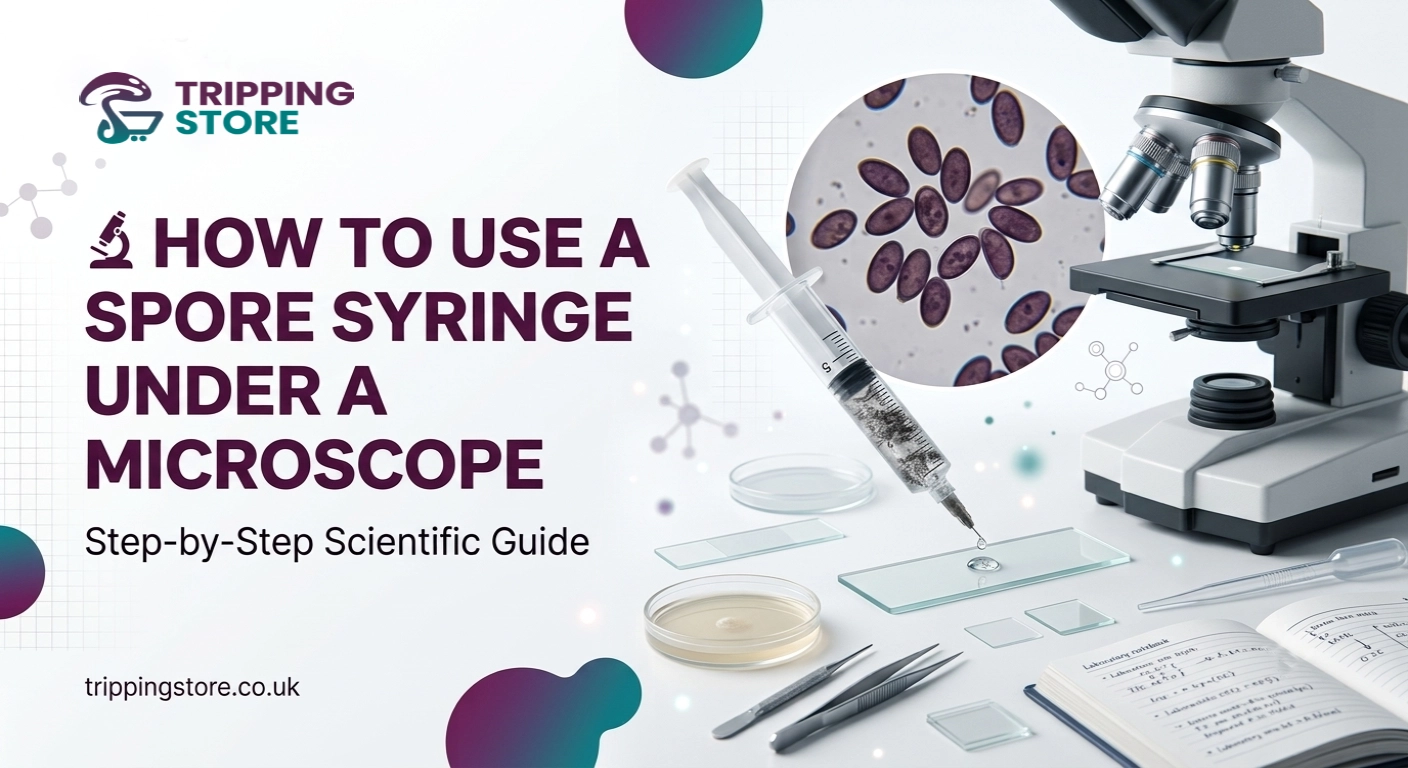
To use a spore syringe under a microscope: clean a glass slide, give the syringe a good shake to redistribute settled spores, dispense a single small drop (around 0.05ml) onto the slide, lower a coverslip at a 45-degree angle to avoid air bubbles, then observe starting at 100x, moving to 400x for general shape and colour, and finishing at 1000x oil immersion for fine detail like the germ pore. Cap the needle immediately after use to prevent contamination. This guide walks through each step in full detail, plus the equipment you need and mistakes to avoid.
Spore syringe slide preparation — from syringe to microscope
0.05mlIdeal drop size per slide
8Steps from syringe to observation
400xStandard working magnification
1000xMagnification for fine detail (oil immersion)
Jump to a section
1. What You'll Need
2. Step-by-Step Process
3. Working Through the Magnifications
4. Common Mistakes
5. After You're Finished
FAQ1. What You'll Need
Good slide prep doesn't require expensive equipment, but a few basics make a real difference to your results.
🔬
Compound Microscope
400x minimum, with 1000x oil immersion capability preferred for detailed work.
🧫
Glass Slides & Coverslips
Standard 25×75mm slides and #1.5 (0.17mm) coverslips work with most microscopes.
💧
Type B Immersion Oil
Needed only for 1000x work — a small drop goes directly on the coverslip.
🧼
Isopropyl Alcohol & Lens Tissue
For cleaning slides and coverslips before and after use.
💉
Your Spore Syringe
Bring it to room temperature before use — cold liquid causes condensation on the slide.
📓
Notebook or Camera Adapter
For recording measurements and observations, or photographing what you see.2. Step-by-Step Process
Follow these steps in order for a clean, usable slide every time.1
Clean your slide — Wipe a glass slide with lens tissue dampened with isopropyl alcohol and let it dry fully. Dust and fingerprints create artefacts that can look like contamination and make focusing harder.
2
Bring the syringe to room temperature — Take it out of the fridge 24 hours before use so it reaches room temperature. Cold liquid causes condensation on the slide that blurs your view.
3
Agitate the syringe — Roll it between your palms, then give the syringe a good shake. Spores settle to the bottom during storage, so this redistributes them evenly through the liquid.
4
Uncap the needle and add one small drop — Around 0.05ml onto the centre of the slide. Less is more — too much liquid causes the coverslip to float and the spores to drift when you try to focus.
5
Apply the coverslip at an angle — Hold it at roughly 45 degrees, let one edge touch the liquid first, then lower it flat. This pushes air out to the sides as it falls, dramatically reducing bubbles.
6
Place the slide on the stage and start at 100x — Get an overview of the whole slide first. Look for areas where spores are well spread out rather than clumped together.
7
Move to 400x for main observation — This is your primary working magnification for shape, colour, and general sample assessment. Use a calibrated eyepiece micrometer here if you're taking measurements.
8
Switch to 1000x oil immersion for fine detail — Add a small drop of Type B immersion oil directly on top of the coverslip, then carefully lower the 100x oil objective into it. This reveals wall thickness and the germ pore clearly.
3. Working Through the Magnifications
Each magnification level serves a different purpose — don't skip straight to the highest setting.| Magnification | Purpose | What to Look For |
|---|---|---|
| 100x | Orientation and overview | Areas of the slide with well-distributed spores, free of large air bubbles |
| 400x | Standard observation | Spore shape, colour, general size, distribution across the field of view |
| 1000x (oil) | Detailed structural analysis | Wall thickness, germ pore shape and size, fine surface texture |
ℹ️ Oil Immersion Tip — Only ever use oil immersion with the 100x oil objective, never with dry objectives. Clean the oil off the objective lens with lens tissue immediately after use to avoid residue building up.
4. Common Mistakes to Avoid
| Mistake | What Happens | Fix |
|---|---|---|
| Too much liquid on the slide | Coverslip floats, spores drift out of focus | Use roughly 0.05ml — a single small drop |
| Dropping the coverslip flat | Traps air bubbles under the glass | Lower it at a 45-degree angle, one edge first |
| Skipping agitation | Uneven spore distribution, patchy or empty fields of view | Give the syringe a good shake first |
| Using a cold syringe straight from the fridge | Condensation blurs the slide | Let it reach room temperature first |
| Jumping straight to 1000x | Hard to locate spores, wastes time | Start at 100x, then 400x, then 1000x |
⚠️ One Thing to Remember — Always cap the needle immediately after drawing a drop. Every time the syringe is exposed to open air, there's a risk of contamination entering, which can ruin every future slide you prepare from it.
5. After You're Finished
Once you've finished observing, a few quick habits protect both your equipment and your syringe for next time.
✅ Wrap-Up Checklist — Wipe any immersion oil off the objective lens with clean lens tissue. Dispose of used slides and coverslips safely. Cap the needle on your syringe firmly. Return the syringe to a clean place in the fridge at 2–8°C, away from light, where it should stay viable for 12–18 months.
Record your observations while they're fresh — spore dimensions, shape, colour, and any notable features. Measuring at least 15–20 spores gives you a more reliable average than judging from just one or two.Ready to Start?
Tripping Store's spore syringes are prepared under sterile conditions in the UK, with verified genetics and consistent spore density — giving you a reliable starting point for microscopy research.Frequently Asked Questions
QHow do I use a spore syringe under a microscope?
Clean a slide, give the syringe a good shake, dispense a small drop (around 0.05ml), lower a coverslip at a 45-degree angle to avoid bubbles, then observe starting at 100x, moving to 400x, and finishing at 1000x oil immersion for fine detail.
QHow much spore solution should I put on a slide?
Around 0.05ml — a single small drop. Too much liquid causes the coverslip to float and the spores to drift, making it harder to focus.
QWhy do I need to agitate the syringe first?
Spores settle to the bottom of the syringe during storage. Giving it a good shake redistributes them evenly through the liquid, so each drop you use contains a good sample.
QWhat magnification should I use to observe spores?
Start at 100x for an overview, move to 400x for standard observation of shape and colour, and finish at 1000x with oil immersion for fine detail like wall thickness and the germ pore.
QHow do I avoid air bubbles under the coverslip?
Lower the coverslip at a 45-degree angle, letting one edge touch the liquid first before lowering it flat. This pushes air out to the sides rather than trapping it underneath.
QDo I need immersion oil to see spores?
No, not for general observation. Immersion oil is only needed at 1000x magnification to reveal fine detail such as wall thickness and the germ pore. Shape and colour are visible at 400x without it.
QWhat should I do with the syringe after I've finished?
Cap the needle immediately, then return the syringe to a clean place in the fridge at 2–8°C, away from light. Stored correctly, it should remain viable for 12–18 months.
QIs it legal to use a spore syringe under a microscope in the UK?
Yes. Psilocybe cubensis spores do not contain psilocybin or psilocin, so they are legal to buy, own, and study for microscopy and taxonomic research in the UK. Cultivating fruiting mushrooms from spores is not legal.