⚖️ Legal Notice: This guide is for general information only and is not legal advice. Laws and enforcement practices change, and this page reflects the position as understood in 2026. Rules can also differ between owning spores, growing mushrooms, and crossing borders with them — always check current official guidance for the specific country you're in before ordering or travelling. See our 2026 UK Legal Guide for the full UK picture.
⚡ Quick Answer
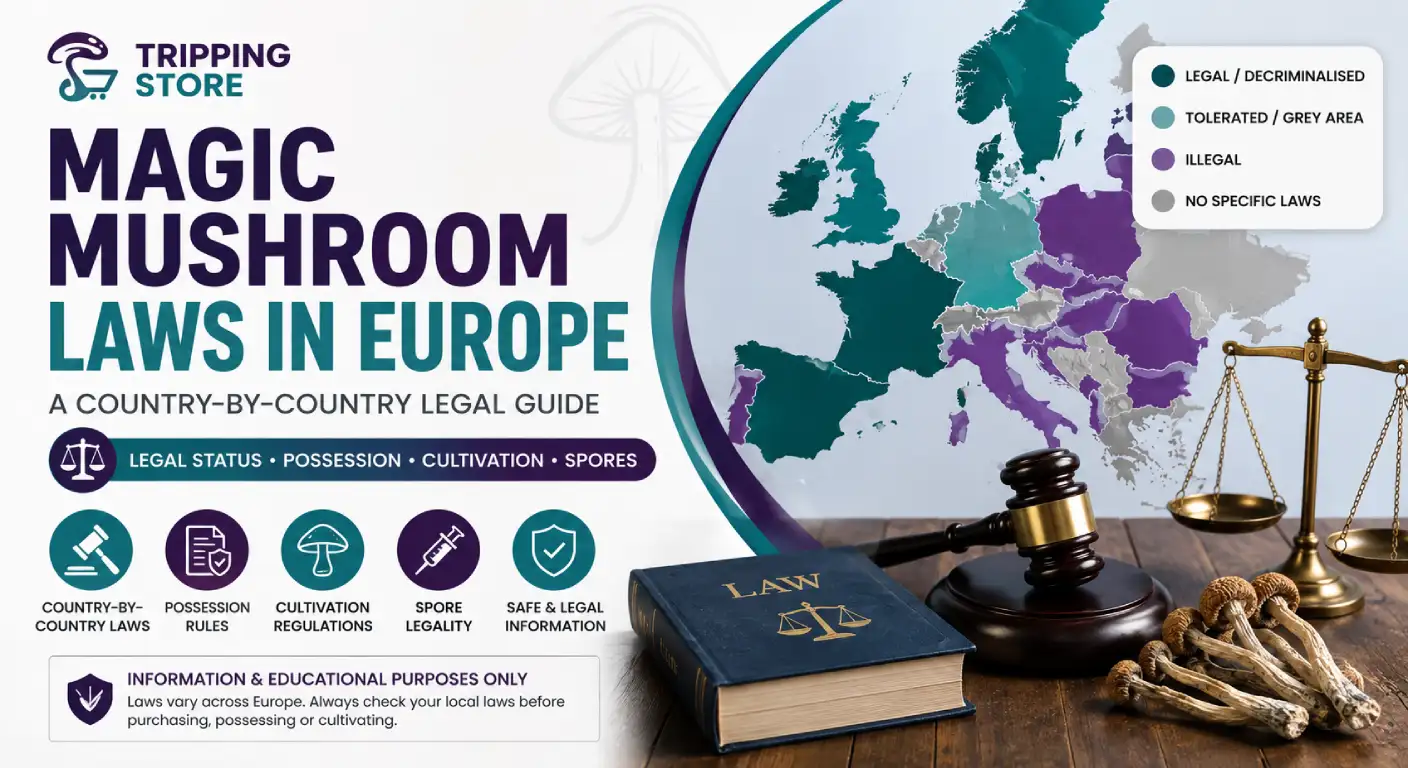
Across most of Europe, mushroom spores are treated differently from the mushrooms themselves, because spores don't contain psilocybin — the same basic logic as the UK. Countries like Germany, Spain, Poland, and Portugal generally treat spores as legal for research and collection, while the mushrooms themselves stay controlled everywhere in the EU. A few countries go further: the Netherlands allows truffles (a different part of the fungus) to be sold openly, and the Czech Republic became the first EU country to regulate medical psilocybin therapy from January 2026. This guide breaks down the picture country by country, with the usual caveat that laws and customs enforcement can change quickly.MostEuropean countries treat spores differently from mushrooms
1Country with open retail sale (Netherlands, truffles)
2026Czech Republic's new medical psilocybin framework
VariesCustoms risk shipping spores between countries
Jump to a section
1. Why Spores Are Often Treated Differently
2. Country-by-Country Overview
3. The Netherlands — A Special Case
4. Recent Changes: Czech Republic and Germany
5. A Note on Shipping Between Countries
FAQ1. Why Are Spores Often Treated Differently From Mushrooms?
Across most European countries, the same basic legal logic applies as in the UK: laws control the chemical compounds psilocybin and psilocin, not the organism itself. Since spores don't contain either compound before germinating, many countries don't classify them as a controlled substance, even though the mushroom itself is controlled everywhere in the EU.
ℹ️ Key Fact — This spore/mushroom distinction is common across Europe, but it isn't universal, and it doesn't mean spores are risk-free everywhere. A few countries scrutinise spore shipments at customs even where possession itself isn't explicitly banned.
2. Country-by-Country Overview
| Country | Spores | Mushrooms / Cultivation | Notes |
|---|---|---|---|
| United Kingdom | Legal | Illegal | Class A once germinated, under the Misuse of Drugs Act 1971 |
| Germany | Legal | Illegal | Grow kits containing active mycelium are treated more strictly than plain spores |
| Spain | Legal | Grey area in private | Private possession and consumption often tolerated at home; public sale and distribution remain illegal |
| Portugal | Generally legal | Decriminalised | Personal possession of all drugs decriminalised since 2001, treated as a health matter rather than a crime |
| Poland | Legal | Illegal | Spores and grow kits legal to own; fruiting bodies are not |
| Austria | Grey area | Decriminalised in practice | "Therapy instead of punishment" approach since 2016 for small personal amounts |
| Czech Republic | Legal | Decriminalised (small amounts) | First EU country with a regulated medical psilocybin therapy framework, effective January 2026 |
| Italy | Sold as botanical/collection items | Illegal | Spores and "virgin" kits without mycelium are sold, but cultivation is treated as a crime |
| France | Often legal, import scrutiny possible | Illegal | Psilocybin strictly controlled; spore shipments can still face customs checks |
| Switzerland | Grey area | Illegal | Article 62a allows prosecutors to drop charges for small personal-use amounts |
| Netherlands | Legal | Mushrooms illegal, truffles legal | Only European country with open retail sale of a psilocybin-containing product (truffles/sclerotia) |
⚠️ Important — This table is a general summary, not a legal ruling. Enforcement practice, customs policy, and interpretation can vary even within a single country, and this page cannot account for every regional or recent change. Always check current official guidance before ordering to or travelling in a specific country.
3. The Netherlands — A Special Case
The Netherlands is genuinely unusual in Europe. Fresh and dried magic mushrooms were banned in 2008, but a different part of the same fungus — sclerotia, commonly called "magic truffles" — were left out of that ban due to a legal technicality: truffles are classed as a different biological structure to the mushroom itself. As a result, truffles are sold openly in Dutch smartshops, making the Netherlands the only country in Europe with an open retail market for a psilocybin-containing product. Spores themselves are also legal there, in line with the same logic used across most of Europe.4. Recent Changes Worth Knowing About
A few genuinely significant developments have happened recently and are worth flagging specifically.
🇨🇿
Czech Republic — Medical Framework (2026)
As of January 2026, the Czech Republic became the first EU country to specifically regulate medical psilocybin therapy, supervised by licensed psychiatrists for psychiatric treatment.
🇩🇪
Germany — Compassionate Access (2025)
Germany launched the EU's first psilocybin compassionate access programme in 2025, treating patients with treatment-resistant conditions through licensed clinics under medical supervision.
✅ Good to Know — Both of these developments apply to regulated medical settings, not general spore or mushroom legality for the public. They don't change the ordinary legal position on spore possession described in the table above.
5. A Note on Shipping Spores Between Countries
Even where a country's own laws treat spores as legal, that doesn't automatically mean shipments crossing its border go unchecked. Customs authorities in several countries apply more caution to spore imports than domestic law alone would suggest, and shipments can occasionally be scrutinised or delayed as a result.
ℹ️ Key Fact — Legal status and shipping/customs risk are two different things. A country can treat spore possession as legal while still applying stricter checks to international parcels. If you're ordering across a border, it's worth checking both the destination country's law and its customs practice.
Ready to Start Your Research?
Tripping Store ships across the UK and internationally, where spore law is well-established for microscopy and research use — every syringe is prepared under sterile conditions strictly for that purpose.Frequently Asked Questions
QAre magic mushroom spores legal across Europe?
Generally yes, in most European countries, since spores don't contain psilocybin. But this isn't universal, and rules on cultivation, customs, and enforcement still vary significantly by country.
QWhich European country has the most open magic mushroom laws?
The Netherlands is the most notable example, with open retail sale of magic truffles (a different part of the fungus to the mushroom itself) available in smartshops.
QIs it legal to grow magic mushrooms anywhere in the EU?
No. Cultivating psilocybin-containing mushrooms remains illegal across every EU country, even where spore possession itself is legal.
QWhat changed in the Czech Republic in 2026?
The Czech Republic became the first EU country to specifically regulate medical psilocybin therapy, supervised by licensed psychiatrists, effective January 2026. This applies to regulated medical treatment, not general spore or mushroom legality.
QCan spores be seized at customs even if they're legal in the destination country?
Yes, this is possible. Legal status and customs practice are separate things, and some countries apply more scrutiny to spore shipments than their underlying law alone would suggest.
QIs this page legal advice?
No. This is general information only, reflecting the position as commonly understood in 2026. Laws and enforcement practices change, so always check current official guidance for the specific country in question, or consult a qualified legal professional.