⚖️ UK Legal Notice: This guide is for learning and research only. Psilocybe cubensis spores do not have psilocybin or psilocin in them, so they are legal to buy in the UK for research under a microscope. Growing Psilocybe cubensis from spores is illegal under UK law (the Misuse of Drugs Act 1971). Always follow UK law. See our 2026 UK Legal Guide for more.
⚡ Quick Answer
To read a spore print, look at the colour, pattern, and density of the spores deposited on the surface. The colour tells you roughly what family of fungi you're looking at — dark purple-brown is typical for Psilocybe cubensis. The pattern shows the gill structure of the mushroom that made it, with lines radiating out from a central point. A dense, even print usually means a healthy, mature specimen, while a patchy or very light print can mean it was collected too early. This guide walks through what each part of a print actually tells you, and how to use one for research.3Main things to check on a print
Dark Purple-BrownTypical colour for cubensis
2–24hrsTypical time to make a good print
Years–DecadesHow long a dry print can last
Jump to a section
1. What a Spore Print Actually Shows
2. Making a Print That's Easy to Read
3. Reading the Colour
4. Reading the Pattern
5. Reading the Density
6. Using a Print Under the Microscope
7. Storing a Print Properly
FAQ1. What a Spore Print Actually Shows
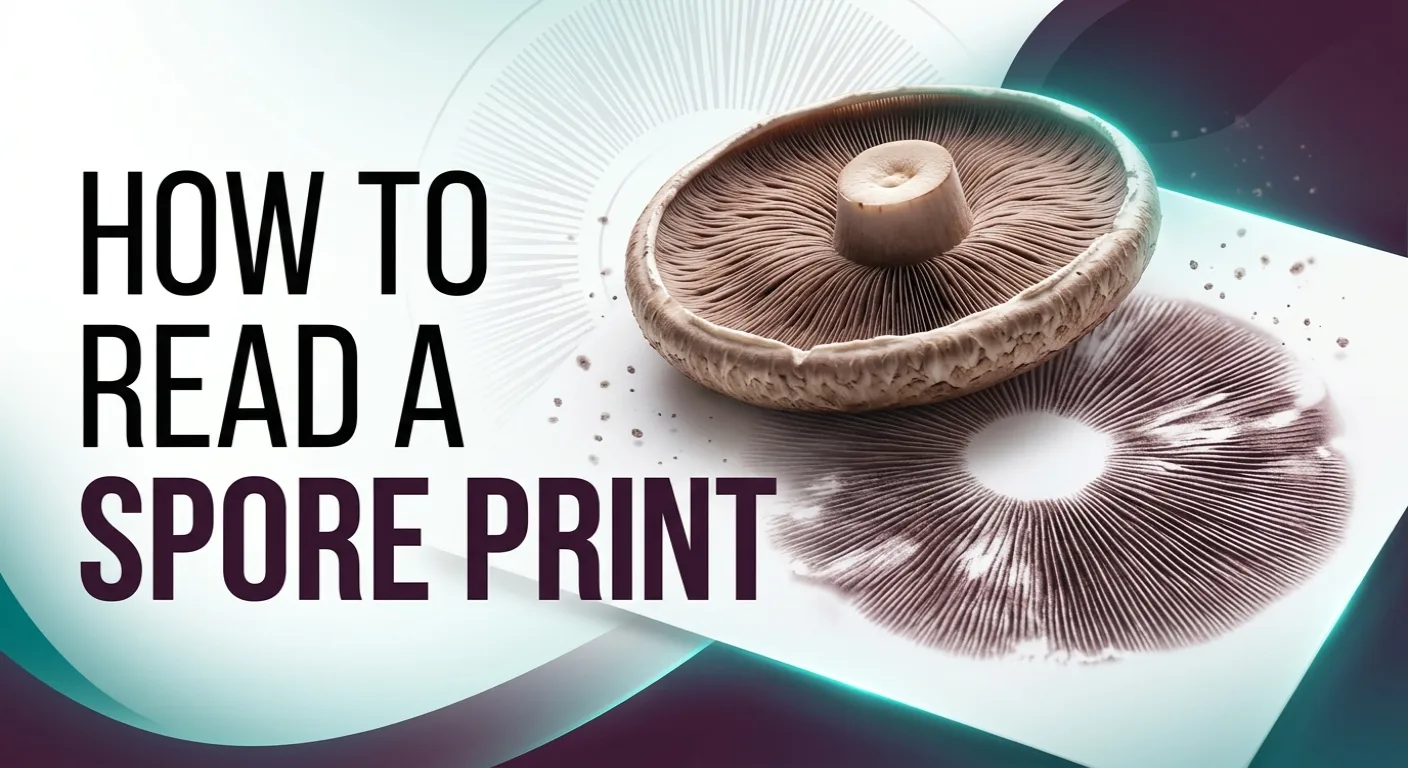
A spore print is made by placing a mushroom cap, gill-side down, on a surface (usually foil or paper) and letting spores fall naturally overnight. What's left behind is a direct copy of the gill structure and a genuine sample of the mushroom's actual spore colour and density.
ℹ️ Key Fact — Unlike a spore syringe, which only shows you spores under a microscope, a print gives you a visible, physical record you can study with the naked eye first, before ever looking closer.
2. Making a Print That's Easy to Read
How you make the print in the first place has a big effect on how easy it is to read afterwards.1
Use split contrast paper — Place the cap half on white paper and half on black paper (or use a piece of clear glass over both). This way, whether the spores turn out light or dark, at least half the print will show up clearly against a contrasting background.
2
Cover it and leave it undisturbed — Place a glass or bowl over the cap to stop air currents disturbing the spores as they fall, typically for 2 to 24 hours depending on the specimen.
3
Remove the cover, then lift the cap straight up — Gently lift the cover first, then lift the cap straight upward without dragging it sideways. Avoid blowing on the print or disturbing the powdery deposit.
4
Let it dry if needed — If the print picked up any moisture during the process, give it a short time to dry fully before handling or storing it.
✅ Why Split Contrast Works — Using both backgrounds at once means you don't have to guess how a print will show up, and you get a reliable read whatever the species.
3. Reading the Colour
Colour is one of the most useful things a print tells you, since different fungi groups tend to produce spores of a fairly consistent colour range.| Colour | What It Suggests |
|---|---|
| Dark purple-brown to blackish-brown | Typical of Psilocybe cubensis and related species |
| Pale, faded, or near white | Usually a print made too early or too thin; albino strain names describe the mushroom, not the spores |
| Bright white, yellow, or green | Likely contamination (mould) rather than a genuine spore print |
| Pink or salmon | Typical of a different genus entirely — not consistent with cubensis |
⚠️ Colour Check — If a print looks nothing like the expected dark purple-brown for a standard cubensis strain, be cautious before assuming it's a genuine, uncontaminated sample.
☀️
Judge in Natural Light
Always check colour under natural daylight if you can. Artificial lighting, especially warm LED or incandescent bulbs, can skew how purple or brown a print looks.
🎯
Check the Thickest Part
Look directly under where the gills or pores sat, not the thin edges. A sparse, dusty layer can look deceptively lighter than the true colour.
👆
Smudge a Small Edge
Gently smudge a tiny corner of the deposit with a toothpick or fingernail. This reveals the true, dense colour more clearly than looking at loose powder.
📖
Compare Against a Chart
Match what you see — pure white, rusty brown, dark purple-black, pink, or salmon — against a reputable spore colour chart or field guide for extra confidence.4. Reading the Pattern
The pattern on a print is a direct copy of the mushroom's gill structure — lines radiating outward from where the stem was attached, like spokes on a wheel.
🎯
Radiating Lines
Clear lines fanning out from a central point reflect the gill structure underneath the cap.
📏
Even Spacing
Regularly spaced lines usually indicate a healthy, well-formed cap at the time of collection.
🌀
Gaps or Breaks
Uneven or broken sections in the pattern can happen if the cap moved during printing, or wasn't perfectly flat against the surface.
🔍
Central Point
The clearer area at the centre shows where the stem was — useful for orienting yourself when studying the print.5. Reading the Density
How thick or thin the deposit looks tells you something about the maturity and health of the mushroom that made it.| Density | What It Suggests |
|---|---|
| Thick, solid, dark deposit | Mature specimen, collected at a good stage for spore release |
| Thin, patchy, or uneven deposit | Possibly collected too early, or the cap wasn't in full contact with the surface |
| Almost no visible deposit | Cap may not have been mature enough to release spores yet |
6. Using a Print Under the Microscope
Reading a print with the naked eye is useful, but a microscope reveals the real detail — individual spore shape, size, and the germ pore (a small thin spot on the spore where it would sprout from).
✅ How to Sample From a Print — Use a sterile tool to scrape a small amount of material from the print, then mix it into a small amount of sterile water to create a suspension. From there, prepare a slide the same way you would with a spore syringe.
7. Storing a Print Properly
A well-made, properly stored print is one of the most durable spore formats available.| Factor | What to Do |
|---|---|
| Moisture | Keep completely dry — moisture is the main risk to a stored print |
| Light | Store in the dark, away from direct light |
| Container | Seal in an airtight bag or container once fully dry |
| Shelf life | Years, sometimes decades, if kept dry, dark, and sealed |
Ready to Get Started?
Tripping Store's spore syringes are prepared under sterile conditions in the UK, giving you a ready-to-use starting sample if you'd rather skip the printing process entirely.Frequently Asked Questions
QShould I use white or black paper to make a spore print?
Use both at once — split contrast paper, half white and half black, so whether the spores turn out light or dark, at least half the print shows up clearly against a contrasting background.
QWhy does lighting matter when judging spore print colour?
Artificial lighting, especially warm LED or incandescent bulbs, can skew how purple or brown a print appears. Judging colour under natural daylight gives a more accurate read.
QHow do I read a spore print?
Look at three things: colour (which suggests the fungi group), pattern (which reflects the gill structure), and density (which suggests maturity and collection quality).
QWhat colour should a Psilocybe cubensis spore print be?
Dark purple-brown to blackish-brown. Bright white, yellow, or green suggests contamination rather than a genuine print.
QWhy does my spore print look patchy or uneven?
This can happen if the cap was collected too early, moved during printing, or wasn't in full flat contact with the surface.
QHow do I use a spore print under a microscope?
Scrape a small amount of material from the print with a sterile tool, mix it into a small amount of sterile water to make a suspension, then prepare a slide the same way you would with a syringe.
QHow long does a spore print last if stored properly?
Years, sometimes decades, as long as it's kept completely dry, in the dark, and sealed in an airtight container.
QWhat does a radiating line pattern on a print actually show?
It's a direct copy of the mushroom's gill structure, with lines fanning out from where the stem was attached to the cap.
QIs it legal to make and study spore prints in the UK?
Yes. Spores don't contain psilocybin, so studying them in print form for microscopy and taxonomic research is legal in the UK.