⚖️ UK Legal Notice: This guide is written strictly for educational, taxonomic, and microscopy research purposes. Psilocybe cubensis spores do not contain psilocybin or psilocin and are legal to purchase in the UK for microscopy research. Growing fruiting mushrooms from spores is illegal under UK drugs legislation. Always comply with the law. See our 2026 UK Legal Guide for full details.
⚡ Quick Answer
For most researchers, a spore syringe is the best all-round choice — it's ready to use immediately, stores well, and gives consistent, repeatable slide preparation. A spore print is better if you want to see the full spore deposit pattern for taxonomic reference or plan to make your own suspension. A spore swab is the most compact option. Because it's dry, it may keep longer than a syringe, which suits postal research kits or long-term, low-volume storage. It does need an extra rehydration step before use. This guide breaks down the real differences so you can pick the right format for what you're actually trying to do.SyringeBest for immediate, repeatable slide prep
PrintBest for taxonomic reference & deposit study
SwabBest for compact, long-term storage
12–18moSyringe shelf life, refrigerated at 2–8°C
Jump to a section
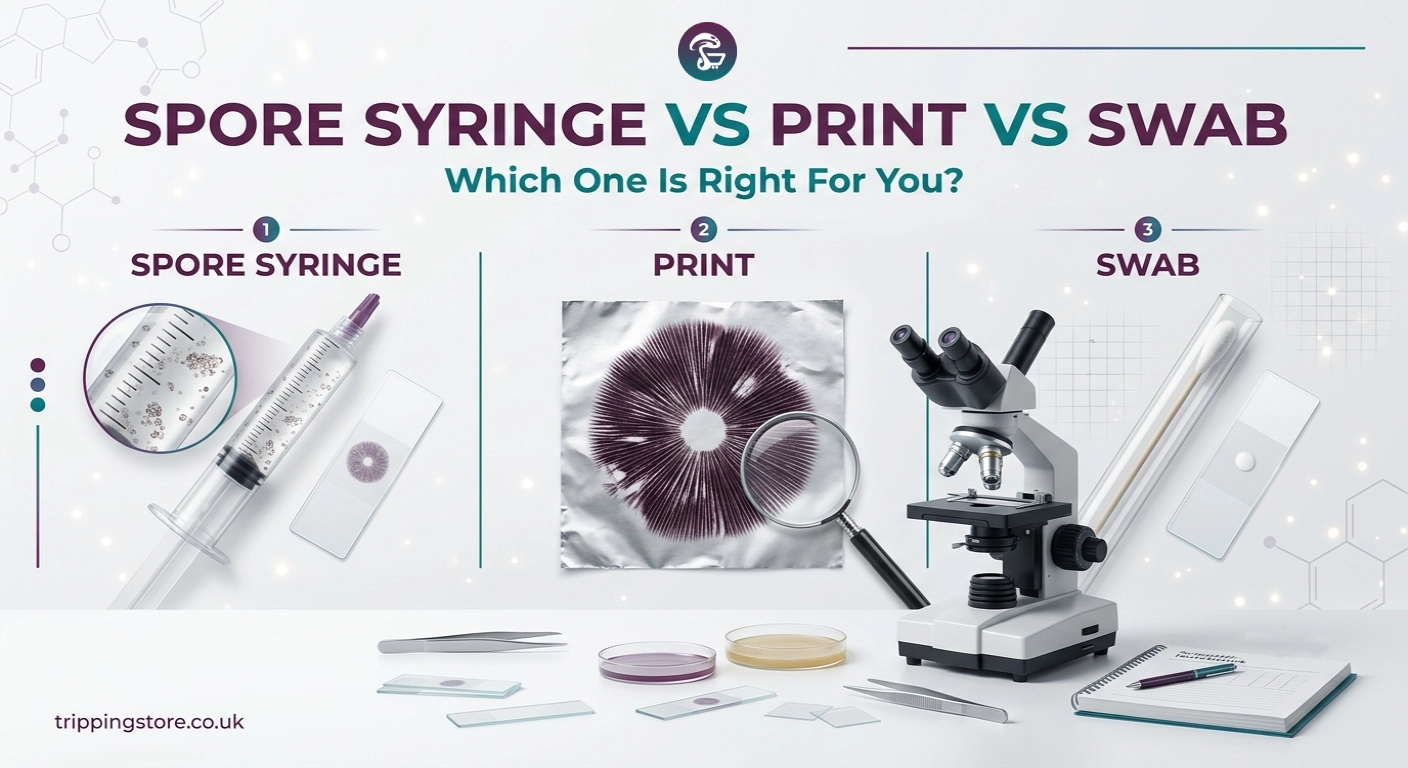
1. What Each Format Actually Is
2. Side-by-Side Comparison
3. Spore Syringes in Detail
4. Spore Prints in Detail
5. Spore Swabs in Detail
6. Which Should You Buy?
FAQ1. What Each Format Actually Is
All three formats contain the same thing — Psilocybe cubensis spores — just prepared and preserved differently.
💉
Spore Syringe
Spores suspended in sterile water inside a syringe, ready to draw a drop directly onto a slide. No preparation needed before use.
📄
Spore Print
Spores deposited directly onto foil or paper as they fall naturally from a mature cap, preserving the full deposit pattern.
🧵
Spore Swab
A sterile cotton or synthetic swab coated in spores, usually sealed in a small vial or sleeve. Needs rehydrating in sterile water before use.2. Side-by-Side Comparison
| Factor | Syringe | Swab | |
|---|---|---|---|
| Ready to use immediately | Yes | Needs suspension | Needs rehydration |
| Slide prep consistency | Very consistent | Variable | Variable |
| Storage space needed | Moderate | Minimal | Minimal |
| Postal-friendly | Yes | Yes | Best |
| Shows deposit pattern | No | Yes | No |
| Beginner-friendly | Very | Moderate | Moderate |
| Typical shelf life | 12–18 months at 2–8°C | No tested figure; dry spores may keep longer | No tested figure; dry spores may keep longer |
3. Spore Syringes in Detail
A spore syringe is spores pre-suspended in sterile water, sealed and ready to go. It's the closest thing to a "just add slide" format available.Best For
Beginners
No extra preparation step, so it's the easiest format to get consistent results from on your first attempt.
Consistency
Very High
Concentration is controlled during preparation, giving predictable, repeatable drops for every slide.
Drawback
Bulkier
Takes up more storage space than a print or swab, and the liquid can't be reduced down for postal weight savings.
✅ Best Use Case — If you're doing regular, repeated slide preparation and want minimal fuss each time, a syringe is almost always the right call.
4. Spore Prints in Detail
A spore print captures the actual deposit pattern as spores fall from the gills of a mature mushroom onto foil or paper below. It's the traditional format used for taxonomic documentation.Best For
Deposit Study
Shows gill pattern and colour density in a way liquid formats can't — useful for macroscopic reference alongside microscopy.
Preparation
DIY Suspension
To use under a microscope, you scrape spores from the print and mix them into sterile water yourself — an extra step syringes skip.
Drawback
Inconsistent Yield
Concentration when you make your own suspension varies depending on how much material you scrape and how much water you add.
✅ Best Use Case — If you want to study or photograph the natural deposit pattern itself, or you're comfortable making your own suspensions, a print offers something a syringe doesn't.
5. Spore Swabs in Detail
A spore swab is a sterile swab coated in spore material, typically sealed in a small tube. It's the most compact format, designed with storage and shipping efficiency in mind.Best For
Compact Storage
Takes up a fraction of the space of a syringe, useful if you're building a reference collection of multiple strains.
Preparation
Rehydration Needed
You'll need to agitate the swab in a small amount of sterile water to release spores into suspension before drawing a slide sample.
Drawback
Extra Step
The rehydration step adds time and a small risk of contamination each time compared to a ready-to-use syringe.
✅ Best Use Case — If postage weight or long-term compact storage matters more to you than convenience, a swab is worth considering — particularly for archiving multiple strains.
6. Which Should You Buy?
There's no single right answer — it depends on what you're optimising for.| If You Want... | Choose |
|---|---|
| The simplest, most consistent option for regular slide work | Spore Syringe |
| To see and document the natural spore deposit pattern | Spore Print |
| Minimal storage space for a growing reference collection | Spore Swab |
| The lowest-effort first purchase as a beginner | Spore Syringe |
ℹ️ Most Researchers Start Here — If you're unsure, a spore syringe is the safest default. It removes the most variables from your first slide preparation attempts, letting you focus on microscope technique rather than sample preparation.
Ready to Choose?
Tripping Store's spore syringes are prepared under sterile conditions in the UK as double-density suspensions — the most beginner-friendly, consistent format for microscopy research.Frequently Asked Questions
QShould I buy a spore syringe, print, or swab?
For most researchers, a spore syringe is the best all-round choice since it's ready to use immediately and gives consistent results. Choose a print if you want to study the deposit pattern, or a swab if compact storage matters most.
QWhat's the difference between a spore syringe and a spore print?
A syringe contains spores already suspended in sterile water, ready to use. A print is spores deposited naturally onto foil or paper — you need to scrape material off and make your own suspension before using it under a microscope.
QIs a spore swab as good as a spore syringe?
For consistency, no — a syringe gives more predictable results with less preparation. A swab's main advantage is its compact size, which suits long-term storage or postal research kits rather than day-to-day convenience.
QHow do I use a spore print under a microscope?
Scrape a small amount of spore material from the print using a sterile tool, mix it into a small amount of sterile water to create a suspension, then prepare a slide from that suspension in the same way you would with a syringe.
QDo spore swabs need to be rehydrated before use?
Yes. Spore swabs are typically dry or lightly coated, so you need to agitate the swab in a small amount of sterile water to release the spores into suspension before drawing a sample for a slide.
QWhich format lasts longest in storage?
A spore syringe stays viable for 12–18 months when refrigerated at 2–8°C, in darkness and never frozen. Prints and swabs are dry, and in lab tests dry spores of some mushroom species have stayed viable for more than two and a half years. We haven't found tested figures for cubensis prints or swabs, so we don't give them a fixed shelf life.
QWhich format is best for beginners?
A spore syringe. It removes the extra preparation steps required by prints and swabs, letting new researchers focus on microscope technique rather than sample preparation.
QCan I buy all three formats of the same strain?
Where a supplier offers multiple formats of the same strain, yes — many researchers keep a syringe for regular slide work and a print for taxonomic reference of the same strain.