⚖️ UK Legal Notice: This guide is for learning and research only. Psilocybe cubensis spores do not have psilocybin or psilocin in them, so they are legal to buy in the UK for research under a microscope. Growing Psilocybe cubensis from spores is illegal under UK law (the Misuse of Drugs Act 1971). Always follow UK law. See our 2026 UK Legal Guide for more.
⚡ Quick Answer
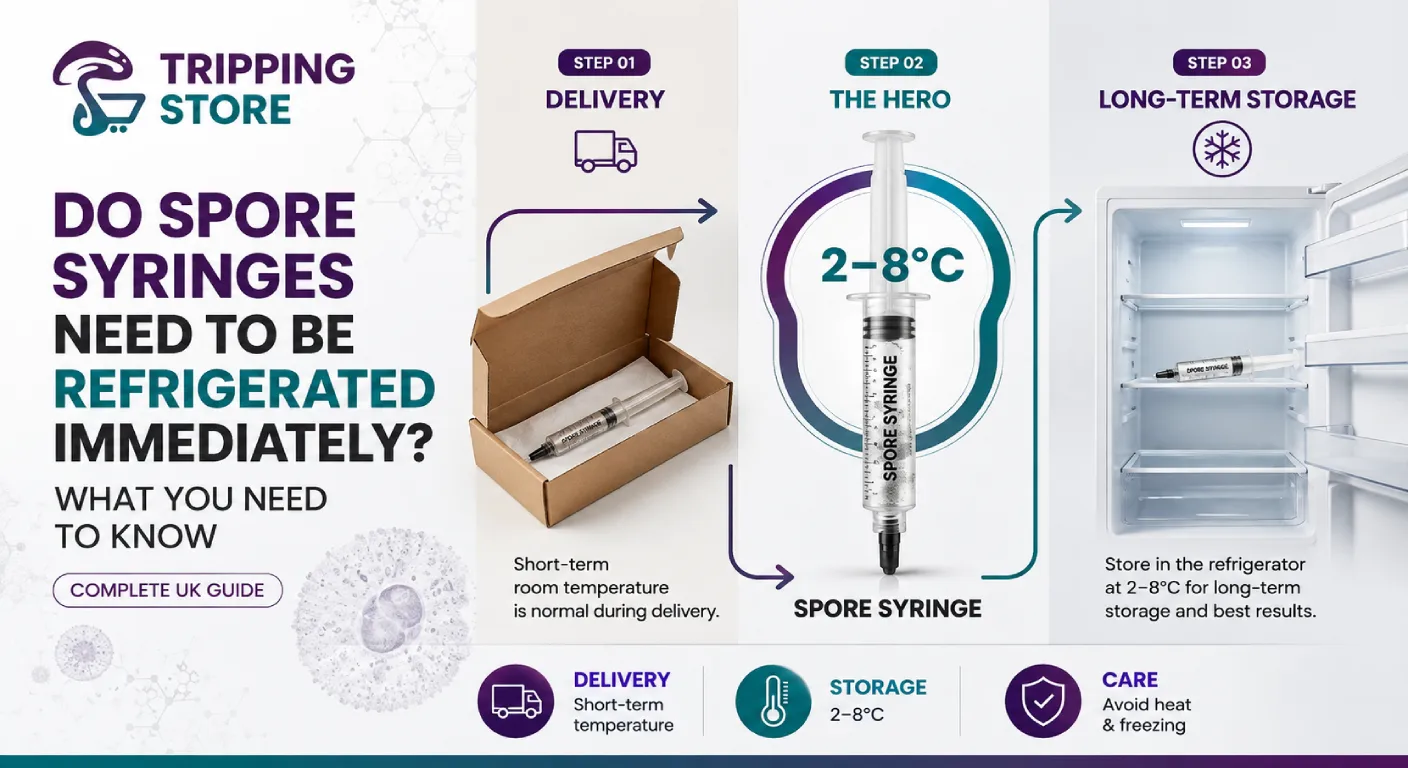
No, not to the minute — and you've got more slack than you might think. A spore syringe that spends a few hours, or even a few days, at room temperature after delivery isn't going to be ruined. What actually matters is the difference over the longer term: left at room temperature for weeks or months, spores gradually lose viability faster than they would in the fridge, where storage extends to 12–18 months. So a delay of a few days before refrigerating is genuinely no problem — it's leaving a syringe at room temperature as a long-term storage plan that isn't a good idea. This guide explains what actually causes damage, what doesn't, and exactly how to store and warm a syringe correctly.Few DaysGenuinely fine at room temperature
12–18moShelf life once refrigerated
~24hrsTime to warm up before use
2–8°CCorrect long-term storage temperature
Jump to a section
1. The Short Answer, Explained
2. What Actually Causes Damage
3. What About Delivery and Transit Time?
4. When You Should Actually Worry
5. Getting It Into the Fridge Properly
6. Warming It Up Before Use
FAQ1. The Short Answer, Explained
Spores don't need to be refrigerated within minutes of arriving. A few hours at normal room temperature — the kind of delay you'd get from a delivery sitting on a doorstep, or forgetting about it for an afternoon — isn't going to meaningfully affect viability (whether the spores are still usable).
ℹ️ Key Fact — Spores are dormant (inactive) at room temperature, not actively decaying by the minute. The fridge slows down a very gradual, natural decline — it's not an emergency measure needed the second a syringe arrives.
2. What Actually Causes Damage?
🔥
Extended Heat
Prolonged exposure to high temperatures — like a hot car, direct sunlight, or near a radiator for hours or days — is what actually accelerates viability loss.
🧊
Freezing
Far more damaging than a delay at room temperature. Ice crystals permanently damage spore structure, even after just one freeze.
💡
Prolonged Light Exposure
Days of direct light exposure slowly degrades spores. A few hours in a dim hallway isn't the same thing.
🔁
Repeated Temperature Swings
Moving a syringe in and out of the fridge repeatedly causes more cumulative stress than one single delay before its first refrigeration.3. What About Delivery and Transit Time?
Spore syringes are routinely shipped by post, often taking a day or more to arrive, and suppliers don't expect every parcel to be refrigerated in transit. This is completely normal and accounted for in how syringes are prepared and packaged.| Situation | Should You Worry? |
|---|---|
| Standard 1–3 day delivery, normal weather | No |
| Sat on doorstep for a few hours after delivery | No |
| A few days at normal room temperature before refrigerating | No — genuinely fine |
| Delivery delayed several days in extreme heat | Possibly — check for warning signs |
| Left in direct sun or a hot vehicle for hours | Possibly — check for warning signs |
4. When You Should Actually Worry
The situations that genuinely risk viability are specific and fairly easy to spot in hindsight.
⚠️ Situations Worth Checking Carefully — Extended heat exposure over multiple days (like being stuck in a hot delivery van or greenhouse), any period of freezing, or a syringe that arrives already looking discoloured or smelling off. In these cases, check the syringe carefully before assuming it's still good — see our guide on why spore syringes turn cloudy for warning signs to look for.
5. Getting It Into the Fridge Properly
Once you do refrigerate it, do it properly rather than rushing.
✅ Good Practice — Store it in a clean place in the fridge at 2–8°C. Keep it in a sealed bag or opaque container to block out light as well.
6. Warming It Up Before Use
Just as important as getting it into the fridge properly is taking it back out properly when you're ready to use it.
ℹ️ Key Fact — Take it out of the fridge and keep it at room temperature for 24 hours before use. This isn't just about comfort — using a cold syringe straight from the fridge can cause condensation on your slide, which affects how clearly you can see spores under the microscope.
Ready to Get Started?
Every TrippingStore spore syringe is prepared under sterile conditions in the UK and shipped with care — designed to handle normal delivery times without any issue.Frequently Asked Questions
QDo spore syringes need to be refrigerated immediately?
No, not to the minute. A few hours, or even a few days, at room temperature won't cause damage. It's leaving a syringe at room temperature for weeks or months as a long-term storage plan that isn't a good idea.
QIs it okay if my spore syringe was at room temperature for a few days before I refrigerated it?
Yes, that's genuinely fine. A delay of a few days doesn't meaningfully affect viability. It's only extended room-temperature storage over weeks or months that gradually shortens shelf life.
QHow long can a spore syringe be kept at room temperature?
Typically a few weeks to a few months, though this varies. It's fine for a short delay before refrigerating, but room temperature isn't suitable for long-term storage the way a fridge at 2–8°C is.
QHow long should I let a syringe warm up before using it?
Take it out of the fridge and keep it at room temperature for 24 hours before use. This helps avoid condensation forming on your slide, which can make spores harder to see clearly under the microscope.
QWill my spore syringe be ruined if I forgot to refrigerate it for a few hours?
Almost certainly not. Spores are dormant at room temperature, not actively decaying by the minute. A short delay isn't the same as prolonged heat exposure or freezing.
QWhat actually damages spore syringes during delivery?
Extended exposure to high heat over multiple days, any period of freezing, and prolonged direct light exposure are the real risks, not a normal delivery timeframe at room temperature.
QIs it normal for spore syringes to be shipped without refrigeration?
Yes. Standard postal delivery isn't refrigerated, and this is completely normal and accounted for in how syringes are prepared and packaged for shipping.
QShould I store my spore syringe in the fridge door?
No. The main body of the fridge is better, since the door experiences more temperature fluctuation every time the fridge is opened.
QHow can I tell if my syringe was damaged during a delivery delay?
Check for warning signs like unusual smell, discolouration, or a change in texture. If it looks and smells normal, it's very likely still fine to use.
QWhat should I do if my delivery was delayed for several days in hot weather?
Check the syringe carefully for signs of contamination or damage before using it. Extended heat over multiple days is more likely to affect viability than a normal delivery window.