⚖️ UK Legal Notice: This guide is for learning and research only. Psilocybe cubensis spores do not have psilocybin or psilocin in them, so they are legal to buy in the UK for research under a microscope. Growing Psilocybe cubensis from spores is illegal under UK law (the Misuse of Drugs Act 1971). Always follow UK law. See our 2026 UK Legal Guide for more.
⚡ Quick Answer
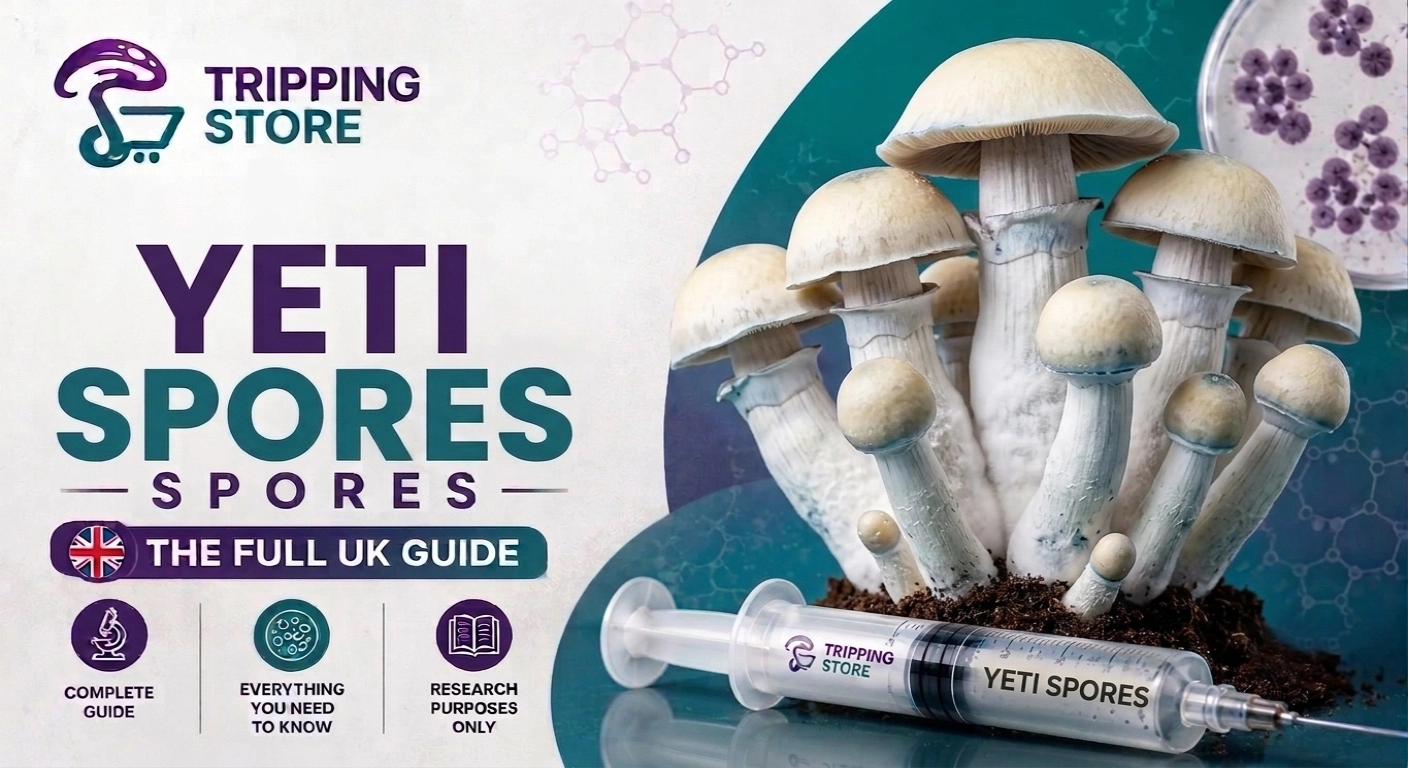
Yeti is a variant of Psilocybe cubensis sold under the Yeti name and often grouped with the True Albino Teacher (TAT) strains. It's said to have been isolated by the mycologist Jik Fibs from Albino Golden Teacher, but that lineage hasn't been independently confirmed. Yeti's mushrooms drop very few spores, since the cap doesn't release spores as freely as most cubensis strains. Its pale colour shows only in the fruiting body (the mushroom itself): under the microscope, Yeti spores look the same as any other P. cubensis spores, with no visible colour or translucency difference. This guide covers where Yeti came from, what its spores look like, how it compares to other strains, and how to store your syringe correctly.TATOften grouped with True Albino Teacher strains (lineage unconfirmed)
Very LowHow many spores the mushroom drops
StandardSpore colour under the microscope — same as other cubensis
AdvancedSpecialist strain — less common, harder to source
Jump to a section
1. Where Yeti Came From
2. What the Spores Look Like
3. What Makes It Distinctive
4. Comparing It to Other Strains
5. How to Prepare a Slide
6. How to Store It
FAQ1. Where Did Yeti Come From?
Yeti is a cultivar — a specific variety — of Psilocybe cubensis, the same species as Golden Teacher, B+, and every other named cubensis strain. It's sold as part of the True Albino Teacher (TAT) group, a name used for strains with pale, low-pigment mushrooms said to trace back to Golden Teacher genetics. That lineage hasn't been independently confirmed.Yeti itself was isolated by the mycologist known as Jik Fibs, who noticed an unusually thick-stemmed mutation while working with Albino Golden Teacher fruiting bodies. Rather than being a deliberate cross between two strains, Yeti is a naturally occurring mutation that was spotted, then carefully stabilised over time into a strain with consistent traits.
ℹ️ Key Science Fact — Yeti, Golden Teacher, B+, and Albino A+ are all the exact same species: Psilocybe cubensis. Yeti's pale mushrooms and low spore output are traits of this particular cultivar, not signs of a different species.
2. What Yeti Spores Look Like Under the Microscope
Yeti spores share the basic subellipsoid (oval, slightly flattened) shape of any cubensis spore, and under the microscope they have the same colour as any other cubensis spores. What Yeti is known for is how few spores the mushroom produces.Shape
Subellipsoid
The standard oval, slightly flattened shape seen across cubensis strains.
Colour
Standard Cubensis
The same colour as any other cubensis spores. Yeti's albino trait shows in the mushroom, not in the spore.
Wall
Standard Thickness
Similar to most cubensis strains.
Germ Pore
Clear and Visible
Present and as easy to see as on other cubensis strains, especially at 1000x with oil.
How Many Spores
Very Low
Yeti is known as a poor spore producer — its cap doesn't release spores as freely as most cubensis strains, similar to Penis Envy's low yield.
How Ours Is Made
From Spore Prints
Our Yeti syringes are prepared from spore prints, the same way as every other strain.
Low Yield, Standard Spores
Yeti is known for low spore production, similar to Penis Envy. Its spores, though, look like standard cubensis spores under the microscope.
✅ What to Look for First — At 400x, you should see the same colour and oval shape as any other cubensis strain. If you were expecting pale or see-through spores, you won't find them: that's normal, because the albino trait only shows in the mushroom.
3. What Makes Yeti Distinctive?
📉
Very Low Spore Yield
Yeti's cap structure limits spore release far more than typical cubensis strains, so the mushroom drops very few spores.
🍄
The Albino Trait Is in the Mushroom
Yeti's pale look shows in the fruiting body (the mushroom itself). It doesn't show in the spores.
🔬
No Special Lighting Needed
Standard brightfield lighting shows Yeti spores just as clearly as any other cubensis strain.
🧬
Worth It for Albino Study
If you're specifically interested in albino cubensis genetics, Yeti is one of the more distinctive albino strains to study.4. How Yeti Compares to Other UK Strains
| Strain | Spore Drop | Difficulty | Best For |
|---|---|---|---|
| Yeti | Very Low | Advanced | Albino genetics study |
| Albino A+ | Moderate | Advanced | Studying an albino variety |
| Penis Envy | Low — rare | Advanced | Studying the gene mutation |
| Golden Teacher | Very High | Beginner | Your first ever slide |
Yeti vs Albino A+ — Two Albino Strains, Different Backgrounds
Both are known for pale, albino mushrooms, but under the microscope both have standard cubensis spores, with no visible colour or translucency difference. The main difference is in the mushrooms: Albino A+ drops a moderate amount of spores, while Yeti is known as a poor spore dropper. Both syringes are made from spore prints in the same way.Yeti vs Penis Envy — Low Yield, Different Cause
Both strains are genuinely low-yield, but for different biological reasons. Penis Envy's cap simply doesn't fully open. Yeti's low output is usually put down to its albino genetics, though its exact lineage hasn't been confirmed. Interestingly, Yeti's growth cycle is also reported to be slower, similar to Penis Envy's.5. How to Prepare a Yeti Slide
Slide prep for Yeti follows the same process as other cubensis strains, and its spores need no special lighting.What You'll Need
- A microscope — 400x zoom at least, 1000x with oil is even better
- Glass slides (25×75mm)
- Coverslips (small glass squares that go on top, #1.5, 0.17mm thick)
- Type B immersion oil, for the 1000x zoom
- Alcohol wipes and lens tissue, for cleaning
- Your Yeti spore syringe
- A notebook to write down what you see
1
Clean your slide — Wipe it with alcohol and lens tissue, then let it dry fully before you use it.
2
Mix the syringe well — Give it a good shake before use to spread the spores evenly.
3
Add one small drop — About 0.05ml, right in the middle of the slide.
4
Put the coverslip on at an angle — Tilt it to about 45 degrees and lower it slowly to avoid bubbles.
5
Scan at 400x — The spores have the same colour as any other cubensis strain, so standard lighting works fine.
6
Switch to 1000x with oil — This is where fine detail like the germ pore and spore wall becomes clear.
⚠️ One Thing to Remember — Always put the needle cap back on right after use to help prevent contamination.
6. How to Store Your Yeti Spore Syringe
Store in a clean place in the fridge.| What | What to Do | Why |
|---|---|---|
| Temperature | Store in a clean place in the fridge (2–8°C) | Slows down germs without harming the spores |
| Freezing | Never freeze it | Ice damages the spores for good |
| Light | Keep it in the dark | Light slowly wears the spores down over time |
| How long it lasts | 12–18 months if stored well | After that, the spores start to break down |
✅ Before Each Use — Take the syringe out of the fridge 24 hours before use to reach room temperature, then give it a good shake before use.
Ready to Get Started?
Tripping Store's Yeti spore syringes are made under clean, sterile conditions in the UK — giving you access to a genuinely rare, distinctive strain once you're ready to move past the basics.Frequently Asked Questions
QIs Yeti legal to buy in the UK?
Yes. Yeti spore syringes are legal to buy and own in the UK for research under a microscope, since spores don't contain psilocybin.
QWhere does the Yeti strain come from?
Yeti is sold under the Yeti name and often grouped with the True Albino Teacher (TAT) strains. It's said to have been isolated by the mycologist Jik Fibs from a thick-stemmed mutation in Albino Golden Teacher, but that lineage hasn't been independently confirmed.
QWhy does Yeti produce so few spores?
Its cap structure limits spore release far more than typical cubensis strains. That's a trait of the mushroom: it doesn't change what the spores look like.
QIs Yeti good for beginners?
It's usually better suited to more experienced researchers. Yeti is a less common, more specialist lab strain that's generally harder to source and work with. That has nothing to do with its spores: under the microscope, Yeti spores look like any other cubensis spores.
QHow does Yeti compare to Albino A+?
Both are albino strains with pale mushrooms, but under the microscope both have standard cubensis spores with no visible colour difference. Yeti's mushroom drops noticeably fewer spores than Albino A+, but our Yeti syringes are made from spore prints, the same as every other strain.
QHow long does a Yeti spore syringe last?
If you store it right, in the fridge at 2–8°C, it should stay usable for 12–18 months.
QDo you ship Yeti spore syringes worldwide?
Yes, we ship across the UK and internationally, with discreet, tracked packaging.