⚖️ UK Legal Notice: This guide is written strictly for educational, taxonomic, and microscopy research purposes. Psilocybe cubensis spores do not contain psilocybin or psilocin and are legal to purchase in the UK for microscopy research. Growing fruiting mushrooms from spores is illegal under the Misuse of Drugs Act 1971. Always comply with UK law. See our 2026 UK Legal Guide for full details.
⚡ Quick Answer
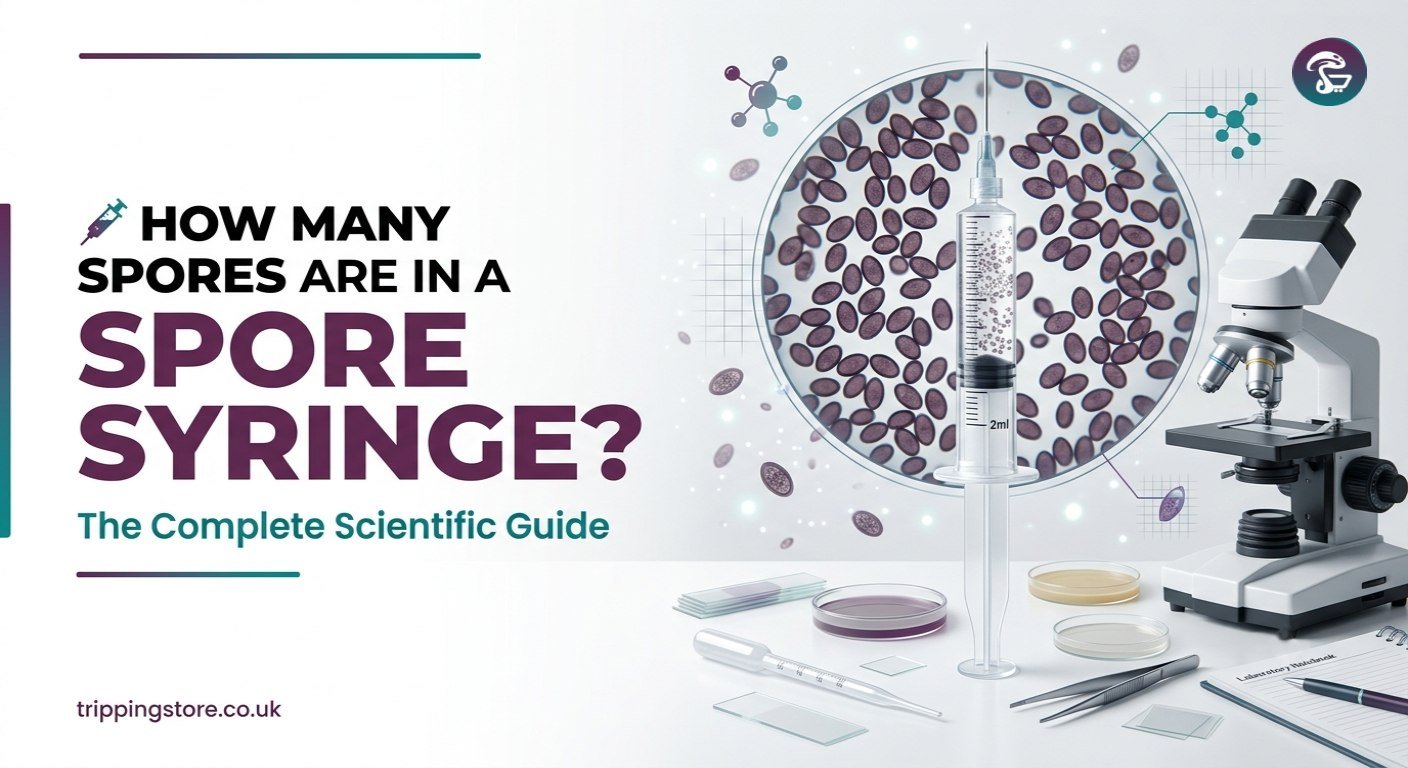
A standard 10ml spore syringe typically contains 1 to 5 million spores, depending on preparation method. Concentration is usually described as spores per millilitre, ranging from around 100,000/ml for standard suspensions up to 300,000–500,000/ml for double-density suspensions. TrippingStore syringes are prepared as double-density as standard, sitting toward the higher end of that range. Concentration mainly affects how easy it is to find usable spore clusters under the microscope — it doesn't meaningfully affect shelf life, which depends on storage conditions instead.1–5MSpores in a typical 10ml syringe
100–500kSpores per ml, standard to double-density
400xMinimum magnification to see spores
2–5xDensity increase, double-density vs standard
Jump to a section
1. How Concentration Is Measured
2. Standard vs Double-Density
3. Why Spore Count Matters
4. Does Count Affect Shelf Life?
5. Storage Guide
FAQ1. How Spore Concentration Is Measured
Spore concentration is measured in spores per millilitre (spores/ml). Labs use a haemocytometer — a small counting-grid slide originally designed for counting blood cells — to count spores within a known volume, then scale that figure up to calculate the concentration across the full syringe.This is a standard technique borrowed from microbiology, and it's how any reputable spore supplier can actually verify what's in their product rather than guessing.
ℹ️ Key Measurement Fact — A 10ml syringe at standard density (roughly 100,000 spores/ml) contains around 1 million spores total. At double-density, that figure rises to 3–5 million.
2. Standard vs Double-Density Syringes
| Type | Approx. Concentration | Approx. Total (10ml) | Best For |
|---|---|---|---|
| Standard suspension | ~100,000/ml | ~1 million | General microscopy |
| Double-density suspension | ~300,000–500,000/ml | 3–5 million | Detailed morphology study |
3. Why Spore Count Matters for Research
🔍
Clearer Slides
Higher concentration means less time spent searching for spore clusters under the microscope.
📐
More Consistent Samples
Useful when comparing morphology across multiple slides or across separate research sessions.
♻️
Less Waste
A well-concentrated syringe gives more usable samples per ml, so a single syringe stretches further.
🎯
Better First Attempts
Beginners get usable results more reliably, even with imperfect drop size or slide technique.4. Does Spore Count Affect Shelf Life?
Not directly. Viability depends far more on storage conditions than raw spore count. A double-density syringe stored badly will degrade just as fast as a standard one — concentration affects how much usable material you have, not how long that material stays viable.Keep your syringe refrigerated at 2–8°C, out of light, and it should stay usable for 12–18 months regardless of concentration level.5. Storage Guide
| Factor | What to Do | Why |
|---|---|---|
| Temperature | Store at 2–8°C (standard fridge) | Slows microbial activity without damaging spores |
| Freezing | Never freeze | Ice crystals permanently damage spore structure |
| Light | Keep in complete darkness | UV and ambient light degrade viability over time |
| Position | Store upright, needle cap on | Prevents spores settling against the plunger seal |
| Shelf life | 12–18 months under ideal conditions | Applies regardless of standard vs double-density |
✅ Before Each Use — Bring the syringe to room temperature first, then agitate for 10–20 seconds before opening. This redistributes spores evenly regardless of the concentration you started with.
Ready to Get Started?
Every TrippingStore spore syringe is prepared as a sterile double-density suspension as standard, giving you a clearer, more reliable sample straight out of the box.Frequently Asked Questions
QHow many spores are in a 10ml syringe?
A standard 10ml syringe typically contains between 1 and 5 million spores in total, depending on concentration.
QIs a higher spore count better?
For research purposes, yes — a higher, double-density concentration gives clearer, more consistent slides and makes it easier to find usable spore clusters quickly.
QCan you see individual spores without a microscope?
No. Spores are microscopic and require at least 400x magnification to be clearly visible.
QDoes spore concentration vary by strain?
Slightly. Preparation method has more impact on concentration than strain, but natural yield can vary a little between strains depending on how densely a fruiting body's spores deposit.
QWhat's the difference between standard and double-density syringes?
Double-density syringes contain roughly 3–5 times more spores per ml than standard suspensions, giving clearer, more forgiving slide preparation.
QHow is spore concentration actually measured?
Using a haemocytometer — a microscope slide with a counting grid — spores are counted in a known volume and scaled up to calculate total concentration.
QDoes a higher spore count mean a shorter shelf life?
No. Shelf life depends on storage conditions such as temperature, light, and freezing — not on spore concentration. Both standard and double-density syringes last equally long when stored correctly.
QAre TrippingStore syringes standard or double-density?
All TrippingStore spore syringes are prepared as sterile double-density suspensions as standard.