⚖️ UK Legal Notice: This guide is written strictly for educational, taxonomic, and microscopy research purposes. Psilocybe cubensis spores do not contain psilocybin or psilocin and are legal to purchase in the UK for microscopy research. Growing Psilocybe cubensis from spores is illegal under UK law (the Misuse of Drugs Act 1971). Always comply with UK law. See our 2026 UK Legal Guide for full details.
⚡ Quick Answer
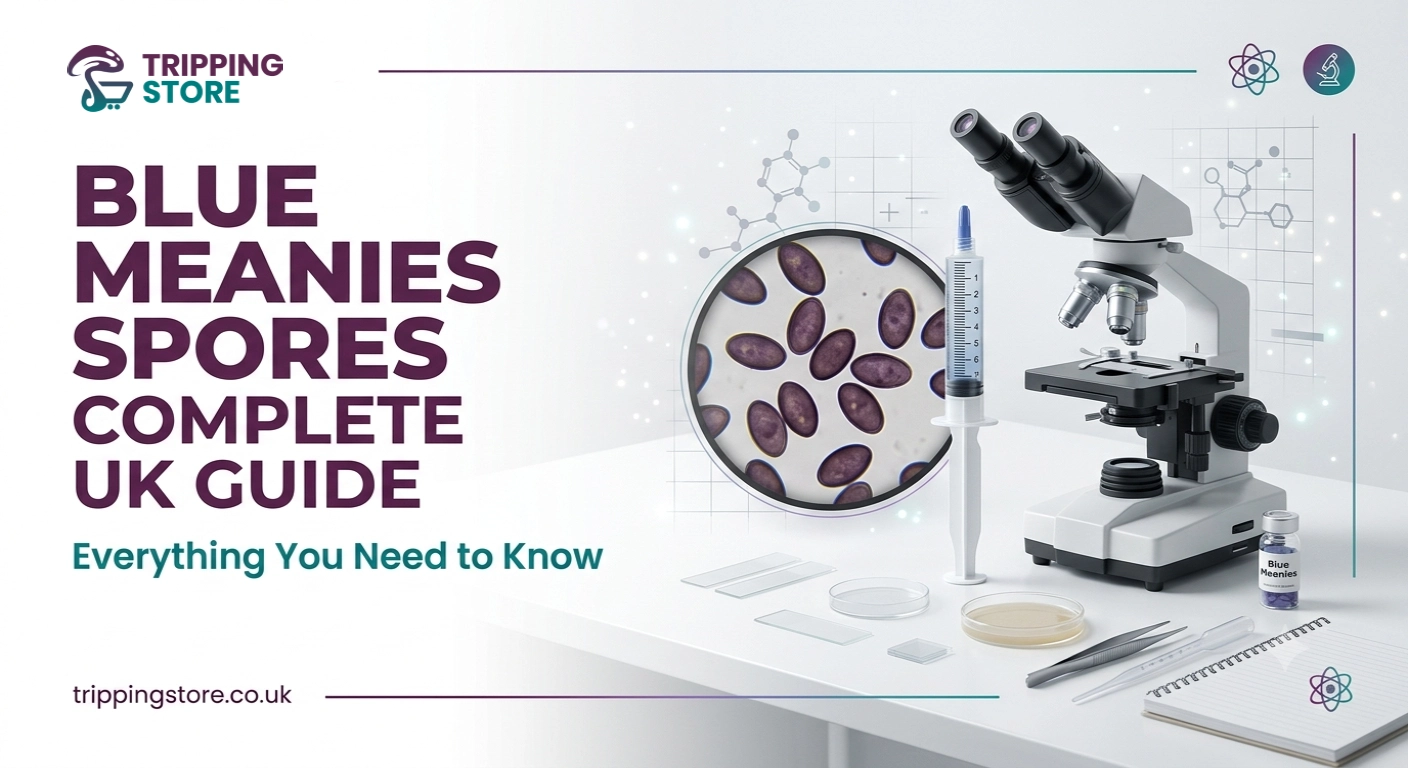
Blue Meanies is a variant of Psilocybe cubensis, named for the blue bruising its fruiting bodies show when handled. That bruising happens in the mushroom’s flesh, not in the spores. The spores are about 11.5–17 µm long and 6–11.5 µm wide, the normal range for P. cubensis, with a brown to purple-brown colour and an oval shape. Deposit density runs moderate rather than heavy, and the strain is generally considered an intermediate step up from beginner strains. This guide covers the genetics behind Blue Meanies, what its spores look like under magnification, how it compares to other strains, and how to store your syringe correctly.
Psilocybe cubensis — Blue Meanies strain · UK legal for microscopy research
This guide walks through what sets Blue Meanies apart genetically, what to expect under the microscope, and how it stacks up against the strains you may already be familiar with.11.5–17 µmSpore length — standard for cubensis
ModerateTypical spore deposit density
400xMinimum magnification to see spores clearly
IntermediateResearch difficulty level
Jump to a section
1. Where It Came From
2. What the Spores Look Like
3. Why It's an Intermediate Strain
4. Strain Comparisons
5. How to Prepare a Slide
6. Storage Guide
FAQ1. Where Did Blue Meanies Come From?
Blue Meanies is a cultivar of Psilocybe cubensis — the same species as Golden Teacher, B+, and every other named cubensis strain. As with most cubensis cultivars, its precise origin is undocumented, though it's been in circulation among mycologists for decades.The name itself refers to the pronounced blue-bruising reaction the fruiting bodies show when the flesh is damaged — a rapid colour change linked to the oxidation of psilocin in the mushroom's tissue. It's worth noting this bruising reaction is a fruiting-body trait, not something visible in spores themselves, which show no colour change of this kind.Not to Be Confused With Panaeolus cyanescens
"Blue Meanies" is sometimes used informally to refer to a different species entirely — Panaeolus cyanescens, also called Copelandia cyanescens. The Blue Meanies covered in this guide is the Psilocybe cubensis cultivar, which is the version most commonly sold and studied in UK mycology circles. Always check which species a supplier is referring to before assuming provenance.
ℹ️ Key Taxonomy Fact — Blue Meanies (the Psilocybe cubensis cultivar), Golden Teacher, B+, and Penis Envy are all the same species. Strain names are informal cultivar labels, not separate scientific classifications. Under a microscope, all cubensis strains share the same species-level spore characteristics.
2. What Blue Meanies Spores Look Like Under the Microscope
Blue Meanies spores share the core cubensis features (brown to purple-brown colour, a visible germ pore, an oval shape) and look like spores from any other P. cubensis strain.Size
10–14 × 6–10µm
The normal P. cubensis range, the same as Golden Teacher or B+. Clearly visible at 400x.
Shape
Ellipsoid, Compact
More rounded and compact than the subellipsoid shape seen in larger strains — a useful contrast for comparative study.
Colour
Dark Purple-Brown
Same pigmentation as other cubensis strains (brown to purple-brown).
Wall
Smooth
No warts or surface features, similar in thickness to other standard cubensis strains, visible at 1000x oil immersion.
Germ Pore
Narrower, Less Distinct
Present and clearly defined, as in any cubensis strain.
Deposit
Moderate
Noticeably less dense than high-yield strains like B+ or Golden Teacher — a trait of the mushroom's spore print, not of the syringe.
Why the Smaller Size Matters for Technique
Blue Meanies spores are the standard P. cubensis size, so slide prep works as with any strain. The germ pore takes some practice to spot confidently on any cubensis spore, which is a good reason to build some baseline experience first.
✅ What to Look for First — At 400x, Blue Meanies spores look like any other P. cubensis spores, Golden Teacher included. Take your time locating a well-populated field of view before switching to 1000x.
3. Why Is Blue Meanies Considered an Intermediate Strain?
Blue Meanies isn't difficult to work with, but it does ask a bit more of your technique than beginner strains do.
🔎
Smaller Target
As with any cubensis strain, steady focus control and a bit of patience help when locating clear, isolated spores.
📉
Lower Deposit Density
The mushroom's spore print is lighter, but every syringe has the same concentration, so slide prep works as with any strain.
🔬
A Good Measuring Exercise
Once you know Golden Teacher or B+ well, measuring Blue Meanies alongside them is a good exercise in spore measurement, and you'll find the sizes overlap.
🧪
A Name With a Story
While spores themselves don't bruise blue, The blue bruising behind the name happens in the mushroom’s flesh, not in the spores. Under the microscope, Blue Meanies spores look like other cubensis spores.4. How Blue Meanies Compares to Other UK Strains
All Psilocybe cubensis strains share species-level spore characteristics, and no published study shows measurable spore differences between cultivars. Here's how Blue Meanies compares with other popular UK microscopy strains.| Strain | Deposit Density | Difficulty | Best For |
|---|---|---|---|
| Blue Meanies | Moderate | Intermediate | A second strain after GT or B+ |
| Golden Teacher | Very High | Beginner | Reference strain, first slides |
| B+ | Very High | Beginner | Comparison with Golden Teacher |
| Penis Envy | Low — rare | Advanced | Genetic mutation study |
Blue Meanies vs Golden Teacher — Measuring Side by Side
This is a good side-by-side exercise in measuring spore size. Measure both and you'll find they overlap: both fall in the normal P. cubensis range of about 11.5–17 µm long and 6–11.5 µm wide (Singer & Smith, 1958; Batista et al., 2025). Once you've studied both, you'll see why strain can't be judged from spore size.Blue Meanies vs Penis Envy — Different Kinds of Difficulty
Both are considered intermediate-to-advanced. Penis Envy is known for low spore yield from a genetic mutation; Blue Meanies is considered more moderately challenging, though its spores are the standard P. cubensis size. Neither is inherently harder to prepare technically; they just demand more careful attention than beginner strains.5. How to Prepare a Blue Meanies Slide
As with any cubensis strain, a careful approach to slide prep pays off.What You'll Need
- Compound microscope — 400x minimum, 1000x oil immersion preferred
- Glass slides (25×75mm)
- Coverslips (#1.5, 0.17mm thick)
- Immersion oil (Type B) for 1000x work
- Lens tissue and isopropyl alcohol for cleaning
- Your Blue Meanies spore syringe
- Notebook for recording observations
1
Clean your slide — Wipe a glass slide with lens tissue dampened with isopropyl alcohol and let it dry fully. Dust and fingerprints create artefacts that can look like contamination.
2
Agitate the syringe thoroughly — Roll it between your palms, then give the syringe a good shake.
3
Add one small drop — Around 0.05ml onto the centre of the slide. Too much liquid causes the coverslip to float and spores to drift.
4
Apply the coverslip at an angle — Hold at a 45-degree angle, letting one edge touch the liquid first, then lower it flat to reduce air bubbles.
5
Scan patiently at 400x — Move the slide around to find a well-populated field of view.
6
Switch to 1000x oil immersion for detail — This is where the compact shape and narrower germ pore become clearly distinguishable from larger strains.
⚠️ One Thing to Remember — Always cap the needle immediately after use. Contamination risk applies to every strain equally.
6. How to Store Your Blue Meanies Spore Syringe
Standard storage rules apply, the same as for any strain.| Factor | What to Do | Why |
|---|---|---|
| Temperature | Store at 2–8°C (standard fridge) | Slows microbial activity without damaging spores |
| Freezing | Never freeze | Ice crystals permanently damage spore structure |
| Light | Keep in complete darkness | UV and ambient light degrade viability over time |
| Where | Store in a clean place in the fridge | Keeps the syringe cold and clean |
| Shelf life | 12–18 months under ideal conditions | Wall structure and clumping degrade beyond this point |
✅ Before Each Use — Take the syringe out of the fridge 24 hours before use to reach room temperature, then give it a good shake before use.
Ready to Get Started?
Tripping Store's Blue Meanies spore syringes are prepared under sterile conditions in the UK, with verified genetics — giving you a reliable, well-documented strain to add to your research collection.Frequently Asked Questions
QIs Blue Meanies legal to buy in the UK?
Yes. Blue Meanies spore syringes are legal to purchase and own in the UK for microscopy and research, as spores don't contain psilocybin.
QWhy is Blue Meanies called that if the spores don't change colour?
The name refers to the blue-bruising reaction seen in the fruiting body's flesh when handled, a trait linked to psilocin oxidation. Spores themselves don't show this colour change.
QHow big are Blue Meanies spores?
About 11.5–17 µm long and 6–11.5 µm wide, the normal range for Psilocybe cubensis, the same as Golden Teacher or B+.
QIs Blue Meanies a good strain for beginners?
It's generally considered intermediate rather than beginner-level; its spores are the standard P. cubensis size. It's a good second or third strain once you've built some experience with a beginner strain.
QIs Blue Meanies the same as Panaeolus cyanescens?
No. "Blue Meanies" is sometimes used informally to refer to Panaeolus cyanescens, a different species entirely. This guide covers the Psilocybe cubensis cultivar of the same name, which is what's most commonly sold under this label in the UK.
QHow long does a Blue Meanies spore syringe last?
Stored correctly in the fridge at 2–8°C, spore syringes typically stay viable for 12–18 months.
QWhy does Blue Meanies need more agitation before use?
It doesn't need more than any other strain: every syringe has the same concentration, because it's set by how many spore prints go into the jar, not by the strain. A good shake before use helps ensure an even sample before drawing a drop.
QDo you ship Blue Meanies spore syringes worldwide?
Yes, we ship UK-wide and internationally with discreet, tracked packaging.