⚖️ UK Legal Notice: This guide is written strictly for educational, taxonomic, and microscopy research purposes. Psilocybe cubensis spores do not contain psilocybin or psilocin and are legal to purchase in the UK for microscopy research. Growing Psilocybe cubensis from spores is illegal under UK law (the Misuse of Drugs Act 1971). Always comply with UK law. See our 2026 UK Legal Guide for full details.
⚡ Quick Answer
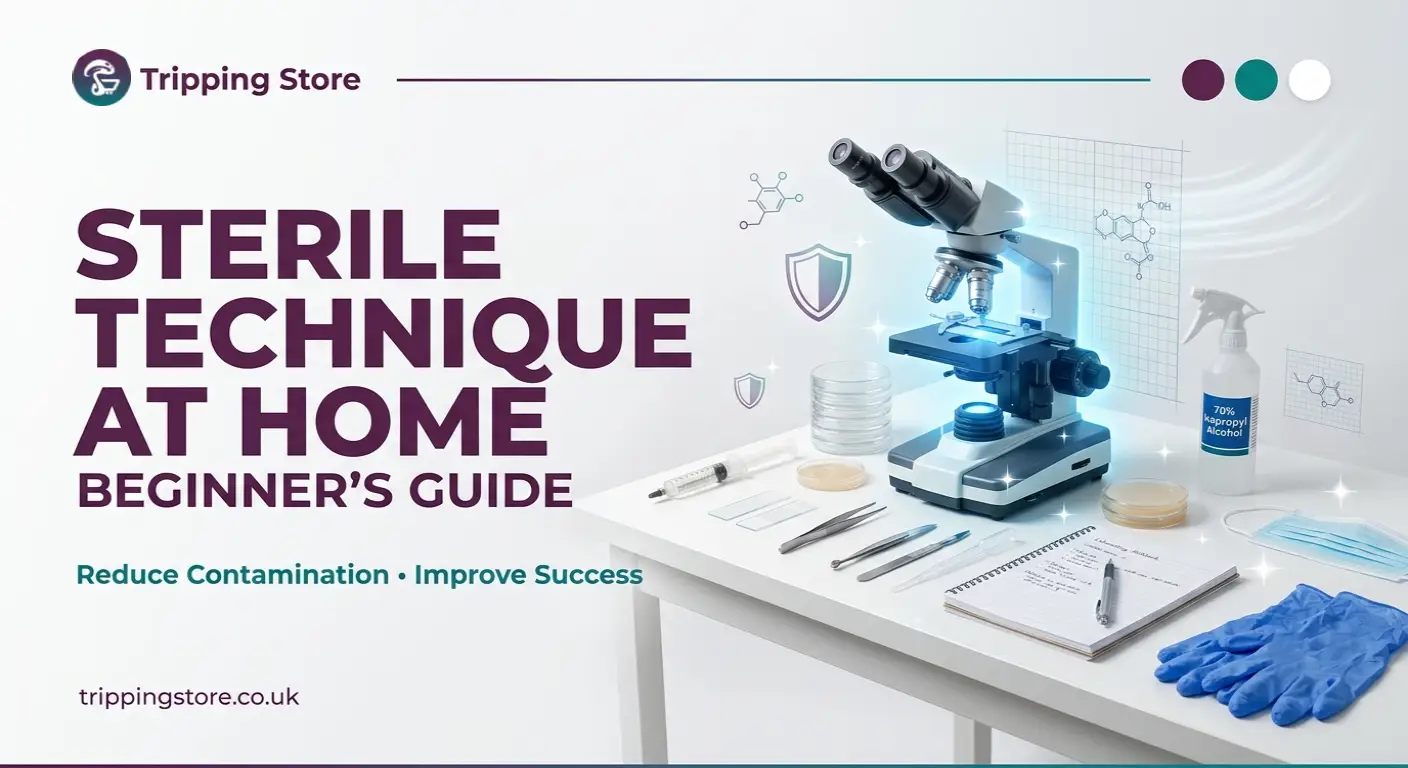
Sterile technique for home microscopy means preventing bacteria, mould spores, and other airborne contaminants from reaching your spore syringe, slides, or equipment while you work. The core habits: work in a clean, still-air space, wipe surfaces and tools with isopropyl alcohol before use, flame-sterilise metal tools where possible, minimise how long containers stay open, and always cap your syringe needle immediately after use. None of this requires a laminar flow hood or lab-grade equipment — good technique with basic tools gets you most of the way there. This guide covers the setup, the habits, and the most common contamination mistakes to avoid.70%Isopropyl alcohol concentration for sterilising
10–15sTime to flame-sterilise a metal tool
0Lab equipment required to get started
ImmediatelyWhen to re-cap a syringe needle
Jump to a section
1. Why Sterile Technique Matters
2. Setting Up a Clean Workspace
3. Core Sterile Technique Habits
4. Sterilising Your Tools
5. Common Contamination Mistakes
6. Spotting Contamination Early
FAQ1. Why Sterile Technique Matters
Contamination doesn't just ruin a single slide — a contaminated syringe can produce unreliable results for every slide you prepare from it afterwards, and a contaminated slide can be mistaken for genuine sample features if you're not careful. Bacterial and mould spores are everywhere in normal household air, and they're far smaller and more mobile than the spores you're trying to study, which makes them surprisingly easy to introduce without realising.
ℹ️ Key Fact — You don't need a sterile room to do reliable microscopy research. You need consistent habits that minimise exposure time and contact points — most contamination happens through avoidable moments, not unavoidable ones.
2. Setting Up a Clean Workspace
Before you touch a syringe or slide, your workspace itself makes a real difference.
🪟
Still Air
Work away from open windows, fans, or air vents. Moving air carries far more airborne contaminants across your workspace than still air does.
🧴
Wiped-Down Surface
Clean your work surface with 70% isopropyl alcohol immediately before you start, and let it fully evaporate before placing anything down.
🧤
Clean Hands
Wash hands thoroughly before starting, and consider wiping them with isopropyl alcohol as an extra step right before handling equipment.
📦
Everything Within Reach
Lay out everything you need before you start — slides, coverslips, alcohol, tools — so you're not reaching around or leaving containers open while searching for something.3. Core Sterile Technique Habits
These are the habits that matter most, in rough order of impact.1
Minimise open-air time — Every second a syringe, slide, or container is open to the air is an opportunity for contamination. Work efficiently and cap or cover things the moment you're done with them.
2
Wipe before, not just after — Clean slides, coverslips, and tools with isopropyl alcohol immediately before use, not just when you remember to. Dust settles constantly, even on "clean" surfaces.
3
Don't breathe directly over open equipment — Turn your head slightly away when a syringe or container is open. Breath carries moisture and airborne particles more than most people expect.
4
Re-cap immediately — Cap your syringe needle the moment you've drawn your sample. Don't set it down open "just for a second" — that's exactly when contamination happens.
5
One tool, one purpose — Don't reuse a tool that's touched one sample on another without cleaning it first. Cross-contamination between samples is just as damaging as contamination from the air.
6
Work in short, focused sessions — Long sessions with equipment open and exposed increase risk. Prepare what you need, work through it efficiently, and close everything up again.
4. Sterilising Your Tools
Different tools need different approaches.| Tool | Sterilisation Method | Notes |
|---|---|---|
| Glass slides & coverslips | Wipe with 70% isopropyl alcohol, air dry | Let alcohol fully evaporate before use |
| Metal tools (needles, scoops) | Flame-sterilise for 10–15 seconds, cool fully | Never touch a hot tool to your sample — let it cool first |
| Work surface | Wipe with 70% isopropyl alcohol | Repeat if you take a break and return later |
| Syringe exterior | Wipe barrel with isopropyl alcohol before use | Avoid getting alcohol near the needle tip or opening |
| Hands | Wash thoroughly, optionally wipe with alcohol | Repeat between handling different samples |
✅ Flame Sterilising Tip — A simple lighter or alcohol lamp works fine for small metal tools. Heat until the metal glows briefly, then let it cool completely in the air before it touches anything — a hot tool can damage samples just as easily as a contaminated one.
5. Common Contamination Mistakes
| Mistake | Why It's a Problem |
|---|---|
| Leaving a syringe uncapped between slides | Every extra second of air exposure raises contamination risk |
| Working near an open window or fan | Moving air carries far more contaminants across your workspace |
| Reusing a dirty tool between samples | Introduces cross-contamination even in an otherwise clean workspace |
| Touching a hot flame-sterilised tool to a sample too soon | Heat can damage or destroy spores before you even observe them |
| Talking or breathing directly over open equipment | Breath introduces moisture and airborne particles onto your workspace |
⚠️ One Thing to Remember — Sterile technique is about consistency, not perfection. A single lapse won't necessarily ruin a sample, but repeated shortcuts add up. Build the habits so they become automatic.
6. Spotting Contamination Early
Knowing what contamination looks like helps you catch problems before they waste further samples.
✅ Warning Signs — Bright yellow, white or highly irregular objects on a slide (rather than oval, brown to purple-brown spores) may indicate mould rather than genuine spores; check shape and structure, not colour alone. Cloudy or discoloured liquid in a syringe that was previously clear can also indicate microbial contamination. If you notice either, don't use that sample for further work.
If you suspect a syringe has become contaminated, it's best to discard it rather than continue trying to work with it — a compromised sample won't give you reliable observations, and continuing to use contaminated equipment risks spreading the problem to future slides and tools.Ready to Get Started?
Tripping Store's spore syringes are prepared under sterile conditions in the UK, giving you a clean starting point — good technique at home keeps it that way through every slide you prepare.Frequently Asked Questions
QDo I need a laminar flow hood for sterile technique at home?
No. Good habits — still air, wiped surfaces, minimal open-air time, and prompt re-capping — get most home researchers most of the way there without specialist equipment.
QWhat concentration of isopropyl alcohol should I use?
70% isopropyl alcohol is the standard recommendation for general surface and tool sterilisation, as it's effective against most microbes while still evaporating cleanly.
QHow do I flame-sterilise a metal tool safely?
Hold the tool in a flame until the metal briefly glows, then let it cool completely in the air before it touches your sample. Never touch a hot tool directly to spores or slides.
QHow can I tell if my spore syringe is contaminated?
Cloudy or discoloured liquid that was previously clear is a common sign. Under the microscope, bright yellow, white or highly irregular objects, rather than oval, brown to purple-brown spores, may indicate mould contamination, but colour alone isn't a reliable test.
QWhy does air movement matter for sterile technique?
Moving air from fans, vents, or open windows carries far more airborne contaminants across a workspace than still air. Working in a still-air space reduces the amount of contamination reaching your equipment.
QShould I re-clean my workspace if I take a break?
Yes. Dust and airborne contaminants settle continuously, so a surface cleaned an hour ago is no longer guaranteed clean. Re-wipe with isopropyl alcohol before resuming work.
QCan I reuse the same tool across different spore samples?
Not without cleaning it first. Reusing a tool between different samples risks cross-contamination, which is just as damaging to your results as airborne contamination.
QWhat should I do if I suspect a syringe is contaminated?
Discard it rather than continuing to use it. A compromised sample won't give reliable observations, and using contaminated equipment risks spreading the problem to future slides and tools.