Mushroom growing has its own language, and it can feel confusing at first. The good news? Once you learn these 32 key words, almost everything starts to make sense. This guide explains every important term in plain English — no science degree needed. We’ve grouped them by stage (getting started, growing, fruiting, harvest, and problems, plus an optional science section) so you can read it in order like a story, or jump straight to the word you’re stuck on.
If you’ve ever read a mushroom growing guide and felt totally lost by words like “inoculation,” “colonisation,” or “primordia” — don’t worry. You’re not alone, and it’s not your fault. Mushroom growers use a lot of specific words, and most guides just throw them at you without explaining what they actually mean.
This guide is different. We’re going to explain every important term in really simple language — the kind you’d use talking to a mate. By the end, you’ll understand exactly what’s going on at every stage, from the first culture to a mushroom you can pick.
1. Getting Started
2. The Growing Stage
3. Fruiting Stage
4. Harvest Time
5. Problems to Watch For
6. The Science Bit
Confusing Word Pairs
🌱 1. Getting Started — The Basics
These are the words you’ll hear before you’ve even started growing. Think of this as your shopping list stage.
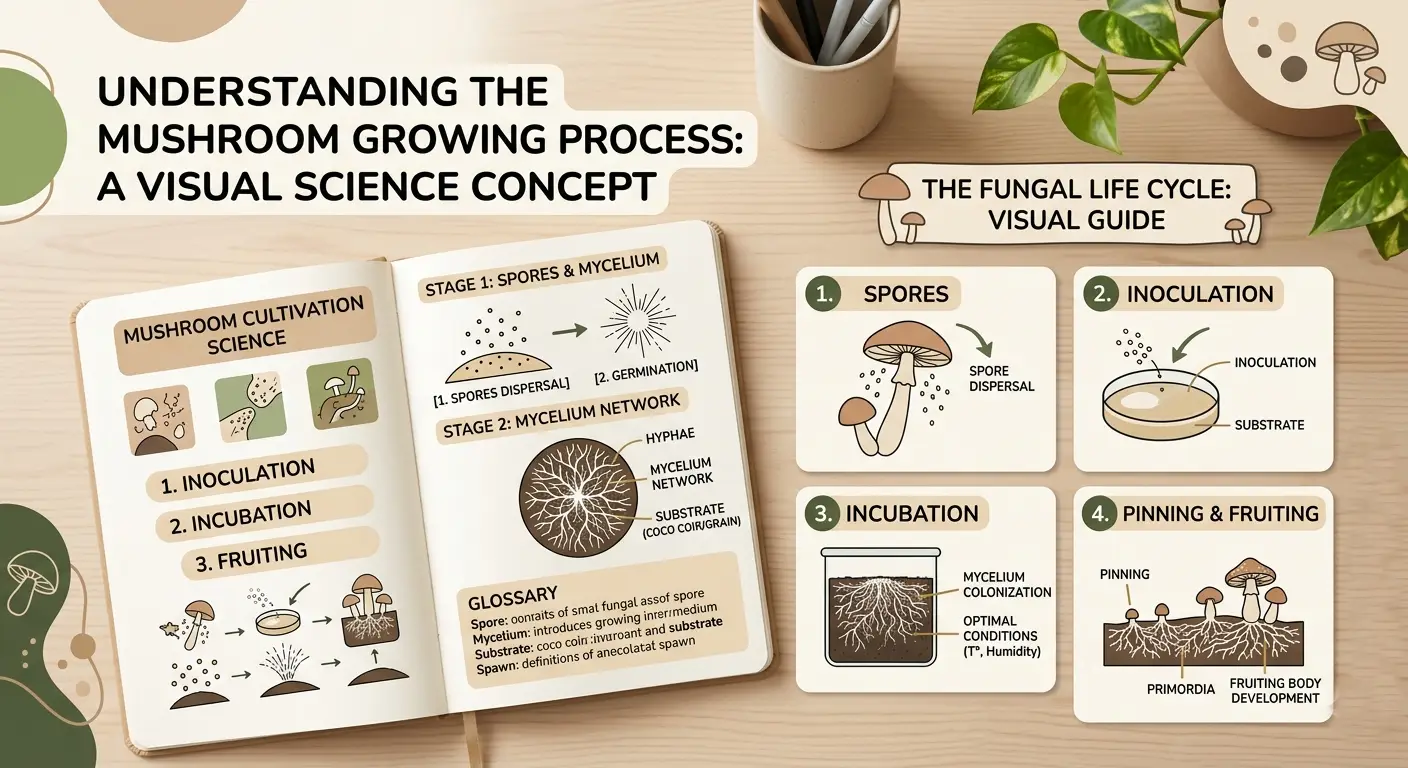
Spores are the tiny single cells a mushroom releases so the fungus can reproduce and spread. A single mushroom can release billions of spores into the air. They’re far too small to see one at a time without a microscope.
This is exactly what it sounds like — a syringe filled with spores mixed into sterile water. It’s a clean, simple way to store spores and to put one small drop onto a microscope slide. Tripping Store sells spore syringes for microscopy research only.
A spore print is what you get when a mature mushroom drops its spores onto something flat, like foil or paper, leaving a powdery pattern. Prints are a common way to store spores and to look at them under a microscope.
A spore swab is just a cotton bud (like a Q-tip) that’s been wiped over a mushroom to pick up spores. It’s a simple, low-cost way to collect spores.
Liquid culture is a jar of sugary water with living mycelium (mushroom “roots” — explained below) already growing in it. Think of it like a starter for bread, but for mushrooms. Because the mycelium is already alive and growing, it’s ready to spread into fresh substrate.
Agar is a jelly-like substance made from seaweed. Growers pour it into petri dishes (the small round plastic dishes you might remember from school science class) where it sets solid. You can then add a small piece of mycelium to the agar and watch it grow — almost like a science experiment you can actually see happening.
Substrate is the “food” that mushroom mycelium grows in and eats. Think of it like soil for a plant — except mushrooms don’t need sunlight, they need the right mix of nutrients, moisture, and warmth. Common substrates include grain, straw, and coco coir (a coconut-fibre material).
Grain spawn is grain (like rye or millet) that has been fully taken over by mycelium. It’s like a “starter pack” — once the mycelium has filled the grain, you can break it up and mix it into a bigger batch of substrate, where it keeps spreading.
🔬 2. The Growing Stage — Colonisation
This is the stage where you’ve added your culture (such as liquid culture or grain spawn) to your substrate, and now you’re waiting (and watching) for things to grow.
Inoculation just means “adding living mycelium (such as liquid culture or grain spawn) to your substrate to get things started.” That’s it. If you’ve ever heard of a flu jab being called a “vaccination,” it’s a similar idea — you’re introducing something living into a new environment so it can grow.
Mycelium is the real mushroom. Seriously. The mushroom you pick and eat is actually just a small part of the organism — like the fruit on a tree. Mycelium is the rest of the tree: a huge network of white, thread-like strands that spreads through the substrate, soaking up food and water.
Hyphae (say it: “high-fee”) are the individual threads that make up mycelium. One hypha is a single thread; lots of them together are called mycelium. They’re so thin you need a microscope to see one properly — but millions of them together form the white fuzzy stuff you can see with your eyes.
Colonisation is the stage where mycelium is spreading through the substrate but no mushrooms have appeared yet. You’ll see white, fuzzy growth slowly taking over — like mould spreading on bread, but this is the good kind. In our grow bags, you’ll usually see the first white growth after 7–10 days, and the whole bag is normally fully colonised in 21–35 days.
Incubation is just the name for the colonisation period — but it focuses on what you need to do: keep things warm and stable so the mycelium can grow as fast as possible. Think of it like keeping a baby chick warm in an incubator. This is also the stage where things are most likely to go wrong if conditions aren’t right (more on that in the Problems section).
Spawning means taking mycelium (usually grain spawn) and mixing it into a fresh, bigger batch of substrate. It’s like taking a small amount of sourdough starter and using it to make a much bigger loaf of bread.
A “cake” isn’t something you eat — it’s the name for a solid block of substrate that’s been completely taken over by mycelium. Once a cake is fully white and firm, it’s ready to start growing mushrooms.
🍄 3. Fruiting Stage — Mushrooms Start to Appear
Once colonisation is finished, it’s time to trick the mycelium into thinking it’s the right season to grow mushrooms. This stage is where things get exciting — you’ll actually start seeing mushrooms form.
Fruiting is the stage where actual mushrooms start growing. To trigger it, growers usually give the mycelium more fresh air and light. This basically tells the mycelium “hey, conditions outside are good now — time to make mushrooms and spread your spores!”
A fruiting chamber is just a container or space set up to keep the right humidity and air flow for mushrooms to grow well. It can be as simple as a plastic tub with holes in it, or as fancy as a dedicated grow tent.
Pins (sometimes called primordia — say it “pry-MOR-dee-uh”) are baby mushrooms. They start as tiny white bumps, smaller than a pinhead, which is where the name “pins” comes from. Over the next few days, these little bumps grow into full mushrooms.
A casing layer is a thin layer of material (often a mix of coco coir and vermiculite) spread on top of the substrate. Its job is simple: keep moisture in, like a damp towel over a bowl of dough. Not every grow needs a casing layer, but it helps some types of mushrooms produce bigger, better flushes.
Fresh Air Exchange just means swapping out stale air for fresh air. Mushrooms breathe in oxygen and breathe out carbon dioxide (CO₂) — just like us. If CO₂ builds up too much, mushrooms can grow weirdly shaped, with long thin stems and tiny caps. Opening a tub lid or fanning it a few times a day fixes this.
Misting means spraying a fine mist of water — like a perfume spray, not a hose — to keep the air around your mushrooms humid. Mushrooms are mostly water, so they dry out fast if the air is too dry.
The veil is a thin layer of tissue that covers the underside of a young mushroom, protecting the gills (and spores) while it’s still developing. As the mushroom cap opens up and gets bigger, the veil tears away — a bit like wrapping paper tearing off a present.
The fruiting body is the fancy name for the actual mushroom — the part with a cap and stem that you can see and pick. Its whole job is to release spores so the cycle can start again somewhere new.
🧺 4. Harvest Time
Harvesting just means picking your mushrooms. The best time to pick is just as the veil starts to tear — this is when the mushroom is fully grown but hasn’t dropped its spores everywhere yet (which can make a mess and increase the chance of problems).
A flush is one “wave” of mushrooms growing and being harvested. Here’s the cool part: after your first flush, the same cake or substrate can often produce a second flush, then a third — like a plant that keeps growing new fruit after each harvest. Each flush is usually a bit smaller than the last.
⚠️ 5. Problems to Watch Out For
Every grower runs into problems sometimes — even the experienced ones. Knowing these words helps you spot trouble early and deal with it before it ruins your whole grow.
Contamination means something unwanted — usually mould or bacteria — has gotten into your substrate and is competing with your mushroom mycelium for food. Left alone, contamination can take over completely. The biggest warning signs are unusual colours (green, black, grey, pink) or a slimy texture and bad smell.
Trichoderma is the most common type of mould that ruins mushroom grows. It’s bright green, spreads fast, and steals nutrients that your mycelium needs. If you see green patches appearing and spreading quickly, it’s almost always this. Sadly, once it takes hold, the substrate usually can’t be saved.
Just like humans, mushrooms breathe in oxygen and breathe out carbon dioxide (CO₂). During colonisation, some CO₂ build-up is actually fine — even helpful. But during fruiting, too much CO₂ causes mushrooms to grow long, thin, and stretched out, with small caps. That’s why Fresh Air Exchange (FAE) matters so much at this stage.
🤔 Confusing Word Pairs, Explained
Some terms get mixed up a lot — even by people who’ve been growing for a while. Here’s how to tell them apart.
These are two names for exactly the same thing — tiny baby mushrooms just starting to form. “Pins” is the casual, everyday word. “Primordia” is the more scientific word you’ll see in textbooks or detailed guides.
Don’t worry if a guide uses one word and another guide uses the other — they’re talking about the exact same baby mushrooms. You’re not missing a step.
Contains spores suspended in sterile water. Spores are dormant single cells, not growing mycelium, and they’re what you look at under a microscope.
Liquid culture already has living, growing mycelium in it — the thread-like network explained above, already up and running in a jar of sugary water.
🧪 6. The Science Bit (Optional, But Cool)
You don’t need to know these to start growing — but they’re handy if you want to understand more about what’s actually happening, or if you’re getting into microscopy.
Mycology is just the scientific word for “the study of fungi.” If someone calls themselves a mycologist, they’re basically a mushroom scientist. Easy.
Microscopy means looking at really small things using a microscope — things too tiny to see with just your eyes, like individual spores. Mushroom spores are usually measured in micrometres (millionths of a metre), which is why you need serious magnification to see them properly.
A strain is like a “variety” — the same way apples come in different varieties (Granny Smith, Pink Lady, Gala), mushrooms of the same species can come in different strains. Each strain might look slightly different, grow at a different speed, or have its own quirks, even though they’re all the same basic species underneath.
Genetics refers to the genetic “instructions” inside spores and mycelium that decide what a mushroom strain will look like and how it will behave — its colour, shape, growth speed, and other traits, all passed down from one generation to the next.
This guide covers general growing terms for gourmet mushroom species. If you’re researching Psilocybe cubensis spores specifically, it’s worth knowing that spores themselves don’t contain psilocybin — so they’re legal to buy in the UK for microscopy and educational research. Growing fruiting mushrooms from them is a different matter legally. For the full picture, check our 2026 UK Legal Guide.
Now that you understand the language, the rest of our guides will make a lot more sense. Check out our beginner guides to see these terms in action.
Frequently Asked Questions
The mushroom is just the small, visible part — like the fruit on a tree. Mycelium is everything else: a huge network of thread-like strands spreading through the substrate, soaking up food and water. The mycelium can keep living and producing new mushrooms (flushes) long after the first ones have been picked.
Yes — completely the same thing. “Pins” is the everyday name growers use because they look like tiny pinheads. “Primordia” is the more scientific term for the exact same baby mushrooms. If you see both words used, they’re describing the same stage.
A spore syringe contains spores suspended in sterile water. Spores are dormant single cells, and they’re what you study under a microscope; Tripping Store sells spore syringes for microscopy research only. A liquid culture contains mycelium that’s already alive and actively growing, mixed into a sugary liquid.
Mushrooms breathe — they take in oxygen and release carbon dioxide (CO₂), just like we do. If CO₂ builds up too much during the fruiting stage, mushrooms grow in a stretched, leggy way with long thin stems and tiny caps, as they try to “reach” for fresher air. Opening the lid or fanning your growing container a few times a day (called Fresh Air Exchange, or FAE) keeps CO₂ levels in check and helps mushrooms grow with a normal shape.
“Fully colonised” means the mycelium has spread through the entire substrate, turning it completely white (or close to it) with no brown or uncoloured patches left. At this point, the substrate is often called a “cake.” Once fully colonised, it’s ready to move on to the fruiting stage, where actual mushrooms will start to grow.
Yes! Each harvest is called a “flush.” After picking your first flush of mushrooms, the mycelium underneath is often still alive and full of energy. With the right care (usually involving rehydrating the substrate), it can produce a second flush, and sometimes a third or fourth. Each flush is usually a bit smaller than the one before, as the substrate’s nutrients get used up.
It starts with inoculation — adding living mycelium, such as liquid culture or grain spawn, to a substrate. The mycelium’s thread-like hyphae then spread through the substrate during colonisation. Only once colonisation is complete does the substrate move on to the fruiting stage, where actual mushrooms appear.