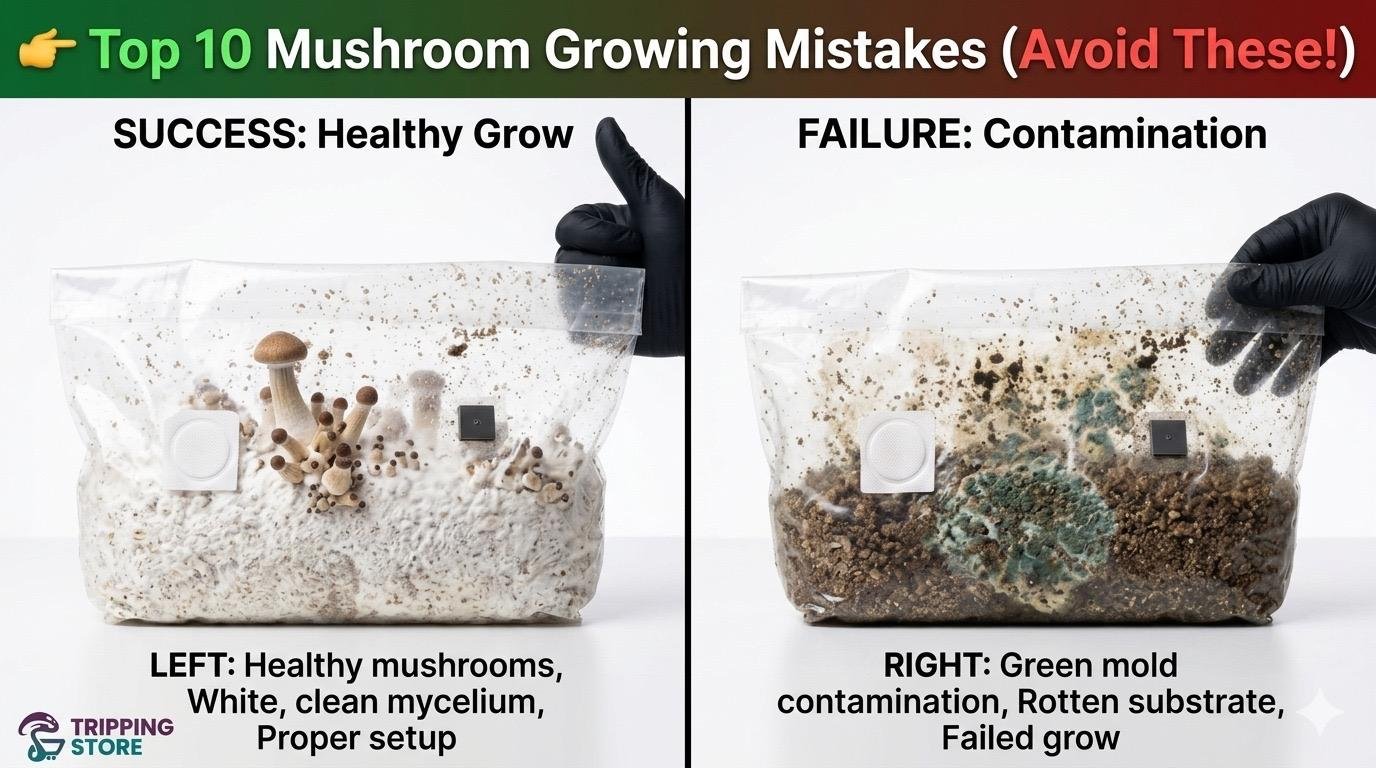
If you’ve experienced a stalled grow or the dreaded “green monster” (Trichoderma), you aren’t alone. In 2026, home mycology has gone mainstream, but the biological learning curve remains steep. Most failures aren’t due to “bad luck”—they are the result of specific, preventable environmental stressors.
This guide identifies the top 10 mushroom growing mistakes and provides professional-grade solutions to ensure your next harvest is a success.
Why Precision Matters in Mycology
Mushrooms are not plants; they are fungi. While plants thrive on sunlight and soil, mushrooms require a sterile, high-humidity “micro-climate.” Even a 2-degree temperature swing or a single unwashed hand can jeopardise your entire yield.
Quick Checklist for Success
- Sterility: 70% ISO is your best friend.
- Environment: Stability > Peak levels.
- Genetics: Start with high-quality spores or liquid culture.
The Top 10 Mushroom Growing Mistakes & Pro Fixes
1. Compromised Sterility (The “Contam” King)
Sterility isn’t just about washing hands; it’s about managing your bio-load. Open-air inoculation is the fastest way to grow mould instead of mushrooms.
- The Fix: The simplest way to start is with an All-In-One Grow Bag, which keeps the environment sealed and safe. When you’re ready to inoculate, use a 70% Isopropyl Alcohol wipe on the bag’s injection port and the surrounding workspace. Do not touch, wipe, or spray the needle itself—it is sterile inside the cap, and any contact (even with alcohol) can introduce contaminants. Focus on a “clean strike”: wipe the port, let it dry for a second so no liquid alcohol gets pushed inside the bag (which can kill your spores), and inject directly. Keep the alcohol spray for your hands and the table, not the needle!
2. “Over-Parenting” (Opening the Bag Too Early)
Beginners often succumb to curiosity, opening their bags to “check the smell” or “see the progress.” This introduces airborne contaminants instantly.
- The Fix: Practise “Set it and Forget it.” Do not open your container until the substrate is 100% colonised (pure white).
3. Inconsistent Temperature Fluctuations
Mycelium hates the “rollercoaster.” If your grow space drops to 15°C at night and hits 28°C during the day, the mycelium will go dormant, allowing bacteria to take over.
- The Fix: Maintain a steady 24–27°C for colonisation, and in our grow bags keep it there through to harvest. Use a heat pad with a thermostat. With our mushroom cultivator heat pad, place the bag directly on top of the probe, as its setup instructions say.
4. Poor Fresh Air Exchange (FAE) vs. Humidity
This is the “Golden Balance.” High humidity is needed for pins, but without oxygen, mushrooms develop “fuzzy feet” (long, thin, aerial mycelium).
- The Fix: Fan your grow 2–4 times daily once fruiting begins. Aim for 90% humidity without letting water “pool” on the surface.
5. Using Low-Quality Genetics
A “cheap” spore syringe often contains high levels of bacteria or weak mycelial strains that struggle to colonise.
- The Fix: Source from verified vendors. Read our 2026 Guide on Spore Syringes to understand what to look for.
6. Over-Misting the Substrate
Directly spraying the mycelium can cause “bruising” (turning blue) or “overlay,” where the surface becomes a hard crust that won’t fruit.
- The Fix: Mist the walls of the bag or tub, not the mushrooms themselves. You want a fine fog, not heavy rain.
7. Ignoring the “Dark Period” Myth
Many growers think mushrooms need total darkness. While they don’t photosynthesise, they do use light as a directional trigger for pinning.
- The Best Practice: Use a simple 12/12 light cycle (ambient room light is fine) to tell the mushrooms which way is “up.”
8. Failure to Identify Contamination Early
Waiting to see if “that green spot” goes away is a mistake. Once mould sporulates (turns green), it can infect your entire house.
- The Fix: Learn to distinguish Mycelium vs. Mould. If it’s green, grey, or pink, get it out of your grow room immediately.
9. Improper Substrate Hydration
If your substrate is too dry, it won’t pin. If it’s too wet (“swampy”), it will rot (sour rot).
- The Fix: Ensure your substrate is at “Field Capacity”—when squeezed hard, only a few drops of water should come out.
10. Lack of Patience (The “Pioneer’s Trap”)
Mycology is a game of weeks, not days. Rushing the process leads to cutting corners on sterility.
- The Fix: Trust the Mycelium Colonisation Timeline. Let the biology do the work.
Pro Strategy: How to Avoid ALL Mushroom Growing Mistakes
If you want near-perfect success, follow this simple framework:
Control These 4 Factors
- Sterility
- Humidity
- Temperature
- Airflow
Use Beginner-Friendly Equipment
- Grow bags
- Pre-sterilised substrate
- Reliable spores
Final Thoughts
Most mushroom growing mistakes are not complicated they’re just common and avoidable.
If you:
- Maintain sterility
- Control your environment
- Stay patient
You can achieve a high success rate even as a beginner.
Remember:
Successful growers don’t avoid failure they avoid mistakes.
FAQ: Mushroom Growing Mistakes
Poor sterility is the biggest mistake. It leads to contamination and failed grows.
Possible reasons:
- Low temperature
- Poor humidity
- Contamination
No. It’s best to discard and restart to avoid spreading contamination.
Typically 10-28 days, depending on conditions, strain & size of the substrate.
This is caused by lack of fresh air (CO₂ buildup).
In a monotub, 1–3 times daily depending on humidity levels. Judge by how they look you are not watering them but adding humidity instead.
No. Opening too early introduces contamination.
For our grow bags, the best temperature is a steady 24–27°C, held from inoculation through harvest.