⚖️ UK Legal Notice: This guide is for learning and research only. Psilocybe cubensis spores do not have psilocybin or psilocin in them, so they are legal to buy in the UK for research under a microscope. Growing Psilocybe cubensis from spores is illegal under UK law (the Misuse of Drugs Act 1971). Always follow UK law. See our 2026 UK Legal Guide for more.
⚡ Quick Answer
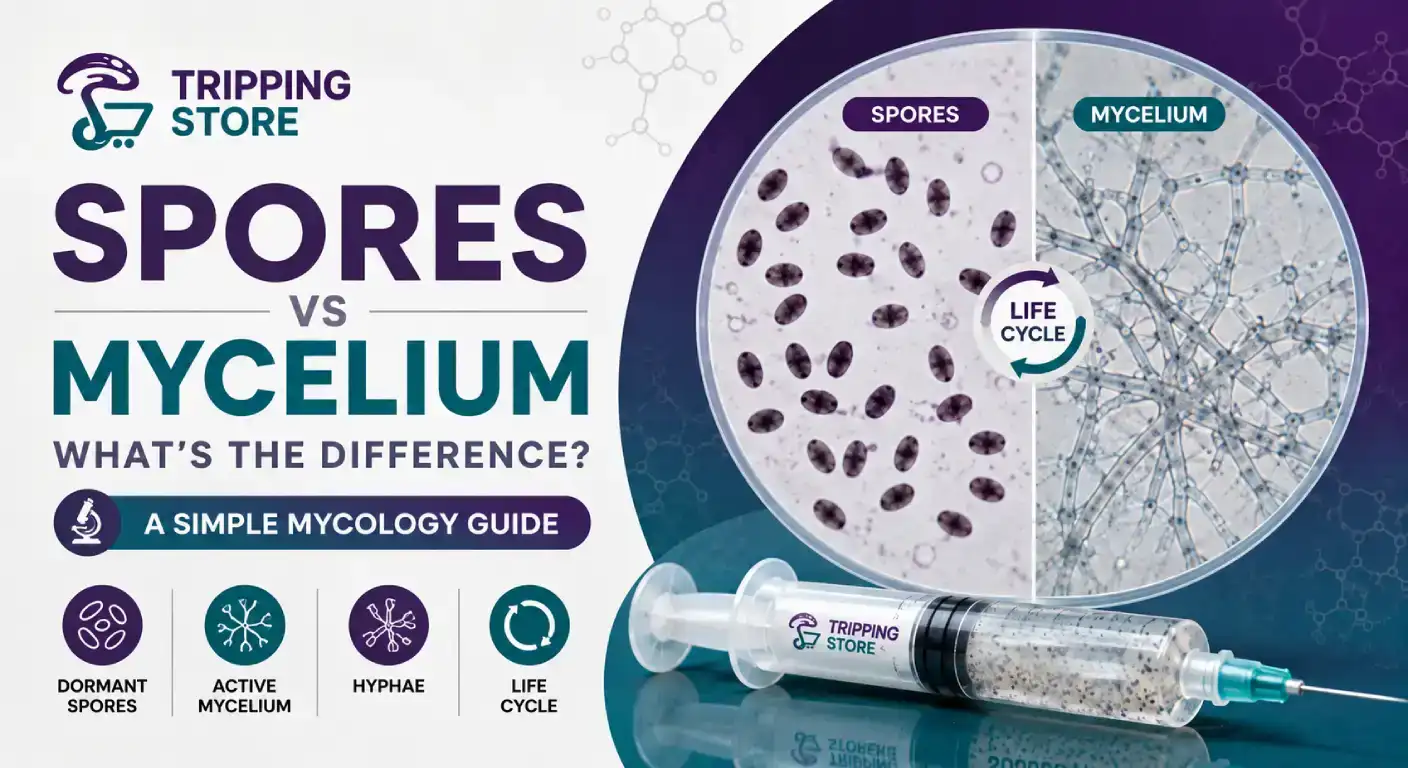
Spores and mycelium are two different stages of a fungus's life, not the same thing. Spores are tiny, dormant reproductive cells released by a mature mushroom — a bit like seeds. Mycelium is what a spore grows into once it germinates: a spreading network of thread-like structures called hyphae that actively feed and grow, eventually capable of producing new mushrooms. In short, spores are dormant and reproductive, while mycelium is the living, actively growing, feeding stage of the fungus. This guide explains exactly how the two relate, and why the distinction matters for research and UK law.DormantSpores — reproductive, inactive
ActiveMycelium — feeding, growing
4–6µmTypical hyphae thread diameter
1Life cycle connecting both stages
Jump to a section
1. What Spores Actually Are
2. What Mycelium Actually Is
3. How They Connect — The Life Cycle
4. Key Differences at a Glance
5. Why the Distinction Matters
FAQ1. What Spores Actually Are
Spores are tiny reproductive cells produced by a mature mushroom, typically released from the gills or pores underneath the cap. They're often compared to seeds in plants — a comparison that's useful, though not exact, since spores contain far less genetic material than a seed does. A single spore can germinate and grow on its own. In many species, though, its hyphae must later fuse with compatible hyphae from another spore, forming a combined mycelium called a dikaryon, before the fungus can go on to produce mushrooms.
ℹ️ Key Fact — Spores are dormant. On their own, sitting in a sealed container, they aren't actively doing anything. They only "wake up" and begin to grow when they land somewhere with the right food, moisture, and warmth.
2. What Mycelium Actually Is
Mycelium is what a spore grows into once it germinates. It's a spreading network of thread-like structures called hyphae — each only about 4 to 6 micrometres wide — that branch and interweave as they grow through a food source, absorbing nutrients along the way.
🍽️
The Feeding Stage
Mycelium is where the fungus actually feeds and grows. It can spread for years, sometimes decades, under the right conditions.
🕸️
Made of Hyphae
Individual thread-like filaments called hyphae branch and fuse together to form the wider mycelial network.
🍄
Produces Fruiting Bodies
Once mature and well-established, mycelium can produce a fruiting body — what most people just call "the mushroom."
♻️
Hidden Most of the Time
Mycelium usually grows unseen within soil, wood, or another substrate. The mushroom itself is a brief, visible stage compared to the mycelium underneath.3. How They Connect — The Life Cycle
Spores and mycelium are two points on the same continuous cycle, not separate, unrelated things.1
A spore lands somewhere suitable — With the right moisture, food, and warmth available, a dormant spore can begin to germinate.
2
It extends a germ tube — This thread-like structure is the very first stage of growth, and it continues extending and branching.
3
Hyphae form and spread — As the germ tube keeps growing and branching, it becomes a network of hyphae — the building blocks of mycelium.
4
Mycelium matures — The hyphal network spreads through its food source, absorbing nutrients and building up energy over time.
5
A fruiting body forms — Once mature and given the right conditions, mycelium can produce a mushroom — the reproductive structure of the fungus.
6
New spores are released — The mature mushroom releases fresh spores, and the whole cycle begins again.
4. Key Differences at a Glance
| Factor | Spores | Mycelium |
|---|---|---|
| State | Dormant | Active, growing |
| Role | Reproductive cell | Feeding & growth stage |
| Structure | Single microscopic cell | Branching network of hyphae |
| Comparable to | A seed | Plant roots and stems combined |
| Typical lifespan (stored correctly) | Months to years | Shorter — 3–6 months refrigerated, as a liquid culture |
5. Why the Distinction Matters
Beyond biology, this distinction has real practical relevance for UK research.
⚠️ Legal Relevance — Spores don't contain psilocybin, which is why they're legal to own for microscopy research in the UK. Mycelium and fruiting bodies are a different matter — actively growing or cultivating a fungus into fruiting mushrooms is illegal under the Misuse of Drugs Act 1971, regardless of what stage of growth it's reached.
✅ For Research Purposes — If you're studying spores under a microscope, you're looking at the dormant, reproductive stage — not the active, growing stage. That's an important distinction to understand both scientifically and for staying within UK law.
Ready to Start Your Research?
Every TrippingStore spore syringe contains dormant spores — the legal, research-focused stage of the fungal life cycle — prepared under sterile conditions in the UK.Frequently Asked Questions
QWhat's the difference between mushroom spores and mycelium?
Spores are tiny, dormant reproductive cells, similar to seeds. Mycelium is what a spore grows into once it germinates — an actively growing, feeding network of thread-like hyphae.
QIs mycelium the same as a mushroom?
No. Mycelium is the hidden, feeding network that grows within soil or another substrate. The mushroom itself, technically called the fruiting body, is a separate, visible reproductive structure that mycelium eventually produces.
QAre spores alive?
Yes, but dormant. Spores are living cells, but they aren't actively growing or feeding the way mycelium is — they stay inactive until they land somewhere with the right conditions to germinate.
QWhat are hyphae?
Hyphae are the individual thread-like filaments, typically 4 to 6 micrometres wide, that branch and fuse together to form the larger mycelial network.
QWhy does it matter whether something is a spore or mycelium for UK law?
Spores don't contain psilocybin, which is why they're legal to own for microscopy research in the UK. Actively growing mycelium into fruiting mushrooms is illegal under the Misuse of Drugs Act 1971.
QCan mycelium turn back into spores?
Not directly. Mature mycelium can produce a fruiting body, which then produces new spores on its gills or pores. The spores themselves don't come from the mycelium directly, but from the fruiting body it grows.