⚖️ UK Legal Notice: This guide is for learning and research only. Psilocybe cubensis spores do not have psilocybin or psilocin in them, so they are legal to buy in the UK for research under a microscope. Growing Psilocybe cubensis from spores is illegal under UK law (the Misuse of Drugs Act 1971). Always follow UK law. See our 2026 UK Legal Guide for more.
⚡ Quick Answer
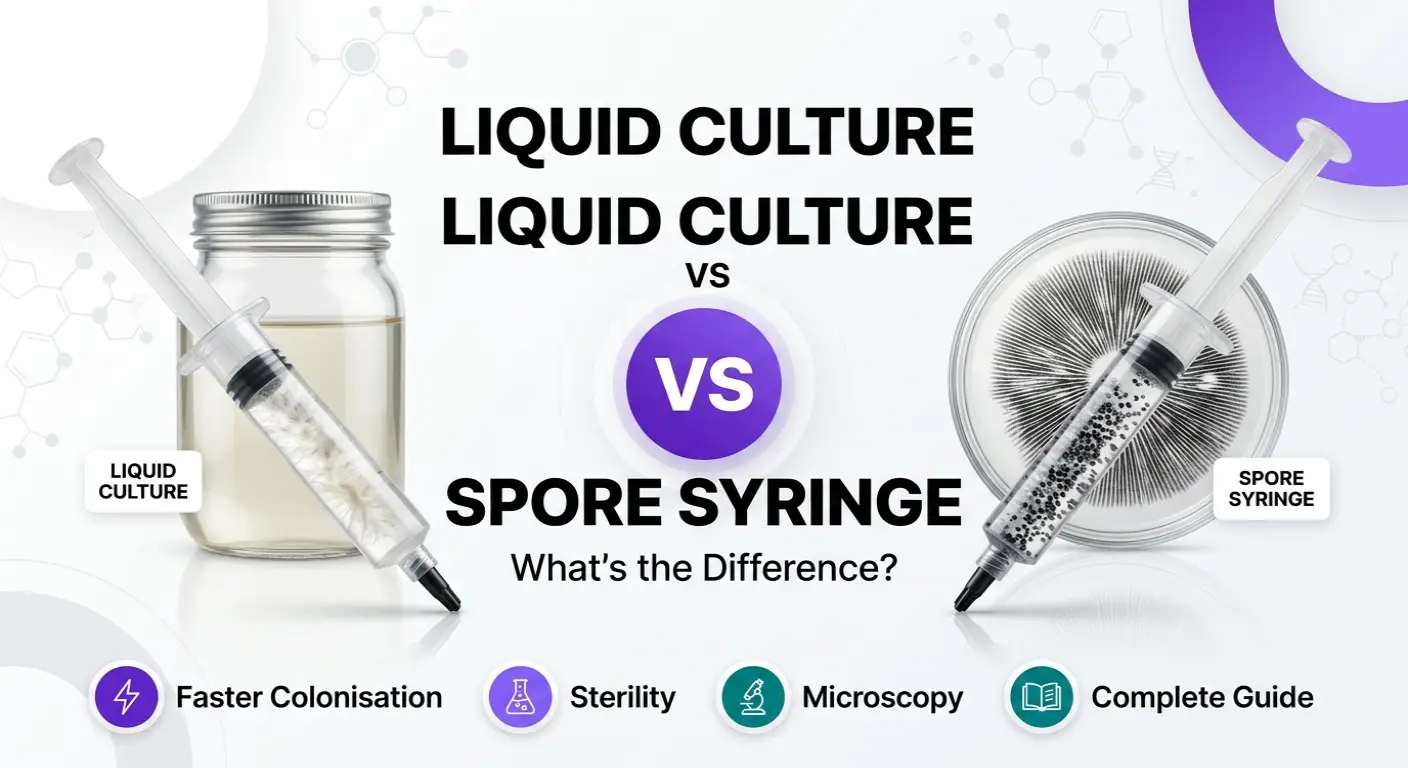
A spore syringe holds spores — the very first stage, before any growth has happened. A liquid culture (often called LC) holds mycelium — the thread-like network a spore grows into once it's already started developing, kept alive and suspended in a sugary liquid. For most microscopy research, a spore syringe is the better choice: it shows you spores in their natural state and needs no extra steps. A liquid culture is more useful if you specifically want to study early mycelium growth or genetics, but it needs more careful handling to keep it viable. This guide breaks down the real differences so you can pick the right one.SporeWhat a syringe contains — the starting point
MyceliumWhat a liquid culture contains — already growing
12–18moTypical shelf life, spore syringe
3–6moTypical shelf life, liquid culture
Jump to a section
1. What Each One Actually Is
2. Side-by-Side Comparison
3. Spore Syringe — Pros and Cons
4. Liquid Culture — Pros and Cons
5. Which Should You Choose?
FAQ1. What Each One Actually Is
💉
Spore Syringe
Spores — the very first stage — suspended in sterile water. Nothing has started growing yet. This is what most people think of as the "starting point."
🧫
Liquid Culture (LC)
A small amount of mycelium (the thread-like network a spore grows into) already developing, kept alive in a sugary liquid solution rather than on solid material.2. Side-by-Side Comparison
| Factor | Spore Syringe | Liquid Culture |
|---|---|---|
| What's inside | Spores (starting stage) | Mycelium (already growing) |
| Ready to use right away | Yes | Yes |
| Shelf life | 12–18 months | 3–6 months |
| Best for microscopy research | Yes | Limited — mycelium looks different from spores |
| Handling care needed | Standard | More careful — contamination risk higher |
| Shows genetic variation | Yes — full genetic mix | Usually no — typically one isolated genetic line |
3. Spore Syringe — Pros and Cons
Pro
Longer Shelf Life
Spores are more stable than mycelium and can sit safely in the fridge (2–8°C, dark, never frozen) for 12–18 months, sometimes longer.
Pro
Best for Microscopy
Spores are exactly what most strain guides and microscopy research focus on — shape, size, colour, and structure. Individual spores are far too small to see with the naked eye, so you'll need a microscope to study them. A magnification of at least 400x will show their shape and colour; researchers who measure spores or look at fine details typically use 1000x with an oil-immersion lens.
Con
No Growth to Observe
A spore syringe can't show you what early mycelium growth actually looks like, since nothing has started growing yet.
4. Liquid Culture — Pros and Cons
Pro
Shows Early Growth
Useful if you specifically want to study what mycelium looks like at an early developing stage.
Pro
Single Genetic Line
When it’s made from one isolated sample rather than thousands of spores, a liquid culture usually represents one specific genetic line.
Con
Shorter Shelf Life
Mycelium is less stable than dormant spores and typically only stays usable for 3–6 months, even stored well.
⚠️ Handling Note — Because a liquid culture already has active growth in it, it's more sensitive to contamination and temperature changes than a sealed spore syringe. Extra care with sterile technique matters more here.
5. Which Should You Choose?
| If You Want... | Choose |
|---|---|
| To study spore shape, size, and colour under a microscope | Spore Syringe |
| The longest possible shelf life | Spore Syringe |
| To see what early mycelium growth looks like | Liquid Culture |
| A single, consistent genetic line rather than a full spore mix | Liquid Culture |
| The simplest starting option as a beginner | Spore Syringe |
ℹ️ Most Researchers Start Here — For general microscopy research and strain study, a spore syringe is the more practical choice for most people. It lasts longer, needs less careful handling, and is exactly what most published spore measurements — including our own strain guides — are based on.
Ready to Choose?
Tripping Store's spore syringes are prepared under sterile conditions in the UK as double-density suspensions — the more practical, longer-lasting choice for most microscopy research.Frequently Asked Questions
QWhat's the difference between a spore syringe and a liquid culture?
A spore syringe holds spores — the very first stage, before any growth. A liquid culture holds mycelium — a thread-like network that's already started growing — kept alive in a sugary liquid.
QWhich lasts longer, a spore syringe or a liquid culture?
A spore syringe. Spores are more stable and typically stay usable for 12–18 months, while a liquid culture usually only lasts 3–6 months even when stored well.
QWhich is better for microscopy research?
A spore syringe, for most people. It's exactly what most strain guides and spore measurements are based on. A liquid culture is more useful specifically for studying early mycelium growth.
QWhy does a liquid culture need more careful handling?
Because it already has active growth inside it, a liquid culture is more sensitive to contamination and temperature changes than a sealed spore syringe, which stays dormant.
QDoes a liquid culture show more genetic variety than a spore syringe?
No, the opposite. A spore syringe contains a full mix of genetic variation from thousands of spores. A liquid culture usually represents just one single, isolated genetic line.
QCan beginners start with a liquid culture instead of a spore syringe?
It's possible, but a spore syringe is generally the simpler, more forgiving starting point, since it needs less careful handling and lasts much longer in storage.
QAre both formats legal to own in the UK?
Spore syringes are legal for microscopy research, since spores don't contain psilocybin. Liquid cultures involve active mycelium growth, so always check current guidance carefully, as the legal position can differ from spores alone.