
⚖️ UK Legal Notice: This guide is for learning and research only. Psilocybe cubensis spores do not have psilocybin or psilocin in them, so they are legal to buy in the UK for research under a microscope. Growing spores into full mushrooms is against the law under the Misuse of Drugs Act 1971. Always follow UK law. See our 2026 UK Legal Guide for more.
⚡ Quick Answer
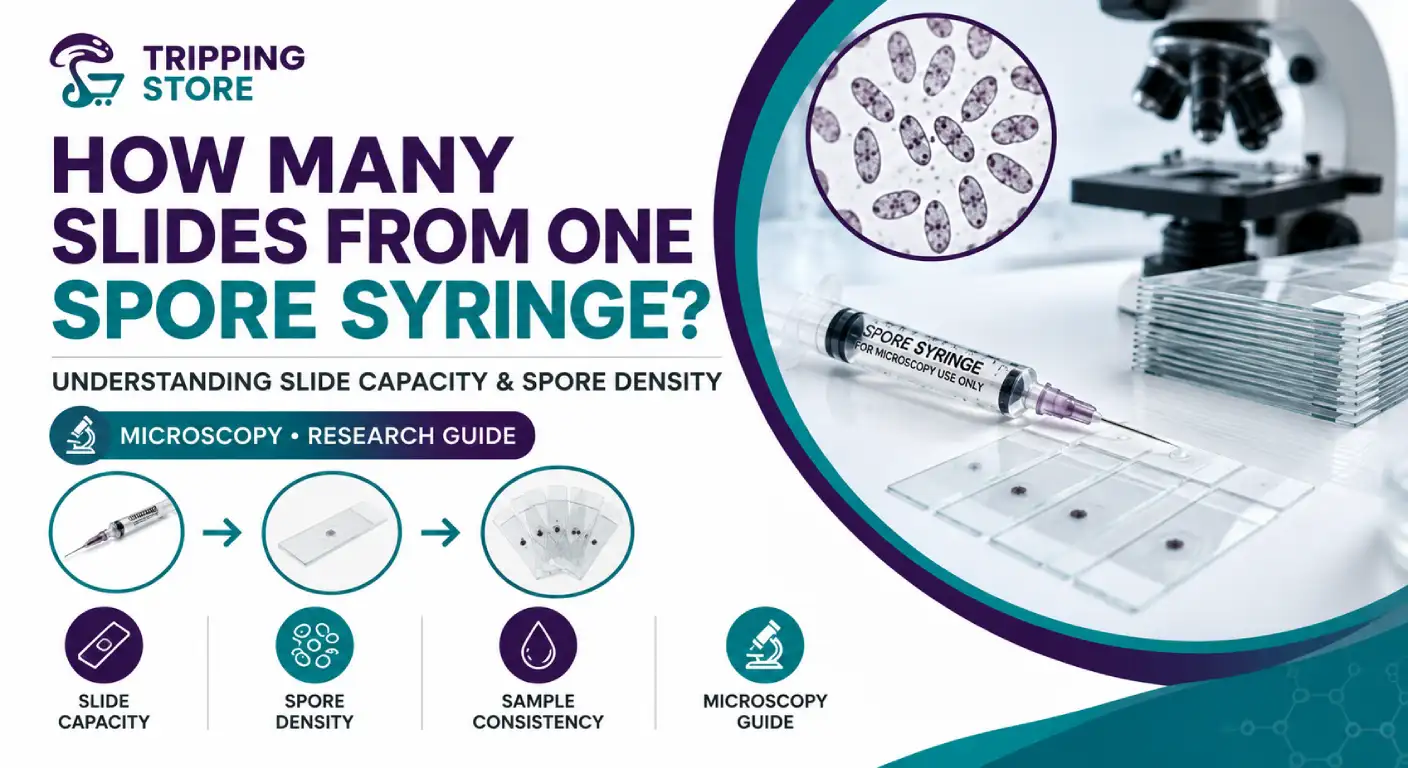
Use just one small drop per slide — roughly 0.05ml — and a standard 10ml syringe can realistically give you well over 100 slides. This is the technique nearly every practical microscopy guide recommends, and it's also simply better practice: too much liquid makes spores harder to focus on, not easier, since they end up floating at different depths and clumping together. You may also see a more conservative figure of around 10 slides per syringe from suppliers assuming a much larger 1–1.5ml drop — but that's more liquid than you actually need. Stick to one small drop, and your syringe will go much further than that. This guide explains the technique, what affects your real yield, and how to make a syringe last as long as possible.1 DropRecommended amount per slide
100+Slides per syringe, using one drop
~0.05mlSize of one recommended drop
~10Slides only if over-pouring (1–1.5ml each)
Jump to a section
1. Use One Small Drop — Here's Why
2. What Actually Affects the Number
3. How to Make a Syringe Go Further
4. When You'll Get Fewer Slides
FAQ1. Use One Small Drop — Here's Why
The clearest, most consistently recommended technique across mycology guides is simple: use just one small drop per slide, around 0.05ml. At that size, a 10ml syringe divides into 200 theoretical draws, and realistically well over 100 usable slides once you account for a bit of waste and needle priming.
ℹ️ Key Fact — Practical microscopy guides don't just recommend one drop to save material — they recommend it because it genuinely gives a clearer view. Too much liquid causes spores to float at different depths and clump together, making them harder to focus on, not easier.
| Approach | Liquid Per Slide | Slides From a 10ml Syringe |
|---|---|---|
| Recommended: one small drop | ~0.05ml | 100+ slides |
| Over-pouring (some conservative estimates assume this) | 1–1.5ml | ~10 slides |
2. What Actually Affects the Number?
💧
Drop Size
Using a slightly larger drop than necessary "just to be safe" is the single biggest factor that reduces total slide count from a syringe.
💉
Needle Priming
A small amount of liquid is used each time just to get a droplet to the tip of the needle, especially if air has entered the syringe.
🔁
Wasted or Failed Slides
Bubbles, dust, or a badly placed coverslip mean some slides get discarded and redone, using up extra liquid along the way.
📊
Syringe Size
Larger 20ml syringes obviously provide roughly double the theoretical yield of a standard 10ml syringe, all else being equal.3. How to Make a Syringe Go Further
✅ Practical Tips — Use just one small drop per slide, not several — this is the single biggest factor separating a syringe that lasts 10 slides from one that lasts 100+. Practice your slide technique on a cheap or expired syringe first, so you're not wasting material on your main research syringe while you're still learning. Keep the needle capped between uses to avoid air getting in, which reduces how much liquid gets wasted repriming the needle each time.
4. When You'll Get Fewer Slides Than Expected
⚠️ Common Reasons for a Lower Yield — Frequently over-pouring drops, a syringe that's mostly used for repeated shaking and testing rather than actual slide draws, or a syringe nearing the end of its shelf life where spores have settled and clumped, making each drop less predictable and sometimes requiring a repeat attempt.
Ready to Get Started?
Every TrippingStore spore syringe is prepared as a sterile double-density suspension in the UK, giving you plenty of usable material to work with across many slides.Frequently Asked Questions
QHow many slides can you make from one spore syringe?
Using the recommended technique of one small drop per slide (around 0.05ml), a 10ml syringe can realistically give you well over 100 slides. Only if you over-pour, using 1-1.5ml per slide, would you get a much lower figure of around 10.
QHow much spore solution should I use per slide?
Just one small drop, around 0.05ml. Practical microscopy guides consistently recommend this amount, and warn that using more makes spores harder to focus on, not easier, since they end up floating and clumping.
QDoes a 20ml syringe give twice as many slides as a 10ml one?
Roughly, yes. Since the calculation is based on total volume divided by drop size, a 20ml syringe should give approximately double the theoretical yield of a 10ml syringe, all else being equal.
QWhy do I seem to be using up my syringe faster than expected?
You're likely using more than one small drop per slide. Practical microscopy guides consistently recommend just one drop, and warn that extra liquid makes spores harder to focus on, not easier, since it causes floating and clumping.
QDoes double-density concentration affect how many slides I can make?
Not directly in terms of liquid volume, but it does affect how many usable spores are in each drop. A double-density syringe gives more consistent, well-populated slides per draw compared to a thinner standard-density mix.
QHow can I make my syringe last longer?
Use the smallest reliable drop size you can work with consistently, avoid wasting drops on practice or failed attempts, and keep the needle capped between uses to reduce liquid lost repriming the needle.
QDoes an older syringe give fewer usable slides?
It can. As spores settle and clump over time, individual drops become less predictable, sometimes requiring an extra attempt to get a well-populated sample, which uses up more liquid overall.