⚖️ UK Legal Notice: This guide is for learning and research only. Psilocybe cubensis spores do not have psilocybin or psilocin in them, so they are legal to buy in the UK for research under a microscope. Growing Psilocybe cubensis from spores is illegal under UK law (the Misuse of Drugs Act 1971). Always follow UK law. See our 2026 UK Legal Guide for more.
⚡ Quick Answer
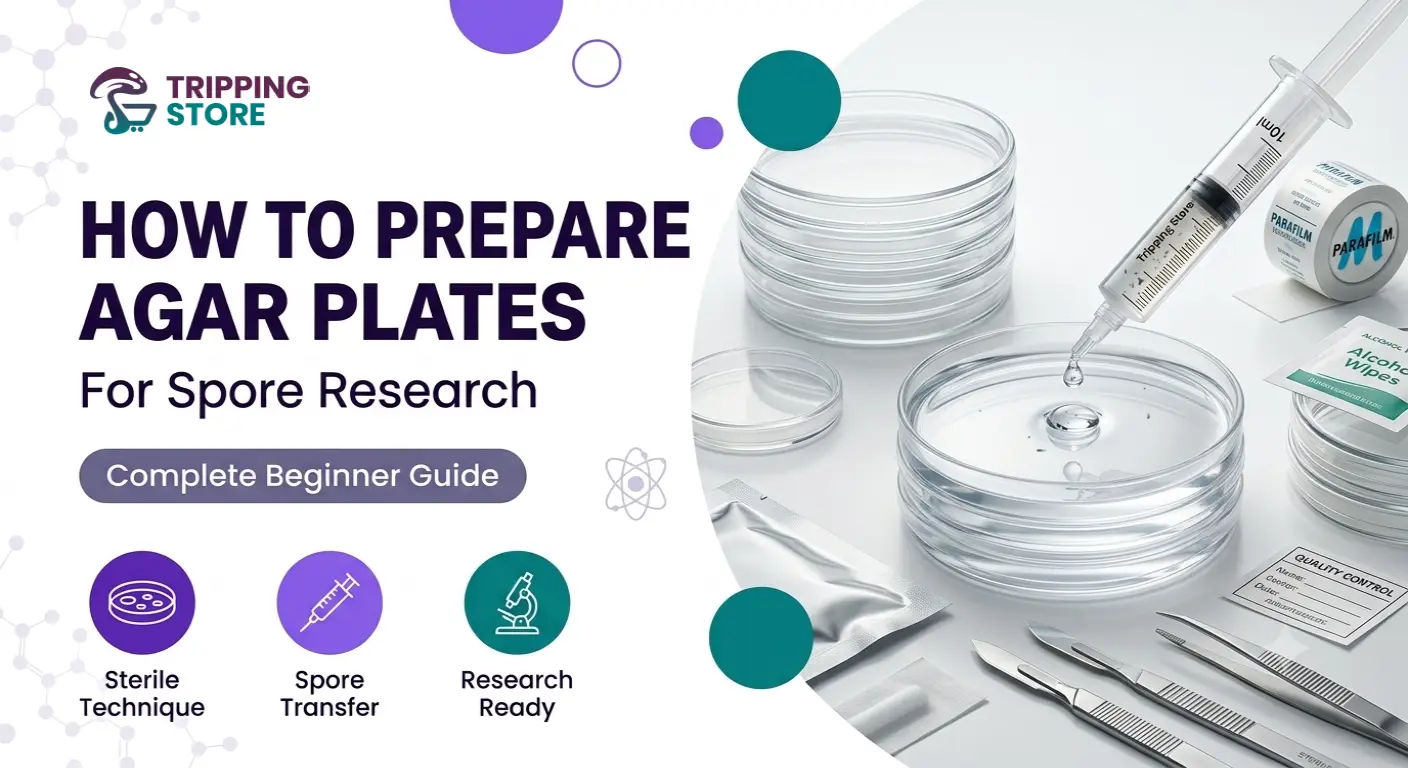
An agar plate is a small dish filled with a jelly-like food mix that scientists use to study tiny living things, like fungi, under controlled conditions. To make one: mix agar powder with nutrients and water, heat it until it dissolves, sterilise it, pour it into clean petri dishes, and let it set. Once set, a plate can be used to check that a batch is sterile, or to grow a culture of an edible species such as the oyster mushroom (Pleurotus ostreatus). This guide walks through the full process, step by step.20gTypical agar powder per litre of mix
121°CSterilising temperature (pressure cooker)
15–20minTypical sterilising time
2–4Weeks a sealed plate can be stored
Jump to a section
1. What Is an Agar Plate?
2. What You'll Need
3. Step-by-Step Process
4. How to Use Your Plates
5. Common Mistakes
6. Storing Prepared Plates
FAQ1. What Is an Agar Plate, Exactly?
Agar is a jelly-like substance made from seaweed. On its own it has no nutrients, but mixed with the right food source, it becomes a stable, see-through surface that fungi can grow across. A "plate" is just a shallow, round dish (called a petri dish) filled with a thin layer of this set agar mix. Because the surface is sterile (free from other germs) when prepared correctly, it lets you study one sample in isolation, without other contamination getting in the way.
ℹ️ Key Fact — Agar itself doesn't feed anything. The actual food usually comes from added ingredients like malt extract, which give the plate the nutrients needed to support growth.
2. What You'll Need
🧪
Agar Powder
The base ingredient that sets into a firm, jelly-like layer once mixed with water and heated.
🍯
Malt Extract (or Similar)
Provides the actual nutrients. Malt extract agar (MEA) is a common, reliable choice for fungal work.
🍽️
Petri Dishes
Small, shallow dishes with lids, usually plastic and pre-sterilised, that hold the set agar.
🔥
Pressure Cooker or Autoclave
Needed to sterilise your agar mix properly — boiling alone doesn't get hot enough to kill everything.
🧤
Sterile Gloves
To avoid introducing contamination while pouring plates.
⚖️
Digital Scale
For accurate measuring — getting the agar-to-water ratio right matters for how the plate sets.3. Step-by-Step Process
1
Measure your ingredients — A common mix is around 20g agar powder and 20g malt extract per litre of water. Weigh everything carefully.
2
Mix with water and heat — Combine the agar, malt extract, and water in a heat-safe container. Heat gently, stirring, until everything fully dissolves.
3
Sterilise the mix — Use a pressure cooker at around 121°C for 15–20 minutes. This kills off any unwanted bacteria or mould spores in the mixture.
4
Let it cool slightly — Wait until the mix is cool enough to handle but still liquid, usually around 50–60°C, before pouring.
5
Pour into petri dishes — Working quickly and cleanly, pour a thin layer into each dish, filling roughly a third of the depth. Replace the lid straight away.
6
Let the plates set and cool — Leave them undisturbed, lid-side down once fully cool, until the agar has fully firmed up.
⚠️ One Thing to Remember — Work as quickly and cleanly as you can once the mix is sterilised. Every extra second the dishes and mix are open to the air is a chance for something else to contaminate your plates.
4. How to Use Your Plates
Once a plate has set and cooled fully, it's ready to use. Two common uses are:Checking a batch is sterile. Pour one or two plates and seal them without adding anything. These are called control plates. If they stay clean over the following days, that batch was sterile. Anything that grows on them is contamination that got in during mixing, sterilising or pouring.
Culturing an edible species. A small piece of tissue from a fresh mushroom of an edible species such as the oyster mushroom (Pleurotus ostreatus) is placed on the plate using sterile technique. Its growth can then be followed on the plate over the following days.
✅ Good Practice — Label every plate with the date and what's on it before you start, and check on it daily without opening the lid unless necessary. Every time you open it, you risk letting in unwanted contamination.
5. Common Mistakes
| Mistake | Why It's a Problem |
|---|---|
| Boiling instead of pressure cooking | Doesn't reach a high enough temperature to properly sterilise the mix |
| Pouring plates while too hot | Can warp or crack plastic petri dishes, and creates condensation as it cools |
| Pouring plates while too cool | Agar starts setting before it's evenly spread, leaving a lumpy surface |
| Leaving lids off too long while pouring | Increases the chance of airborne contamination landing on the plate |
| Skipping the digital scale | Wrong ratios lead to a plate that's either too soft or too firm to use properly |
6. Storing Prepared Plates
Unused plates can be stored for later use if kept correctly.| Factor | What to Do |
|---|---|
| Temperature | Store in the fridge at 2–8°C |
| Sealing | Wrap the edges with parafilm or similar to reduce moisture loss |
| Position | Store lid-side down to stop condensation dripping onto the agar |
| Shelf life | Typically usable for 2–4 weeks, though this varies by recipe |
Ready to Get Started?
Tripping Store stocks agar plates, petri dishes and other mycology lab equipment.Frequently Asked Questions
QHow do I make an agar plate?
Mix agar powder with a nutrient source like malt extract and water, heat until dissolved, sterilise in a pressure cooker, then pour into clean petri dishes and let them set fully before use.
QWhy do I need a pressure cooker instead of just boiling?
Boiling water only reaches 100°C, which isn't hot enough to kill all bacteria and contaminant spores. A pressure cooker reaches around 121°C, which properly sterilises the mix.
QWhat does agar actually feed the sample with?
Nothing on its own. Agar just provides a firm, stable surface. The actual nutrients come from added ingredients like malt extract.
QHow long can I store unused agar plates?
Typically 2–4 weeks in the fridge at 2–8°C, sealed with parafilm and stored lid-side down, though this can vary depending on the recipe used.
QWhat temperature should the agar mix be when I pour it?
Around 50–60°C — cool enough to handle safely, but still fully liquid so it spreads evenly before setting.
QWhy does my agar plate look lumpy after setting?
This usually happens if the mix was poured too cool and started setting before it spread evenly across the dish. Pour while it's still fully liquid.
QIs agar work legal in the UK?
Making agar plates is legal. So is owning Psilocybe cubensis spores and studying them under a microscope, because the spores contain no psilocybin or psilocin. Germinating those spores is different. A germinated spore grows into mycelium, and Psilocybe cubensis mycelium has been found to contain psilocin. UK law classes any fungus that contains psilocin, or an ester of psilocin, as a Class A drug. So germinating these spores, or growing or isolating their mycelium on agar, counts as producing a Class A drug, even if no mushrooms ever form.