⚖️ UK Legal Notice: This guide is written strictly for educational, taxonomic, and microscopy research purposes. Psilocybe cubensis spores do not contain psilocybin or psilocin and are legal to purchase in the UK for microscopy research. Growing fruiting mushrooms from spores is illegal under the Misuse of Drugs Act 1971. Always comply with UK law. See our 2026 UK Legal Guide for full details.
⚡ Quick Answer
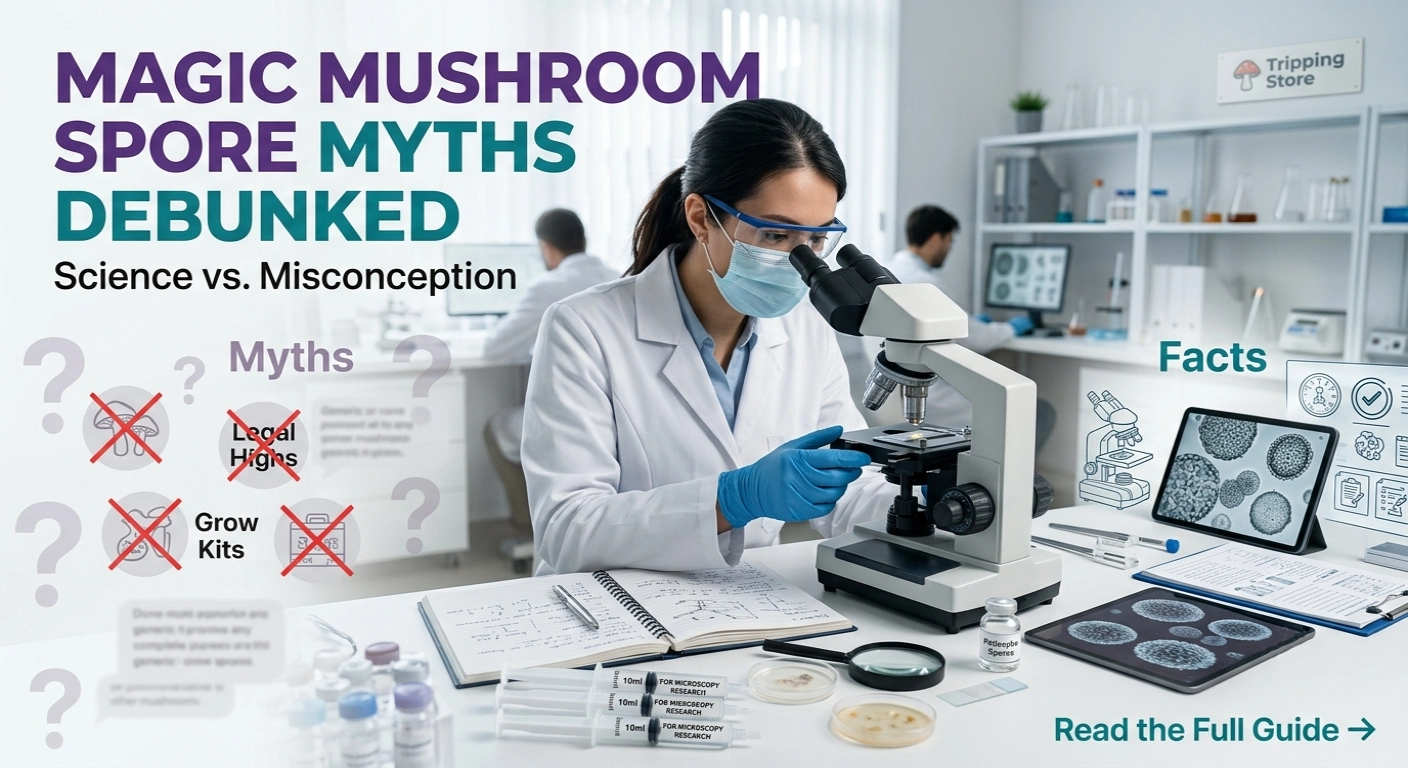
The most common mushroom spore myths are that spores are illegal in the UK (they're not — they don't contain psilocybin), that spores themselves are psychoactive (they aren't — psilocybin only develops as a mushroom fruits), and that all spore syringes are basically the same (they vary significantly in concentration, sterility, and genetic consistency). This guide works through the most persistent myths one by one, with the actual facts behind each.0%Psilocybin content in genuine spores
LegalSpore ownership status across the UK
7Myths covered in this guide
12–18moReal typical shelf life, stored correctly
Jump to a section
Myth 1: Spores Are Illegal
Myth 2: Spores Are Psychoactive
Myth 3: All Syringes Are the Same
Myth 4: Spores Never Expire
Myth 5: Strain Names Are Scientific
Myth 6: More Expensive Means Better
Myth 7: You Can Tell Strains Apart by Eye
FAQMyth 1: "Mushroom Spores Are Illegal in the UK"
| Myth | Reality |
|---|---|
| Spores are a controlled substance, like the mushrooms themselves | False — spores are legal to buy and own for microscopy research across the whole UK |
ℹ️ What Actually Is Illegal — Germinating spores and cultivating them into fruiting mushrooms containing psilocybin is illegal everywhere in the UK. It's the act of production, not the spores themselves, that the law targets.
Myth 2: "Spores Themselves Are Psychoactive"
| Myth | Reality |
|---|---|
| Handling or consuming spores produces psychoactive effects | False — spores contain no psilocybin or psilocin |
Myth 3: "All Spore Syringes Are Basically the Same"
| Myth | Reality |
|---|---|
| Any syringe labelled with a strain name is equivalent to any other | False — concentration, sterility, and genetic consistency vary significantly between suppliers |
Myth 4: "Spore Syringes Never Expire"
| Myth | Reality |
|---|---|
| Spores stay viable indefinitely regardless of storage | False — typical viable shelf life is 12–18 months under ideal conditions |
⚠️ Freezing Is a Common Mistake — Some assume freezing preserves spores longer, the way it does with some biological samples. In practice, ice crystal formation damages spore wall structure permanently. Refrigeration, not freezing, is correct.
Myth 5: "Strain Names Are Official Scientific Classifications"
| Myth | Reality |
|---|---|
| Golden Teacher, B+, Penis Envy etc. are separate species | False — all are cultivars of the same species, Psilocybe cubensis |
Myth 6: "More Expensive Always Means Better Quality"
| Myth | Reality |
|---|---|
| Price reliably indicates spore quality or concentration | Partly true, often misleading — price reflects many factors, not just quality |
Myth 7: "You Can Reliably Tell Strains Apart Just by Looking"
| Myth | Reality |
|---|---|
| Experienced researchers can identify strain from spore appearance alone | False — species-level features overlap heavily between strains |
Ready to Start Your Research?
Tripping Store's spore syringes are prepared under sterile conditions in the UK as double-density suspensions, with verified, tracked genetics — so what you order is what the science says it should be.Frequently Asked Questions
QAre mushroom spores actually legal in the UK?
Yes. Spores don't contain psilocybin or psilocin, so they're legal to buy and own for microscopy research across England, Scotland, Wales, and Northern Ireland.
QDo spores contain psilocybin?
No. Psilocybin and psilocin develop as a mushroom grows and fruits — spores themselves, as reproductive cells, contain neither compound.
QIs every spore syringe the same regardless of supplier?
No. Concentration, sterility practices, and genetic sourcing vary between suppliers, all of which affect the quality and reliability of your research material.
QDo spore syringes expire?
Yes, effectively. Stored correctly, they typically remain viable for 12–18 months, though poor storage — heat, light, or freezing — can shorten this significantly.
QShould I freeze spore syringes for longer storage?
No. Freezing causes ice crystals to form that permanently damage spore wall structure. Refrigeration at 2–8°C is correct, not freezing.
QAre Golden Teacher and B+ different species?
No. Both are cultivars of the same species, Psilocybe cubensis. Strain names are informal labels, not separate scientific classifications.
QCan I identify a strain just by looking at its spores?
Not reliably. Species-level features overlap heavily between cubensis strains. Some differences are detectable, but definitive identification needs documented provenance, not appearance alone.