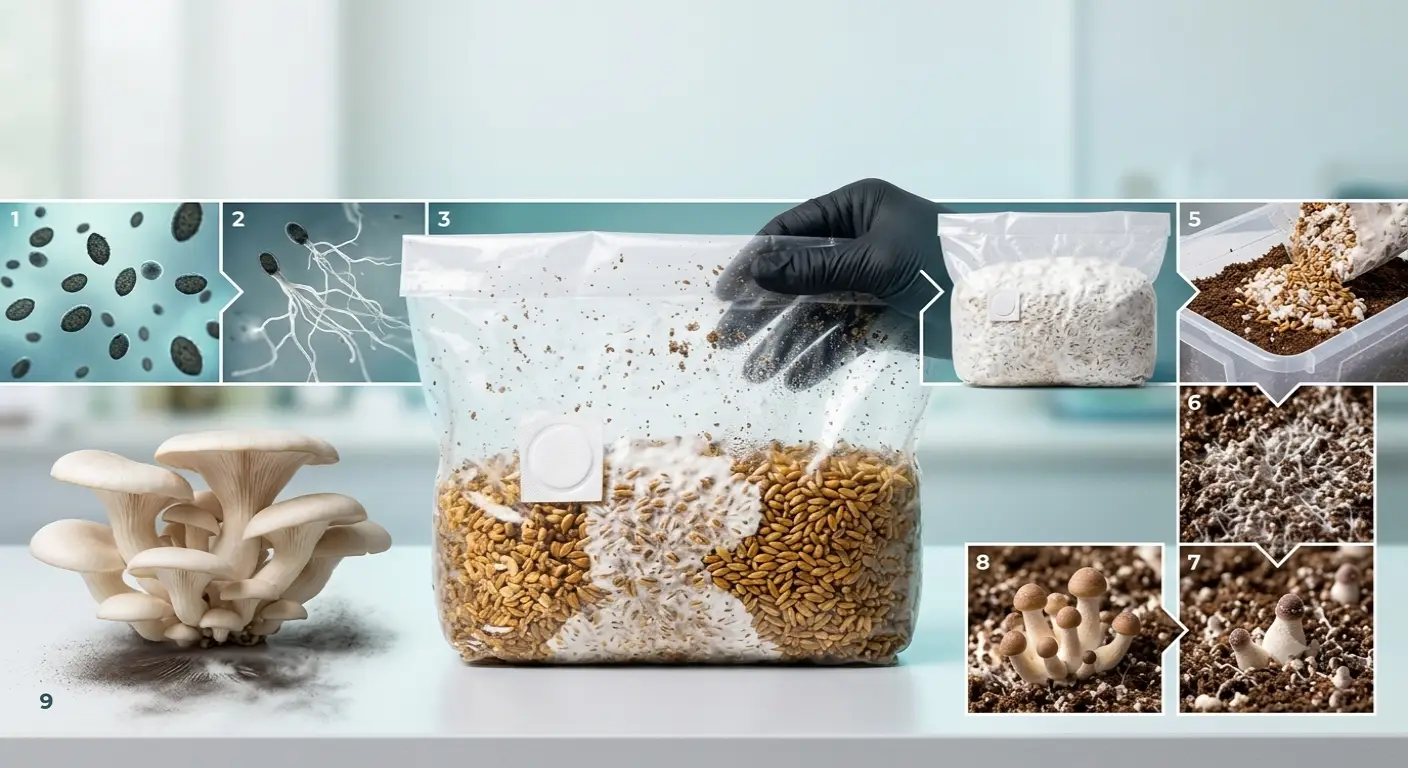
The mushroom life cycle has six key stages: spore dispersal, spore germination, hyphal growth, mycelium colonisation, primordia (pin) formation, and fruiting body maturation. The mushroom itself — what most people think of as “the fungus” — is only the final reproductive stage and lasts just a few days. The real organism is the mycelium: an invisible network of thread-like cells that grows through substrate, absorbs nutrients, and can persist for years. Understanding every stage of this cycle is fundamental to successful mushroom cultivation research.
When most people picture a mushroom, they picture the cap and stem — the familiar shape that appears above ground or on a log after rain. But that structure is only the very tip of the iceberg. The mushroom you see is a temporary reproductive organ, present for just a few days out of a life cycle that can span weeks, months, or even years.
The real story of a fungus happens underground, inside substrate, and at a microscopic level — in the vast, branching networks of mycelium that do all the work of nutrient absorption, growth, and reproduction. For anyone serious about mushroom cultivation research, understanding the complete life cycle is not optional background knowledge. It is the foundation everything else is built on.
This guide walks through every stage of the mushroom life cycle in detail — the biology behind each phase, what it looks like in practice, how it applies to cultivation, and what can go wrong at each step.
The Six Stages of the Mushroom Life Cycle
Before exploring each stage in detail, here is the complete cycle at a glance. Every stage flows into the next — and understanding where each one leads is what makes the whole system make sense.
🌬️ Spore Dispersal
A mature mushroom releases billions of microscopic spores from its gills into the surrounding environment. Spores are carried by wind, water, insects, and animals — travelling vast distances in search of a suitable substrate.
🌱 Spore Germination
A spore that lands on a nutrient-rich substrate in the right temperature and humidity conditions begins to germinate. The spore wall breaks open and the first hyphal cell emerges — the beginning of the organism’s growth.
🔬 Hyphal Growth & Mating
Germinated spores produce hyphae — microscopic thread-like filaments. Hyphae from compatible spores fuse together in a process called plasmogamy, forming dikaryotic (two-nuclei) mycelium capable of producing fruiting bodies.
🕸️ Mycelium Colonisation
Dikaryotic mycelium expands rapidly through the substrate, secreting enzymes that break down organic matter and absorbing the resulting nutrients. This is the colonisation stage — the longest and most critical phase of cultivation.
📍 Primordia Formation
Once colonisation is complete and environmental triggers are met (temperature drop, fresh air, light), the mycelium condenses into dense hyphal knots called primordia — commonly called “pins.” These are the first visible signs of baby mushrooms forming.
🍄 Fruiting Body Maturation
Selected pins develop into full fruiting bodies. The cap expands, gills form underneath, and the mushroom matures over 3–7 days. At maturity, the cap opens to release spores — completing the cycle and beginning the next generation.
Stage 1: Spore Dispersal — Where Every Life Cycle Begins
A fungal spore is the equivalent of a plant seed — a single-celled structure containing all the genetic material needed to produce the next generation of the organism. What makes spores remarkable is their sheer number and their resilience. A single mature Psilocybe cubensis cap can release anywhere from 10 million to several billion spores during its mature phase.
This massive overproduction is not waste — it is a survival strategy. The vast majority of spores will land in unsuitable conditions and never germinate. The few that find themselves on appropriate substrate with the right moisture, temperature, and nutrient availability are the ones that carry the species forward.
How Spores Are Dispersed
- Wind: The primary dispersal mechanism for most species. Spores are light enough to travel kilometres from the parent mushroom
- Water: Rainfall carries spores downward into soil; water flow spreads them laterally through substrates
- Animals and insects: Spores adhere to fur, feathers, and insect bodies, being carried to new locations
- Human activity: Spore syringes and prints allow deliberate introduction of specific genetics to controlled substrates — the cultivator’s equivalent of nature’s dispersal
Spore Morphology and Viability
Spores vary significantly between species in size, shape, pigmentation, and wall thickness. In Psilocybe cubensis, spores are oval (some slightly angular face-on), brown to purple-brown under the microscope, and about 11.5–17 µm long and 6–11.5 µm wide (Singer & Smith, 1958; Batista et al., 2025), characteristics that are central to microscopy-based species identification.
Spore viability — the ability to germinate successfully — declines over time. Properly stored spore syringes (2–8°C, away from light) remain viable for 12–18 months. Spore prints stored dry and cool can retain viability for several years. Temperature extremes, UV light, and freeze-thaw cycles all accelerate viability loss. For full guidance see our Storage & Shelf Life guide.
Psilocybe cubensis spores do not contain psilocybin or psilocin and are legal to purchase in the UK for microscopy and taxonomic research purposes. The controlled compounds only develop during germination and mycelial growth. Tripping Store sells spore syringes for lawful microscopy research only. See our 2026 UK Legal Guide for full details.
Stage 2: Spore Germination — The Critical First Step
Germination is the transition from dormant spore to active organism — and it is the most uncertain stage in the entire life cycle. A spore can remain dormant for years, waiting for the right conditions. When those conditions arrive, germination begins within hours.
Conditions Required for Germination
| Factor | Required Condition | Effect if Wrong |
|---|---|---|
| Temperature | 24–26°C optimal | Below 18°C: dormancy. Above 28°C: spore damage |
| Moisture | Substrate at field capacity | Too dry: no germination. Too wet: bacterial competition |
| Nutrients | Organic substrate present | No nutrients: germination fails within days |
| Oxygen | Aerobic environment | Anaerobic conditions inhibit hyphal development |
| Competition | Low contamination pressure | Competing organisms outpace germinating spore |
In cultivation, this stage corresponds to the period immediately after inoculation — typically days 1–7. No visible growth is normal during this window. The spore is metabolically active but the hyphal structure is too small to see without magnification. Resist the urge to disturb the bag during this phase.
Stage 3: Hyphal Growth and Mating
Once germination occurs, the spore begins producing hyphae — the fundamental structural unit of all fungi. A single hypha is a microscopic, tube-like cell approximately 2–10 micrometres in diameter, growing exclusively from its tip in a process called apical extension.
Individual hyphae branch constantly as they grow, forming an increasingly dense network. But here is where the biology gets interesting: a single germinated spore produces monokaryotic hyphae — containing only one set of nuclei and incapable of producing fruiting bodies on their own.
Plasmogamy: The Mating Event
For the life cycle to progress to fruiting, two compatible monokaryotic hyphae must find each other and fuse — a process called plasmogamy. Not all hyphae are compatible. Fungi have complex mating systems; in many species, including Psilocybe cubensis, there are multiple mating types and only compatible types can fuse successfully.
When compatible hyphae fuse, the resulting mycelium becomes dikaryotic — containing two sets of nuclei per cell (one from each parent). Dikaryotic mycelium is the fertile form capable of eventually producing fruiting bodies. This is why growing from a single spore will often not produce fruiting bodies — you need genetic diversity from multiple compatible spores, which is exactly what a well-prepared spore syringe provides.
This is why spore syringes contain thousands to millions of spores rather than just a few. The high density ensures that compatible mating types encounter each other quickly within the substrate, accelerating the transition to fertile dikaryotic mycelium and reducing the time to visible colonisation.
Stage 4: Mycelium Colonisation — The Engine of Growth
Dikaryotic mycelium is the workhorse of the fungal life cycle. Once established, it grows at an exponential rate — a single mycelial network can colonise an entire grain bag within 2–4 weeks under optimal conditions at 24–26°C.
How Mycelium Feeds
Unlike animals, fungi cannot ingest food. Instead, mycelium uses a process called extracellular digestion: it secretes enzymes directly into the surrounding substrate that break down complex organic compounds (cellulose, lignin, starches, proteins) into simple sugars and amino acids. These molecules are then absorbed directly through the hyphal walls.
This is why substrate choice matters so much. Different fungi have evolved to digest different substrates — Psilocybe cubensis evolved on manure-based substrates rich in partially digested plant matter, which is why dung-master bags and coco coir/vermiculite mixes work so well as cultivation substrates.
What Healthy Colonisation Looks Like
- Colour: Bright white throughout — fluffy (tomentose) or rope-like (rhizomorphic)
- Smell: Fresh, earthy, mushroom-like through the filter
- Progress: Visibly advancing day by day in correct temperature conditions
- Condensation: Light moisture on bag walls — normal metabolic water production
For a complete guide to diagnosing colonisation problems — including stalled growth, contamination, and temperature issues — see our Mycelium Growth Patterns guide.
The Life Cycle in Nature vs In Cultivation
The biology is identical — but the cultivator’s role is to compress, optimise, and control what nature does slowly and unpredictably.
- Spores disperse randomly — billions land in unsuitable locations
- Germination depends on seasonal rainfall and temperature
- Mating occurs wherever compatible spores happen to land nearby
- Colonisation competes with hundreds of rival organisms
- Fruiting triggered by seasonal changes over months
- Full cycle can take 6–12+ months in natural conditions
- Spores delivered directly to sterilised substrate via syringe
- Temperature maintained at optimal 24–26°C year-round
- Millions of compatible spores in every syringe ensure rapid mating
- Pre-sterilised substrate eliminates competitive contamination pressure
- Fruiting triggered deliberately by temperature drop and FAE
- Full cycle compressed to 6–10 weeks under controlled conditions
Stage 5: Primordia Formation — Pins Appear
After colonisation is complete, the mycelium does not immediately fruit. It first enters a consolidation phase — thickening, strengthening its network, and waiting for specific environmental triggers that signal it is safe and appropriate to reproduce.
The Environmental Triggers for Pinning
In nature, fruiting is triggered by seasonal changes. In cultivation, the cultivator replicates these signals deliberately:
- Fresh air exchange: The real fruiting cue is increasing airflow to lower CO₂ — no temperature drop is needed, since 24–27°C works constantly through colonisation and fruiting
- Fresh air exchange (FAE): Increasing air flow drops CO₂ levels, which were elevated during colonisation. Low CO₂ is a critical pin trigger
- Light: Indirect light (12 hours per day) helps orient pin direction and stimulates formation — though it is less critical than temperature and FAE
- Humidity: High relative humidity (90–95%) prevents the developing pins from drying out
When these conditions align, the mycelium condenses into dense hyphal knots at the substrate surface — areas of intensified growth where hyphae intertwine tightly. These hyphal knots develop into primordia, commonly called pins: small, rounded protrusions that are the first visible sign of baby mushrooms.
Pins that form but stop developing before reaching maturity are called aborts. The most common causes are humidity fluctuation, CO₂ build-up from insufficient FAE, and temperature swings. Aborts are normal in small numbers — a flush that aborts entirely usually indicates a persistent environmental issue worth correcting before the next flush.
Stage 6: Fruiting Body Maturation — The Final Stage
From the hundreds or thousands of primordia that initially form, fruiting body selection takes place — only the most vigorous pins, typically those with the best position and nutrient access, develop into full fruiting bodies. The rest abort and are reabsorbed by the mycelium.
This selection process is not random. It reflects the fungus prioritising quality over quantity — investing resources in the specimens most likely to successfully disperse spores and propagate the next generation.
The Development Sequence
- Pin formation — small round primordia appear at the substrate surface
- Stem elongation — the stipe (stem) extends rapidly as cells fill with water
- Cap development — the pileus (cap) forms and expands outward, initially dome-shaped
- Veil present — a partial veil covers the gills in young mushrooms, protecting developing spore surfaces
- Veil tearing — as the cap flattens and expands, the veil tears away from the cap edge, leaving the annulus (ring) on the stem
- Gill exposure — gills become fully exposed and begin releasing spores
- Spore release — billions of spores are released, completing the cycle
The entire sequence from visible pin to mature spore-releasing mushroom takes 3–7 days depending on species, temperature, and humidity. This is why fruiting bodies are considered ephemeral — the mushroom exists for a remarkably short time relative to the mycelium that produced it.
Harvesting Timing
In cultivation research, the optimal harvest window is just before or at veil tear — when the cap has flattened but before the veil fully separates. At this stage the mushroom is at its most developed but has not yet dropped its spore load into the substrate, which can trigger contamination and reduce subsequent flush yield.
Multiple Flushes: The Life Cycle Continues
One of the most fascinating aspects of mushroom cultivation is that a single colonised substrate block can produce multiple successive flushes — not because the life cycle restarts, but because the mycelium survives the fruiting event and continues to hold nutrients in reserve.
After the first harvest, the mycelium rehydrates, reconsolidates, and — given continued correct conditions — will initiate another round of pin formation. Most cultivated cubensis blocks produce up to 3 flushes (sometimes more, depending on remaining nutrition) before the substrate is exhausted, though highly productive genetics on nutrient-dense substrates can yield more.
Between flushes, rehydration is key. Soaking the block in water for 12 hours at room temperature replenishes moisture lost during the first flush and helps trigger the next pinning event by temporarily lowering substrate temperature — mimicking a rainfall event in nature.
Tripping Store stocks everything you need for mushroom cultivation research — from spore syringes and all-in-one grow bags to grain spawn, substrates, and heat mats.
Frequently Asked Questions
The mushroom life cycle has six distinct stages: spore dispersal, spore germination, hyphal growth and mating, mycelium colonisation, primordia (pin) formation, and fruiting body maturation. The cycle is continuous — each mature fruiting body releases spores that begin the next cycle. In cultivation, the focus is primarily on stages 2–6, with the cultivator controlling environmental conditions at each phase to optimise growth speed and yield.
Mycelium is the main body of the fungus — a vast, branching network of microscopic thread-like cells (hyphae) that grows through substrate, secretes enzymes to digest organic matter, and absorbs nutrients. It is the permanent, persistent part of the organism. A mushroom (fruiting body) is a temporary reproductive structure produced by the mycelium when environmental conditions are right. It exists only to release spores and typically survives for just 3–7 days. The mycelium that produced it can live for years.
In natural conditions the full cycle varies enormously by species and environment — from weeks to months. In controlled cultivation, the cycle is dramatically compressed. From inoculation to first harvest typically takes 4–6 weeks at 24–27°C: approximately 1 week for germination, 2–4 weeks for colonisation, 1 week for pinning and fruiting body development. Slower-colonising strains or lower temperatures extend this timeline.
Primordia (singular: primordium) are the earliest visible stage of mushroom development — tiny dense knots of mycelium that form when colonisation is complete and environmental fruiting triggers are met. Cultivators call them “pins.” They matter because they represent the transition from colonisation to fruiting: their appearance confirms that colonisation was successful and that conditions are correct for the next phase. If pins form but abort rather than develop, it usually signals a humidity, CO₂, or temperature problem worth addressing before the next flush.
Fruiting is triggered by environmental signals that mimic natural seasonal changes. The three key triggers in cultivation are: increased fresh air exchange which lowers CO₂ levels, high humidity (90–95% relative humidity), and indirect light exposure — no temperature drop is needed, since 24–27°C works constantly through both colonisation and fruiting. Of these, CO₂ reduction is the most important. Without these triggers, fully colonised substrate can remain vegetative (mycelium only) indefinitely.
Most cultivated Psilocybe cubensis bags produce up to 3 flushes (sometimes more, depending on remaining nutrition) before the substrate is fully exhausted. The first flush is typically the largest. Subsequent flushes are often progressively smaller as substrate nutrients deplete. Between flushes, rehydrating the block by soaking in water for 12 hours at room temperature replenishes moisture and helps trigger the next pinning event. Highly nutrient-dense substrates and vigorous genetics can produce more flushes, though yield per flush will decline.
Dikaryotic mycelium is mycelium that contains two sets of nuclei per cell — one from each of two compatible parent spores. It forms when hyphae from compatible spores fuse in a process called plasmogamy. Dikaryotic mycelium is the only form capable of producing fruiting bodies. Monokaryotic mycelium (from a single spore) grows but cannot fruit. This is why spore syringes contain large numbers of spores — ensuring that compatible mating types encounter each other quickly within the substrate and form fertile dikaryotic mycelium.
Psilocybe cubensis evolved on manure-based substrates in subtropical environments. In cultivation, it performs well on a range of substrates. Grain-based bags (rye, millet, wheat berry) colonise fastest because the mycelium can quickly access readily available starches. All-in-one BRF (brown rice flour) bags are forgiving for beginners. Bulk substrates like coco coir with vermiculite are popular for fruiting. Tripping Store’s range of grow bags and kits covers all major substrate types at various sizes.