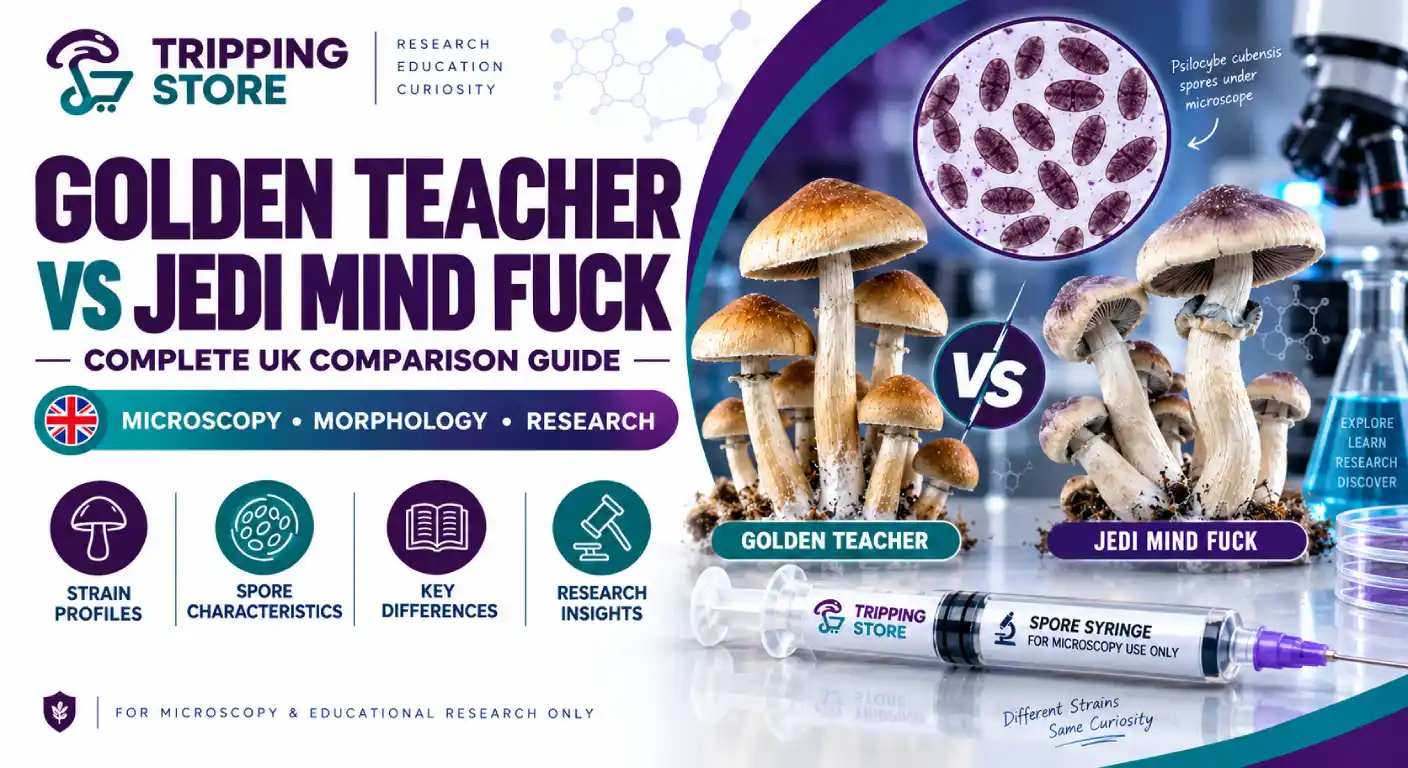
Golden Teacher and Jedi Mind Fuck (JMF) are both Psilocybe cubensis strains, and under the microscope their spores can’t be told apart. Both fall in the normal species range of about 11.5–17 µm long and 6–11.5 µm wide (Singer & Smith, 1958; Batista et al., 2025), and no published study has compared spores between strains. The real differences are in the mushrooms: Golden Teacher’s caps open wide and drop heavy spore prints, while JMF is known for more variety in cap colour, size and shape from one mushroom to the next. Golden Teacher is the usual first strain; JMF is best studied second, once you’re comfortable with the basics.
Golden Teacher and Jedi Mind Fuck are two of the most frequently discussed Psilocybe cubensis strains in UK mycology research circles — and also two of the most commonly compared. Both are dark-spored cubensis varieties, and under the microscope their spores look alike. The differences are in the mushrooms and in where each strain fits in your study: Golden Teacher as the standard reference strain, JMF as a strain known for variable mushrooms.
This guide compares both strains across everything that matters for microscopy research — spore appearance, spore production, genetic background, microscopy technique and research value. We also explain why the microscope setup is the same for both, and give a clear verdict on who should study each one.
Golden Teacher vs Jedi Mind Fuck: At-a-Glance Comparison
| Feature | 🟢 Golden Teacher | 🟣 Jedi Mind Fuck |
|---|---|---|
| Species | Psilocybe cubensis | Psilocybe cubensis |
| Origin | 1980s — Southeast Asia / Central America | 2000s — North American mycology community |
| Spores under the microscope | Standard P. cubensis — can’t be told apart | Standard P. cubensis — can’t be told apart |
| Spore Drop (from the mushroom) | Very High | Moderate |
| Mushroom Variety | Typical for P. cubensis | Known for variable cap colour, size and shape |
| Genetic Stability | Very stable | Stable with phenotypic expression |
| Microscopy Difficulty | Beginner | Intermediate |
| Best Research Use | Baseline, taxonomy, skill-building | Second-strain comparison with GT |
| UK Availability | Widely available | Widely available |
Individual Strain Profiles
Golden Teacher: Why It Is the Universal Starting Point
Golden Teacher has been the go-to reference strain for microscopy education since the 1980s, and that reputation is fully deserved. Its heavy natural spore drop and the amount of guidance available for it make it a practical first strain for learning.
The caps open fully and flatten at maturity, releasing large quantities of dark purple-brown spores directly onto the print surface. This makes print collection straightforward. It doesn’t change the syringe: every Tripping Store syringe has the same concentration, whatever the strain, because it’s set by how many spore prints go into each batch.
What Golden Teacher Looks Like Under the Microscope
At 400x magnification on a standard brightfield microscope, Golden Teacher spores present as textbook Psilocybe cubensis:
- Shape: Ellipsoid in side view, and some look slightly six-sided face-on (Batista et al., 2025), with the small natural variation you’d expect in any P. cubensis sample
- Size: about 11.5–17 µm long and 6–11.5 µm wide, the species range (Singer & Smith, 1958; Batista et al., 2025)
- Colour: brown to purple-brown, depending on lighting and mounting liquid — good contrast under standard brightfield
- Wall: Smooth — the same as any P. cubensis spore
- Germ pore: Visible at 1000x oil immersion, as on any P. cubensis spore
- Apiculus: Distinct attachment point, well-defined
Golden Teacher spores look like any other P. cubensis spores, with a little natural variation from spore to spore. What makes it good for skill-building is familiarity: it’s the usual first strain, so it’s the easiest one to compare your own slides and notes against while you learn to tell normal variation from a preparation error.
✅ Research TipA Golden Teacher slide makes a useful reference slide when you start a new strain. Because P. cubensis spores look alike across strains, a clear difference between your two slides usually points to preparation or lighting rather than the strain.
Jedi Mind Fuck: The Variable-Mushroom Strain
Jedi Mind Fuck (JMF) emerged in North American mycology communities in the 2000s and quickly gained a distinct reputation — not for any single dramatic physical characteristic, but for variety in its mushrooms: cap colour, size and shape can differ noticeably from one fruiting body to the next.
That variety belongs to the mushrooms, not the spores. The scientific term is phenotypic plasticity: the same genetics can look noticeably different depending on conditions. No published study has compared JMF with other strains on this, and none has compared spores between strains. Under the microscope, JMF spores look like any other P. cubensis spores.
The Name — And Why It Does Not Affect the Science
The name “Jedi Mind Fuck” is a cultural label from the underground mycology community, and like all informal cubensis variety names, it is not a taxonomic designation. Under scientific classification, JMF spores are Psilocybe cubensis — the same species as Golden Teacher, B+, Blue Meanies, and every other cubensis strain. The name tells you nothing about the spores: JMF spores share the same species-level characteristics as every other cubensis strain.
What JMF Looks Like Under the Microscope
- Shape: Ellipsoid in side view, and some look slightly six-sided face-on (Batista et al., 2025), with the same small natural variation as any P. cubensis sample
- Size: about 11.5–17 µm long and 6–11.5 µm wide, the species range; there are no published measurements for JMF on its own
- Colour: brown to purple-brown, the same as Golden Teacher — good brightfield contrast
- Wall: Smooth — similar profile to standard cubensis
- Germ pore: Visible at 1000x oil immersion, as on any P. cubensis spore
- Compared with GT: No reliable difference — a JMF slide and a GT slide look alike
ℹ️ Why Natural Variation MattersIn mycology, phenotypic expression — how genetic variation shows up physically — is an important area of study. In P. cubensis it shows up in the mushrooms, which is where JMF’s reputation comes from. On a slide, JMF and Golden Teacher spores show the same small spore-to-spore variation that is normal for the species.
Head-to-Head: Microscopy Characteristics
🟢 Golden Teacher
🟣 Jedi Mind Fuck
⚠️ Important Diagnostic NoteGolden Teacher and Jedi Mind Fuck cannot be reliably distinguished by spore microscopy alone. Both share the same species-level morphological characteristics of Psilocybe cubensis. Definitive strain identification requires documented provenance and genetic sequencing — not visual spore observation. Both strains show the same small spore-to-spore variation that is normal for the species.
Microscopy Setup: What Each Strain Needs
Both strains use exactly the same setup on a standard brightfield microscope, so the notes below apply to either one.
For Golden Teacher
- Magnification: 400x is sufficient for routine observation. 1000x oil immersion for germ pore detail and precise measurement
- Illumination: Standard brightfield — excellent contrast without adjustment
- Slide prep: 1–2 drops from syringe on clean slide, distilled water, coverslip at angle. Straightforward every time
- What to document: Spore length, width, shape class, germ pore position
For Jedi Mind Fuck
- Magnification: The same as GT — 400x for routine observation, 1000x oil immersion for detail and measurement
- Illumination: Standard brightfield — same as GT
- Slide prep: Same method as GT
- What to document: The same as GT — measure 15–20 spores per slide and note shape class, length and width for each
✅ Best Practice: Study Both TogetherA useful exercise is to prepare a Golden Teacher slide and a JMF slide in the same session and compare them side by side. You’ll find the spores look alike, which shows an important principle in mycology: strains of the same species are told apart by their mushrooms and their documented provenance, not by their spores.
Research Value: Which Strain Should You Choose?
Matching the Strain to Your Research Goals
The right choice depends entirely on where you are in your microscopy journey and what you want to study.
Choose Golden Teacher if you…
- Are new to cubensis microscopy
- Are building and refining slide preparation technique
- Need a reliable baseline reference for other strains
- Want a familiar reference strain to check your results against
- Are calibrating your microscope’s measurement accuracy
- Are building a teaching or reference collection
- Want the most extensively documented cubensis specimen
Choose JMF if you…
- Have solid slide preparation technique already
- Are interested in a strain known for variable mushrooms
- Want a second strain to compare against GT
- Are comfortable measuring and documenting spores
- Want to broaden your strain collection
- Are comparing strain characteristics across a collection
UK Legal Context: Purchasing Spores for Microscopy
- Psilocybin and psilocin are Class A controlled substances under the Misuse of Drugs Act 1971
- Spores of Psilocybe cubensis do not contain psilocybin or psilocin — these compounds only develop during germination
- Spores are legal to purchase, possess, and study in the UK for microscopy and taxonomic research only
- Any intent to cultivate fruiting mushrooms from spores is illegal
- Both Golden Teacher and Jedi Mind Fuck spore syringes are sold at Tripping Store for lawful microscopy research only
For a full breakdown of current UK law, see our 2026 UK Psilocybin Law Guide.
Both syringes are prepared under sterile conditions at Tripping Store from verified genetics — giving you the clearest, most reliable starting point for your research.
Frequently Asked Questions
Under the microscope, there isn’t a reliable one. Both are Psilocybe cubensis, and their spores share the same size range (about 11.5–17 µm long and 6–11.5 µm wide; Singer & Smith, 1958; Batista et al., 2025), the same shape and the same brown to purple-brown colour. No published study has compared spores between strains. The differences are in the mushrooms: Golden Teacher’s caps open wide and drop heavy spore prints, while JMF is known for more variety in cap colour, size and shape. Every Tripping Store syringe has the same concentration, whatever the strain.
No. Both belong to Psilocybe cubensis and share the same species-level characteristics — brown to purple-brown colour, an ellipsoid shape, a smooth wall and a visible germ pore — and both show the same small spore-to-spore variation that is normal for the species. Telling the strains apart needs documented provenance or genetic testing; microscopy shows you the species, not the strain.
Golden Teacher. The spores of both strains look alike, so the reason isn’t what you’ll see on the slide. Golden Teacher is the standard reference strain and the usual first choice, which makes it the easiest to compare your own slides and notes against while you learn. Start with Golden Teacher and add JMF once your skills are established.
For routine observation of both strains, 400x brightfield magnification is sufficient to see spore shape, pigmentation, and general morphology. For detailed work — measuring spore dimensions accurately and observing the germ pore — 1000x oil immersion gives the best results. The same settings work for both strains.
Yes — for microscopy research purposes. Psilocybe cubensis spores, including JMF, do not contain psilocybin or psilocin and are legal to purchase and possess in the UK for microscopy and taxonomic study. Purchasing spores with the intent to cultivate fruiting mushrooms is illegal under the Misuse of Drugs Act 1971. Tripping Store sells JMF spore syringes for lawful microscopy use only. See our full UK legal guide.
A germ pore is a thin-walled region at one end of the spore where germination initiates. It is a species-level characteristic of Psilocybe cubensis and is present in both Golden Teacher and JMF spores. Visibility depends on magnification, focus depth, and illumination. At 1000x oil immersion with good Köhler illumination, the germ pore is visible on both Golden Teacher and JMF spores in the same way. It is not a strain-differentiating feature.
Store all spore syringes at 2–8°C in a refrigerator, in a sealed sterile bag with the needle cap attached, away from direct light. Never freeze — ice crystal formation damages spore walls. Bring to room temperature and agitate gently before each use. Properly stored syringes remain viable for 12–18 months. For long-term collection preservation, spore prints stored in cool, dry, dark conditions can remain viable for several years. See our Storage & Shelf Life guide.
JMF is an independently stabilised Psilocybe cubensis strain without a well-documented hybrid lineage — unlike Tidal Wave (B+ × Penis Envy, bred by Doma Nunzio of Magic Myco) or Bluey Vuitton, which have known parent strains. JMF’s reputation comes from its mushrooms, not from a documented lineage. It is, however, an excellent comparative specimen alongside Tidal Wave for researchers interested in how different cubensis varieties express phenotypic variation.