Mushroom Grow Bag
Temperature —
Master the Perfect 24–27°C Range
One number controls everything about your grow: the temperature inside your bag.
Why Temperature Is the #1 Factor in Your Grow
If you only control one thing in your mushroom grow setup, make it temperature. Not humidity. Not light. Not airflow. Temperature.
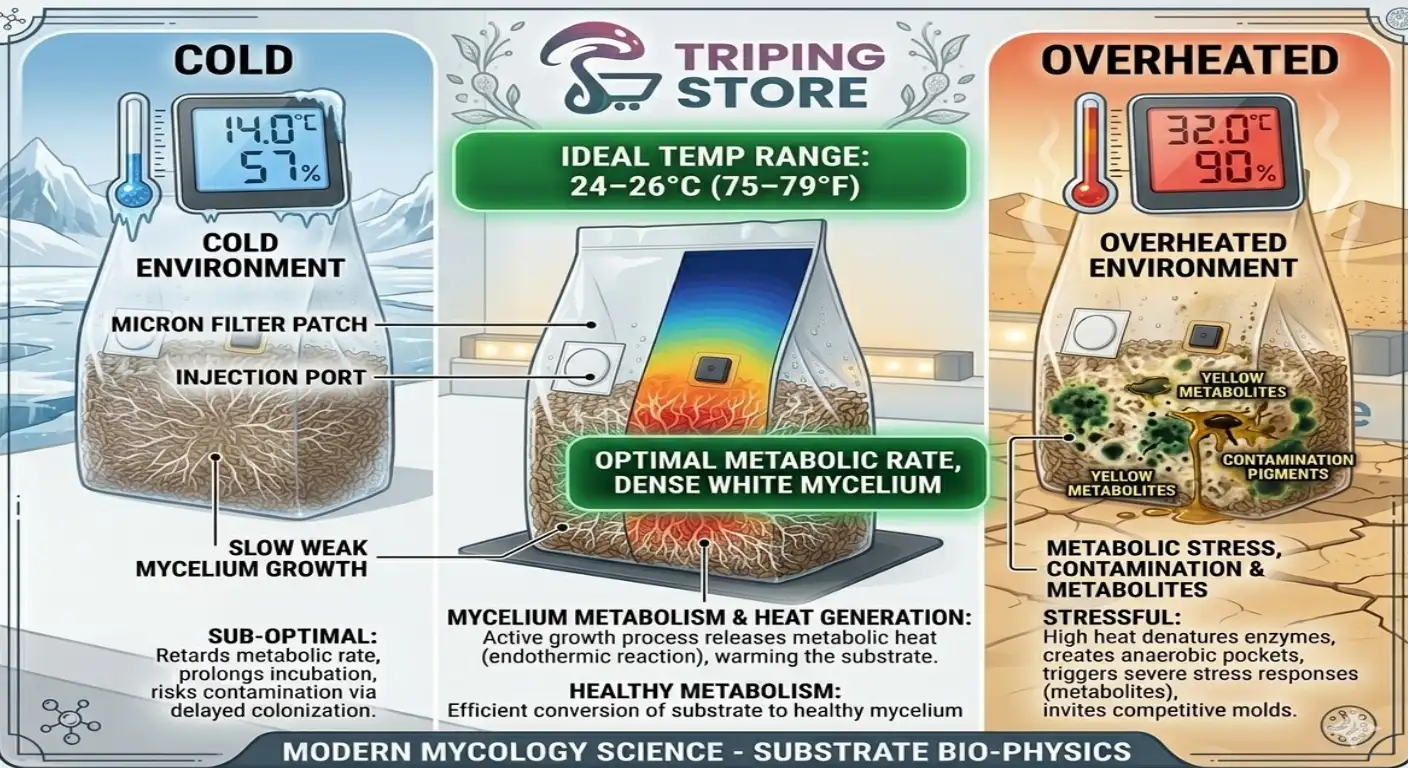
Here’s why: temperature directly controls how fast your mycelium metabolises — how quickly it spreads, how strongly it competes against mould and bacteria, and whether your grow bag becomes a clean white block of healthy fungus or a contaminated write-off.
The 24–27°C range isn’t a rough guide — it’s the result of real-world grow performance data, and it applies across all three stages of your grow. That’s what makes it such powerful knowledge: you don’t need a different setup for each phase.
Ideal Temperature by Growth Stage
The best part about the 24–27°C range is how consistent it is. You don’t need to crank it up for one phase and dial it down for another. A stable environment at this temperature works throughout your entire grow — from the moment you inoculate to the day you harvest.
| Stage | Target Temp | What Happens | Result |
|---|---|---|---|
| Inoculation | 24–27°C | Spores / liquid culture activate quickly in the substrate | Fast, clean initial colonisation |
| Colonisation | 24–27°C | Mycelium spreads aggressively through the bag | Dense white growth, low contamination window |
| Fruiting | 24–27°C | Pins form and develop into full mushrooms | Stable pinning, higher yield, thicker stems |
| Risk Zone | >27°C | Metabolic stress, bacteria thrive, mould spreads fast | Contamination — bag likely lost |
Why 24–27°C Is the Gold Standard
You might be wondering — why this specific range? There are four practical reasons this window consistently outperforms everything else:
1. Faster Mycelium Expansion
Mycelium has an optimal metabolic temperature — the point where enzyme activity is most efficient. At 24–27°C, the mycelium network spreads at its fastest sustainable pace. It’s not sprinting so hard that it overheats (more on that below), but it’s moving quickly enough to outpace competing organisms.
2. Lower Contamination Pressure
Most harmful moulds and bacteria — the ones that ruin grow bags — also prefer warm environments, but they need time to establish. When your mycelium colonises quickly at 24–27°C, it physically occupies the substrate before contamination can take hold. Speed is your best defence.
3. Perfect Moisture Balance
Temperature and humidity inside a grow bag are directly linked. Too hot and the substrate dries out from the inside. Too cold and you get excess condensation pooling at the bottom. At 24–27°C, internal humidity stays stable without intervention.
4. Faster Harvest Cycles
Growers consistently report 20–30% faster production cycles at this temperature compared to growing at ambient UK room temperatures (typically 18–21°C in winter). Over multiple flushes, that adds up to significantly more mushrooms in the same timeframe.
The Hidden Science: Mycelium Generates Its Own Heat
This is the bit that surprises most beginners — and understanding it will save you from a common mistake that catches even experienced growers out.
Mycelium is a living organism, and like all living organisms, it generates heat as a byproduct of metabolism. This process is called thermogenesis, and it means the temperature inside your grow bag will always be higher than the room around it — especially during active colonisation when metabolic activity peaks.
Temperature Danger Zones Explained
Knowing the sweet spot is only half the picture. Understanding what happens outside it — and why — helps you respond quickly if something goes wrong.
- Colonisation slows dramatically or stalls
- Mycelium growth becomes weak and patchy
- Longer window for contamination to establish
- Pins may fail to form in fruiting phase
- Extended timelines — weeks instead of days
- Yellow or brown metabolite secretions appear
- Sour or unusual smell from the bag
- Mould spreads rapidly through the substrate
- Mycelium may die back from heat stress
- Bag is usually unrecoverable — start again
How to Maintain Perfect 24–27°C at Home
This is where most beginners struggle — and where success is genuinely decided. Knowing the right temperature is easy. Maintaining it consistently through a UK winter, in a spare room, is the actual challenge.
The good news: you don’t need expensive professional equipment. Two solutions cover the vast majority of home grows:
Seedling Heat Pad
- Gentle, steady warmth from below
- Prevents slow colonisation in cooler UK homes
- Low cost, low complexity to set up
- Works well for 1–4 bags at a time
- High-quality pads tested for even heat distribution can be used with bags placed directly on top
Heat Box / Grow Chamber
- Creates a fully controlled micro-climate
- Eliminates external temperature swings
- Prevents condensation spikes between day/night
- Handles multiple bags simultaneously
- Closest setup to commercial cultivation conditions
⚠️
Important: Not All Heat Pads Are Equal
Whether you can place your grow bag directly on a heat pad depends entirely on the quality of the pad. Here’s the honest truth:
Cheap or low-quality heat pads distribute heat unevenly — they create hot spots concentrated at the base of your bag. This can push the bottom of the substrate well above 30°C while the top sits at 22°C. That kind of uneven heat is worse than no heat at all. With pads like these, always use a cardboard buffer, a tray, or an enclosed heat box to separate the bag from the surface.
High-quality seedling heat pads — like the ones we sell here at Tripping Store — are specifically tested for even heat distribution across the entire surface. Because of this, we do tell our customers that it’s fine to place their grow bags directly on top of the heat pads we stock. That said, we always recommend being cautious: monitor your bag temperatures, especially during the active colonisation phase when thermogenesis adds internal heat on top of whatever your pad is providing.
Stage-by-Stage Temperature Behaviour
While the target range stays consistent throughout your grow, what’s happening inside the bag is very different at each stage. Understanding this helps you anticipate — and avoid — problems before they appear.
Frequently Asked Questions
The ideal mushroom grow bag temperature is 24–27°C (75–79°F) for all stages — inoculation, colonisation, and fruiting. This range delivers the fastest mycelium growth with the lowest contamination risk. Stability within this range matters more than hitting an exact number.
Yes — but at typical UK room temperatures of 18–21°C, growth slows significantly. Colonisation takes longer, and the extended timeline gives contamination more opportunity to establish. Raising to 24°C makes a noticeable difference to speed and success rate, especially in winter.
Condensation inside a grow bag is almost always caused by temperature fluctuations — warm periods followed by cooler periods create moisture that can't escape. This can pool at the bag base and create anaerobic (airless) zones where contamination thrives. A stable 24–27°C environment significantly reduces condensation. If your room temperature swings significantly between day and night, a heat box or insulated setup will help.
Yes — a heat pad is an excellent and affordable way to maintain stable warmth, especially in cooler homes during UK autumn and winter. Whether you can place bags directly on the pad depends on the quality of the pad. High-quality seedling heat pads tested for even heat distribution — like those we sell at Tripping Store — are safe to place bags on directly. Cheap or untested pads can create hot spots at the bag base, so with those you should always use a cardboard buffer or tray. When in doubt, add a layer and monitor your temperatures closely.
Yes. Temperature is the more fundamental variable because it directly controls metabolic speed — how fast your mycelium grows and how strongly it competes against contamination. Humidity supports surface conditions (especially important during fruiting) but cannot compensate for incorrect temperature. Get the temperature right first, then worry about humidity.
Yellow patches or secretions (called metabolites) on mycelium are a stress response — the mycelium secreting compounds in reaction to unfavourable conditions. The most common cause is overheating above 27°C. Check your environment temperature immediately. Small yellow patches caught early can sometimes resolve if conditions are corrected, but widespread yellowing is usually a sign the bag is compromised.
Sources & Further Reading
- Stamets, P. — Mycelium Running: How Mushrooms Can Help Save the World. Ten Speed Press. Temperature and metabolic rate of fungal growth.
- Chang, S.T. & Miles, P.G. — Mushrooms: Cultivation, Nutritional Value, Medicinal Effect, and Environmental Impact. CRC Press. Stage-by-stage cultivation parameters.
- Tripping Store UK — Resource Hub. Step-by-step guides for our grow bags and monotub kit.