What Is Psilocybin?
Psilocybin is a naturally occurring psychedelic compound found in certain mushroom species. It belongs to the tryptamine class of compounds — the same broad family as serotonin — which explains why it interacts with the brain’s serotonin receptors and has become such a significant subject of neurological research.
Johns Hopkins Medicine describes it as a naturally occurring psychedelic found in “magic mushrooms,” while Imperial College London’s Centre for Psychedelic Research studies psilocybin specifically in relation to how psychedelic drugs act in the brain and their potential clinical utility.
In educational and scientific writing, psilocybin is discussed across three distinct contexts: mushroom biology (which species produce it and why), neuroscience research (how it interacts with brain chemistry), and drug law (its controlled status in the UK and internationally). This guide covers all three.
Where Does Psilocybin Occur in Nature?
Psilocybin is primarily associated with mushroom species within the genus Psilocybe. However, it is also documented — in taxonomic and educational mycology contexts — within other genera including Panaeolus, Gymnopilus, and Pluteus.
🍄 Key Distinction for Foragers & Students
Most mushrooms do not contain psilocybin. The compound is present only in specific species across a small number of genera. Scientific and safety writing must not treat all fungi as chemically equivalent — doing so creates dangerous misidentification risk.
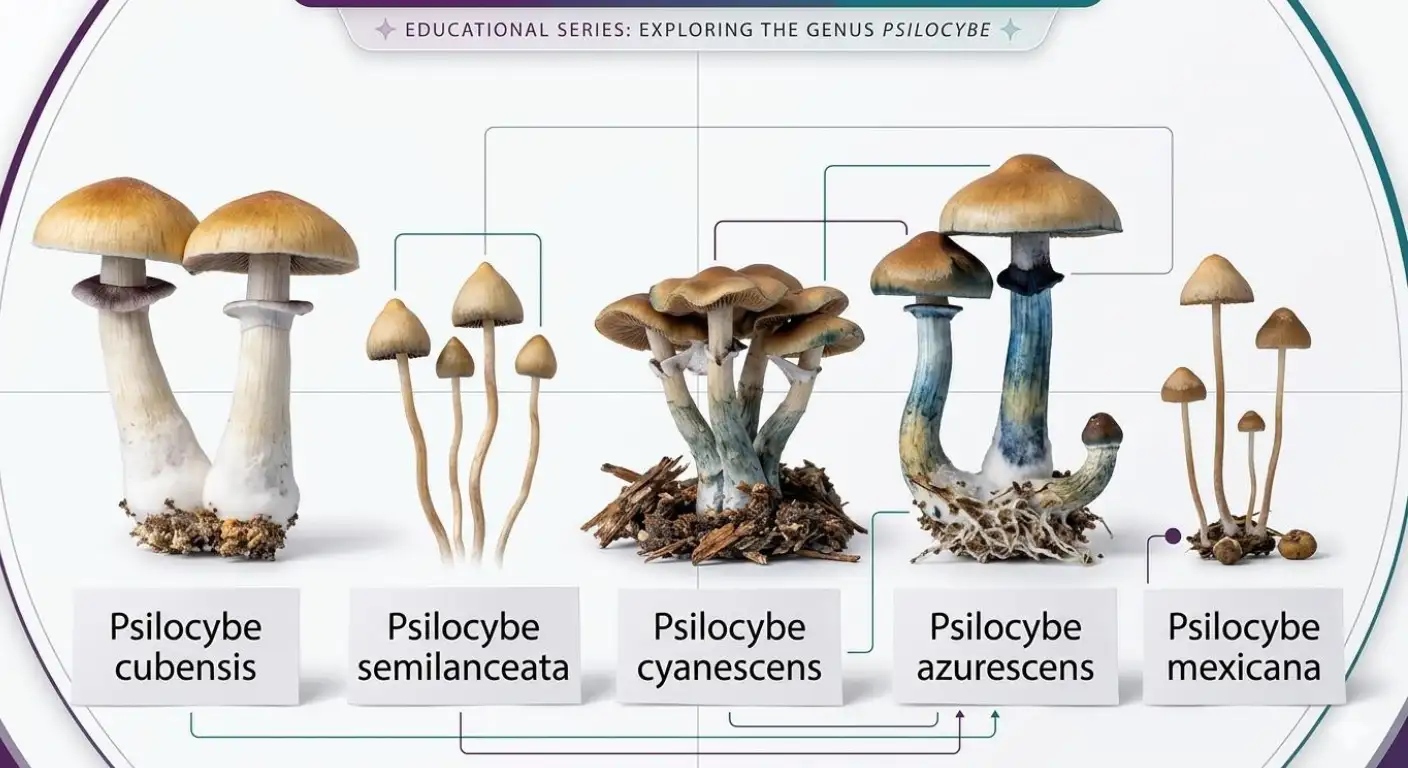
The most commonly referenced species in scientific literature and educational guides include Psilocybe semilanceata (the Liberty Cap, native to the UK), Psilocybe cubensis, Psilocybe cyanescens, Psilocybe azurescens, and Psilocybe mexicana. Each has a distinct morphology, habitat range, and geographic distribution.
For a detailed visual guide to identification features — including cap shape, colouration, and lookalikes — see our Identify Magic Mushrooms in the UK guide.
Psilocybin and Mushroom Spores: An Important Distinction
One of the most important distinctions in mycology education concerns the relationship between psilocybin and mushroom spores. These two subjects are frequently conflated by beginners — but they belong to entirely different areas of study.
🔬 Biology vs Chemistry
Mushroom spores are
microscopic reproductive cells
— the biological mechanism by which fungi propagate. Psilocybin is a
chemical compound.
Spores contain no psilocybin. It is made by the growing fungus and is found in both the mycelium and the mushroom itself. In educational mycology, spore-print and microscopy content should stay firmly in the biology domain, separate from chemistry and law discussions.
Psilocybin in Scientific Research
Psilocybin has been the subject of a significant and accelerating body of scientific interest over the past two decades. Two institutions are at the forefront of this work:
- Imperial College London’s Centre for Psychedelic Research — focuses on understanding how psychedelic drugs act in the brain, with major clinical work on treatment-resistant depression and other mental health conditions.
- Johns Hopkins Center for Psychedelic and Consciousness Research — presents psilocybin as a central area of study in brain science and mental health research, including clinical trials for depression, addiction, and end-of-life anxiety.
Legal Status in the United Kingdom
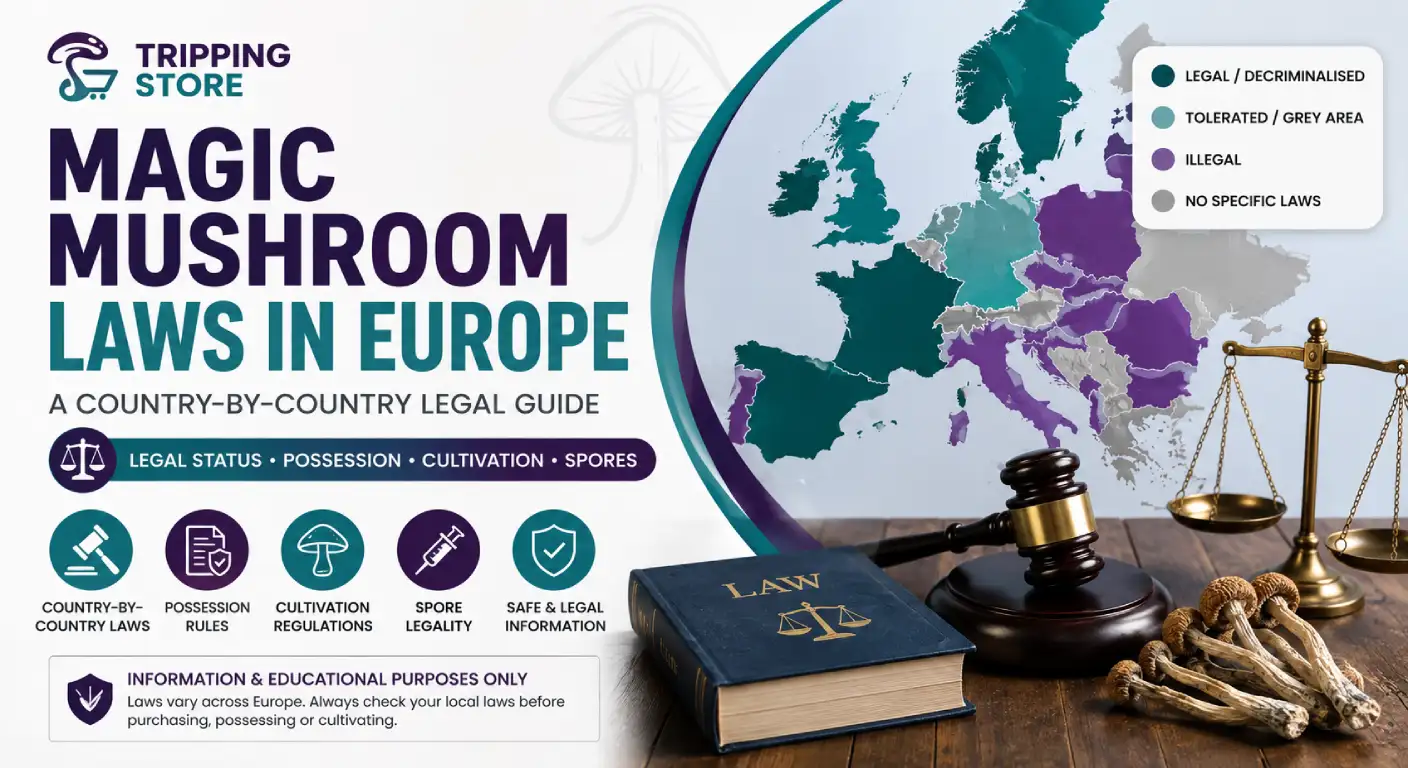
The UK legal position on psilocybin is clearly defined by primary legislation. Section 21 of the Drugs Act 2005 inserted into the existing Class A framework a provision that classifies “fungus (of any kind) which contains psilocin or an ester of psilocin” as a controlled drug.
This classification includes fresh forms of such fungi — a deliberate expansion from the earlier position under the Misuse of Drugs Act 1971, which had left a legal gap around freshly picked mushrooms. The associated Explanatory Memorandum to the Misuse of Drugs (Amendment) (No. 2) Regulations 2005 makes the legislative intent explicit.
⚠️ UK Class A Status
In the UK, fungi containing psilocin or an ester of psilocin are treated as Class A controlled substances. GOV.UK publishes the penalties framework for possession, supply, and production of controlled drugs by class. This page is educational only. For legal questions, consult a qualified solicitor. See our full UK magic mushroom legality guide.Psilocybin vs Psilocin
These two compound names appear together frequently — in research literature, public discussion, and UK legislation — but they refer to distinct (though related) substances. Understanding the distinction matters both chemically and legally.
| Compound | Research | UK Law | Key Detail |
|---|---|---|---|
| Psilocybin | Primary focus of academic and clinical research; the compound most referenced in scientific literature | Not named directly — referenced by implication via psilocin’s ester relationship | Better-known publicly; what people typically search for |
| Psilocin | The active metabolite that psilocybin converts to in the body; mediates the pharmacological effects | Named explicitly in Schedule 2 of the Misuse of Drugs Act 1971 (Class A); section 21 of the Drugs Act 2005 added fungus that contains it | The compound UK law directly addresses; psilocybin is an ester of psilocin |
In practical terms, psilocybin is a phosphorylated ester of psilocin. When consumed, the body converts psilocybin into psilocin through a process called dephosphorylation. It is psilocin that actually binds to serotonin receptors in the brain. UK legislation uses the language of “psilocin or an ester of psilocin,” which captures both compounds under a single legal provision.
Why Psilocybin Appears in Identification Guides
Searches for mushroom identification in the UK — particularly around species that are known to be controlled — frequently encounter the word “psilocybin.” It is worth explaining why, and what the limits of that context should be.
A well-structured educational mushroom guide serves two separate functions:
- Mushroom structure and safety — covering spore morphology, print characteristics, microscopy techniques, lookalike species, and poisoning risk. This is primarily a biology and safety domain.
- Chemical and legal context — covering compound names, classification under drug law, and current research. This is the domain of chemistry, pharmacology, and legislation.
These two areas should be kept clearly separated to serve the reader’s actual needs: the forager or student needs to know what they’re looking at and the risks involved, not a pharmacology tutorial; the researcher or legally curious reader needs precise compound and law information. Good educational content gives both audiences what they need, clearly signposted.
Educational content only.
This article is written for informational and scientific reference. It does not constitute legal or medical advice, and does not encourage the use of controlled substances.
Frequently Asked Questions
Psilocybin is a naturally occurring psychedelic compound (C₁₂H₁₇N₂O₄P) found in certain mushroom species — particularly those within the genus Psilocybe. It belongs to the tryptamine class of compounds and has been the subject of structured academic research at institutions including Imperial College London and Johns Hopkins.
Psilocybin is associated especially with species in the genus Psilocybe, including P. semilanceata (native to the UK), P. cubensis, P. cyanescens, and others. It is also documented in certain species of Panaeolus, Gymnopilus, and Pluteus. The vast majority of mushroom species do not contain psilocybin.
No. Psilocybin and psilocin are Class A drugs under the Misuse of Drugs Act 1971. Section 21 of the Drugs Act 2005 amended that Act so that any fungus of any kind that contains psilocin or an ester of psilocin — including fresh mushrooms — is also a Class A controlled drug. This page is educational only and is not legal advice. For legal queries, consult a qualified solicitor.
In educational mycology, spores are understood as microscopic reproductive cells — distinct from the chemical compounds associated with fruiting bodies. Microscopy and spore-print content is treated as a biology subject, kept separate from the chemistry and law discussions that centre on psilocybin and psilocin.
Psilocybin is the compound most referenced in research and public discussion. Psilocin is the active metabolite that the body converts psilocybin into — it is psilocin that binds to serotonin receptors and produces pharmacological effects. UK legislation specifically names psilocin and esters of psilocin (which includes psilocybin) in its Class A provision.
Yes. Major academic institutions including Imperial College London's Centre for Psychedelic Research and Johns Hopkins' Center for Psychedelic and Consciousness Research publicly describe ongoing psilocybin research in controlled clinical settings, with focus areas including treatment-resistant depression, addiction, and end-of-life anxiety. This research is strictly supervised and does not imply that unsupervised use is safe.
Sources & References
- Johns Hopkins Medicine — Center for Psychedelic and Consciousness Research. hopkinsmedicine.org
- UK Legislation — Drugs Act 2005, Section 21. legislation.gov.uk
- UK Legislation — Explanatory Memorandum to the Misuse of Drugs (Amendment) (No. 2) Regulations 2005. legislation.gov.uk
- Imperial College London — Centre for Psychedelic Research. imperial.ac.uk
- Imperial College London — Centre for Psychedelic Research: Current Research. imperial.ac.uk
- GOV.UK — Penalties for drug possession and dealing by class. gov.uk