⚖️ UK Legal Notice: This guide is written strictly for educational, taxonomic, and microscopy research purposes. Psilocybe cubensis spores do not contain psilocybin or psilocin and are legal to purchase in the UK for microscopy research. Growing fruiting mushrooms from spores is illegal under UK drugs legislation. Always comply with the law. See our 2026 UK Legal Guide for full details.
⚡ Quick Answer
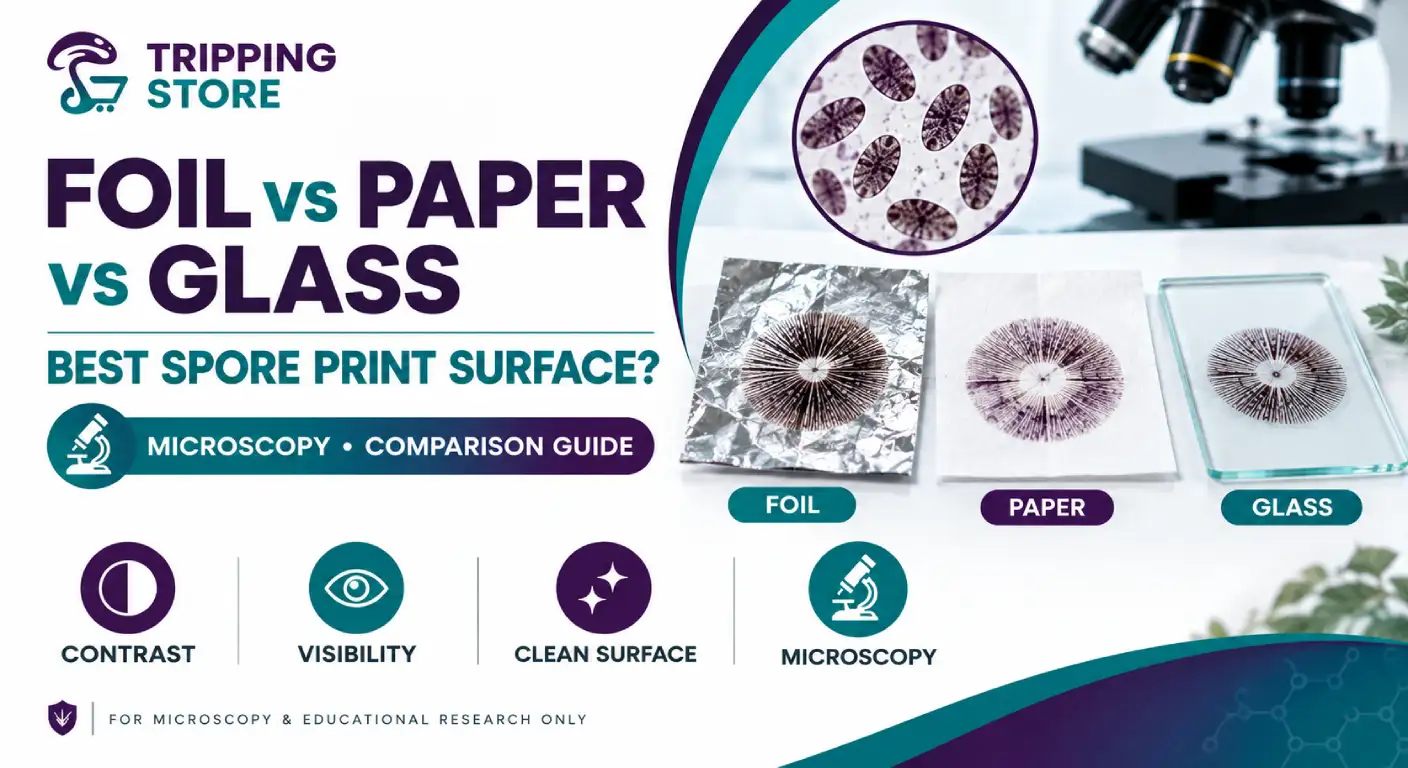
For most research and cultivation work, aluminium foil is the best surface for a spore print. It's easy to wipe clean with alcohol before use, so it stays more sterile than paper, and dried spores lift off cleanly without soaking into the surface. Paper (especially a mix of white and black card) is better if your main goal is identification, since the colour contrast makes it easy to read a spore's true colour. Glass is the most durable and easiest to store long-term, but it's fragile, awkward to post, and not the easiest surface to scrape spores off. This guide breaks down all three so you can pick the right one for what you're actually doing.FoilBest for sterility & easy spore transfer
PaperBest for reading spore colour
GlassBest for durable, long-term storage
3Main surfaces researchers compare
Jump to a section
1. Aluminium Foil — The Cultivator's Choice
2. Paper — Best for Identification
3. Glass — Durable but Niche
4. Head-to-Head Comparison
5. How to Make a Foil Spore Print
6. How to Store a Finished Print
FAQ1. Aluminium Foil — The Cultivator's Choice
Aluminium foil is the surface most researchers reach for when the print is going to be used for further study — transferred to a syringe, checked under a microscope, or kept for genetic reference. The big advantage is sterility: foil can be wiped down with isopropyl alcohol right before use, cutting down the risk of unwanted mould or bacteria landing on your print. Non-stick foil also lets the dried spore deposit peel away cleanly, rather than scraping and losing half of it.
ℹ️ Key Science Fact — Foil doesn't absorb moisture the way paper does. Spores sit on top of the surface instead of soaking into fibres, which is exactly why they're so much easier to collect again afterwards.
✅ Watch For This — If you seal up a foil print before the spore deposit is completely dry, trapped moisture can turn it messy inside the packet. Always give it a full day or two to air-dry first. Foil is also thin, so handle it gently — it tears easily if you fold or unfold it roughly.
2. Paper — Best for Identification
Plain white paper or index card is the classic choice when the goal is simply reading the spore colour — useful for basic taxonomic reference. Because spore colour can range from almost white to deep purple-black, researchers often use a "split" sheet: half white, half black, so a print lands clearly against contrasting paper whichever colour it turns out to be.The catch is that paper is absorbent. Spores gradually work their way into the fibres, which makes a paper print harder to fully recover later if you want to transfer it to another surface. Paper also isn't easy to sterilise — wiping it with alcohol just makes it wet and unusable, so untreated paper carries more contamination risk than foil.
⚠️ One Thing to Remember — Very absorbent paper, like tissue or kitchen roll, is too soft for this. Spores sink straight into the fibres and become almost impossible to read or recover. Stick to plain printer paper or card. Being organic, paper is also more prone to attracting mould or pests over time, so it's not ideal for long-term storage.
3. Glass — Durable but Niche
A glass slide or small pane gives you the most durable, longest-lasting print. It's completely inert, won't fade or absorb moisture, and a labelled glass print can be stored flat for years without degrading — useful if you're building a reference collection. Its biggest advantage for research use is that a print made directly on a glass slide can go straight under the microscope, with no need to transfer the spores anywhere first.The downsides are practical rather than scientific: glass is heavier, more fragile, and far more awkward to post to someone else than a folded piece of foil or paper. If you cover the mushroom with a glass jar or cup while the print forms, trapped humidity can condense on the inside and drip onto the print, so it needs a little more care to set up than foil or paper. Scraping a dried deposit off glass also takes more effort than peeling it off non-stick foil.
🧊
Won't Absorb Moisture
Unlike paper, glass keeps the spore deposit sitting cleanly on the surface rather than soaking in.
📦
Harder to Transport
Fragile and heavier than foil or paper, so it's a poor choice if the print needs to be posted anywhere.
🔎
Straight to the Microscope
A print made on a glass slide can go directly under the microscope, skipping the transfer step entirely.
🗄️
Best for Long-Term Storage
Doesn't degrade the way paper can, making it a solid choice for a permanent reference collection.4. Head-to-Head Comparison
| Surface | Sterility | Ease of Transfer | Durability | Best For |
|---|---|---|---|---|
| Aluminium Foil | High | Easy | Moderate | Cultivation & microscopy research |
| Paper / Card | Low–Moderate | Moderate | Moderate | Visual identification |
| Glass | High | Fiddly | High | Direct microscopy & archival storage |
Foil vs Paper — Sterility vs Colour Contrast
Foil wins if you plan to actually use the spores afterwards — it's more sterile and gives spores up more easily. Paper wins if you just want to read what colour the spores are, since the contrast against white or black card is much clearer than on shiny foil.Foil vs Glass — Practicality vs Permanence
Foil is lighter, cheaper, and easier to post or store flat in a packet. Glass lasts almost indefinitely and looks better for a labelled reference collection, but it's not something you'd want to rely on if the print needs to travel anywhere.5. How to Make a Foil Spore Print
Since foil is the best all-round choice for research use, here's the basic method.What You'll Need
- A sheet of non-stick aluminium foil
- Isopropyl alcohol and a clean cloth or wipe, to sterilise the foil first
- A clean glass or jar, to cover the print while spores drop
- A notebook to record the date and details
1
Wipe the foil down — Clean it thoroughly with isopropyl alcohol and let it dry fully before you start.
2
Lay the foil flat — Place it somewhere still, away from drafts or airflow that could scatter the spores.
3
Cover with a glass or jar — This stops air currents from carrying spores away as they drop.
4
Leave for several hours — Most deposits form within 4–12 hours, though leaving it overnight gives a denser print.
5
Let it fully air-dry — Give it a day or two before folding or sealing it, so no moisture gets trapped inside.
6. How to Store a Finished Print
However you made it, a spore print needs to be kept dry, dark, and protected from moisture to stay usable for reference.| Factor | What to Do | Why |
|---|---|---|
| Moisture | Add a silica gel packet before sealing | Stops trapped damp from ruining the print |
| Sealing | Fold in a zip-lock bag or airtight container | Keeps air and moisture out long-term |
| Temperature | Store somewhere cool and dark, ideally in the fridge | Slows down any degradation over time |
| Labelling | Write the date and details on the packet | Keeps your reference records accurate |
✅ Good Habit — Double-bagging a foil print (foil packet inside a sealed zip-lock) is a simple way to keep moisture out without any special equipment.
Prefer a Ready-Made Option?
If you'd rather skip the print-making process entirely, Tripping Store's spore syringes are prepared under sterile conditions in the UK and ready to use straight away — no drying, sterilising, or transferring required.Frequently Asked Questions
QIs making a spore print legal in the UK?
Making a spore print is a standard mycology technique used for identification and research. Our spore syringes themselves are legal to buy and own in the UK for microscopy research, since they don't contain psilocybin. Growing fruiting mushrooms from spores is illegal under UK law.
QWhat's the best surface for a spore print?
Aluminium foil is generally best for research and cultivation use, since it's the easiest to sterilise and gives up spores most cleanly. Paper is better if you just want to read the spore's colour.
QWhy is foil more sterile than paper?
Foil can be wiped down with isopropyl alcohol right before use. Paper can't be cleaned the same way without getting wet and unusable, so it carries more contamination risk.
QWhy do some people use black and white paper together?
Spore colour ranges from almost white to deep purple-black. Splitting the paper half white, half black means a print shows up clearly against contrast, whichever colour it turns out to be.
QIs glass a good surface for a spore print?
Glass is very durable, inert, and doesn't absorb moisture, making it good for long-term storage. It's more fragile and harder to transport than foil or paper, so it's less practical for everyday use — but it's the only surface that lets you go straight to the microscope without transferring the spores first.
QCan I check a spore print under the microscope without transferring it?
Yes, if it's made on a glass slide. A print on foil or paper needs to be scraped or mixed into a suspension first, but a glass print can go directly under the microscope.
QWhat's the biggest risk when using glass for a print?
Condensation. If you cover the mushroom with a glass jar or cup while the print forms, trapped humidity can build up and drip onto the print, so it's worth checking on it rather than leaving it fully sealed for too long.
QHow long does it take to make a spore print?
Most deposits form within 4 to 12 hours, though leaving it overnight usually gives a denser, easier-to-read print.
QHow should I store a finished spore print?
Keep it dry, dark, and sealed with a silica gel packet in an airtight bag or container, ideally somewhere cool like a fridge.
QCan I buy spores from Tripping Store instead of making my own print?
Yes. Tripping Store sells spore syringes prepared under sterile conditions in the UK, ready to use straight away for microscopy research, with fast, discreet UK-wide delivery.