Double Density Spore Syringes UK: The Complete Guide 2026
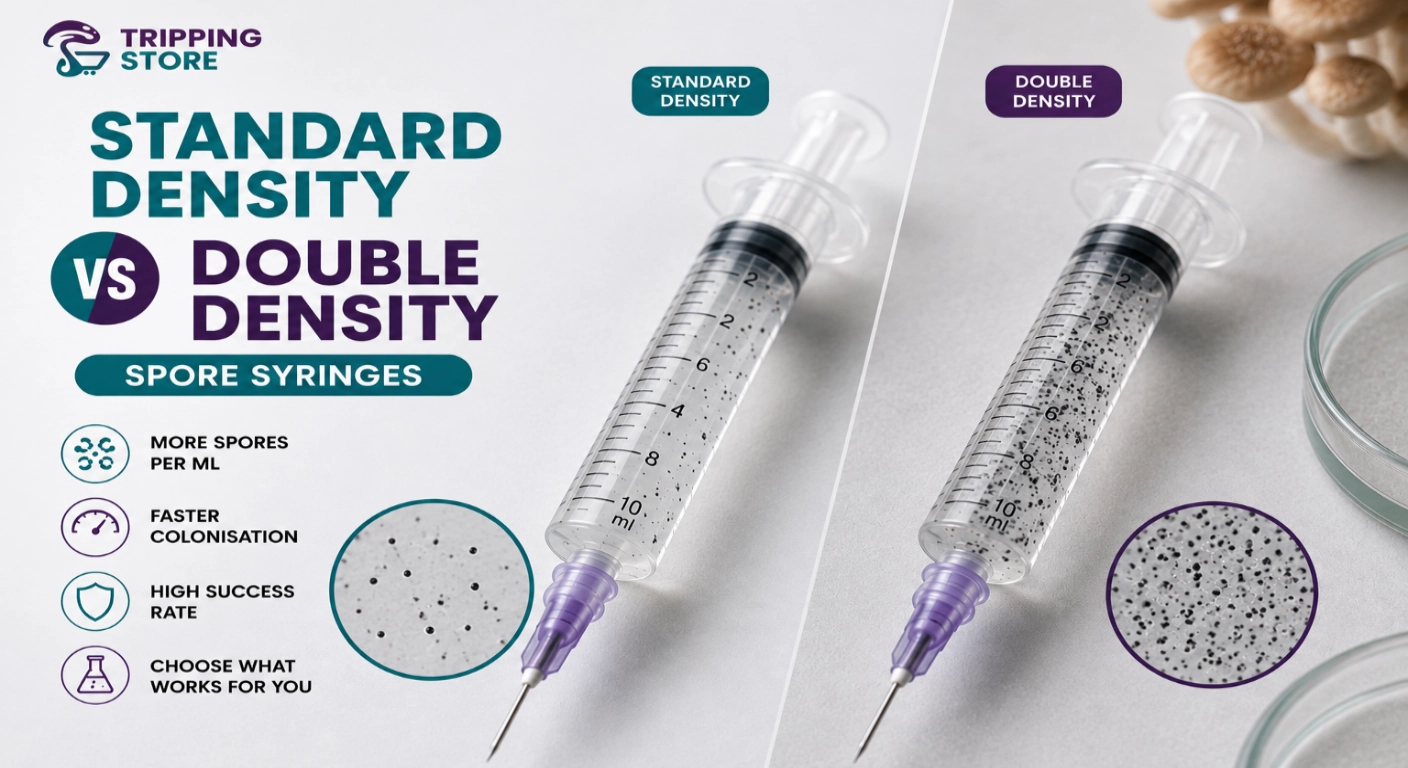
A double density spore syringe contains roughly twice the concentration of spores compared to a standard syringe — suspended in the same volume of sterile water. The liquid looks visibly darker, often appearing dark purple-brown or near-black. For microscopy researchers, this means more spores per slide, faster and easier observation at 400x, and more material to work with across multiple slide preparations from a single syringe. Tripping Store's Sterile Double-Density Spore Syringes are prepared in the UK under laboratory conditions and are available across all major Psilocybe cubensis strains.
If you've bought a spore syringe before, you might have noticed that some look much darker than others. Some are almost clear with just a faint haze. Others are so dark you can barely see through the liquid at all. That difference isn't random — it comes down to spore density, and it matters more than most people realise.
This guide explains exactly what double density means, why it's useful for microscopy research, how to tell a genuinely high-density syringe from a normal one, and what to look for when you're buying one in the UK.
1. What Is a Double Density Spore Syringe?
A spore syringe is a syringe filled with spores suspended in sterile water. The spores are collected from a mature mushroom — either from a spore print or directly from the gills — and then mixed into water that has been sterilised to remove any bacteria or contaminants.
A double density syringe is simply one where twice as many spores have been loaded into the same volume of water. It's the same 10ml syringe, the same sterile water — just with roughly double the spore count.
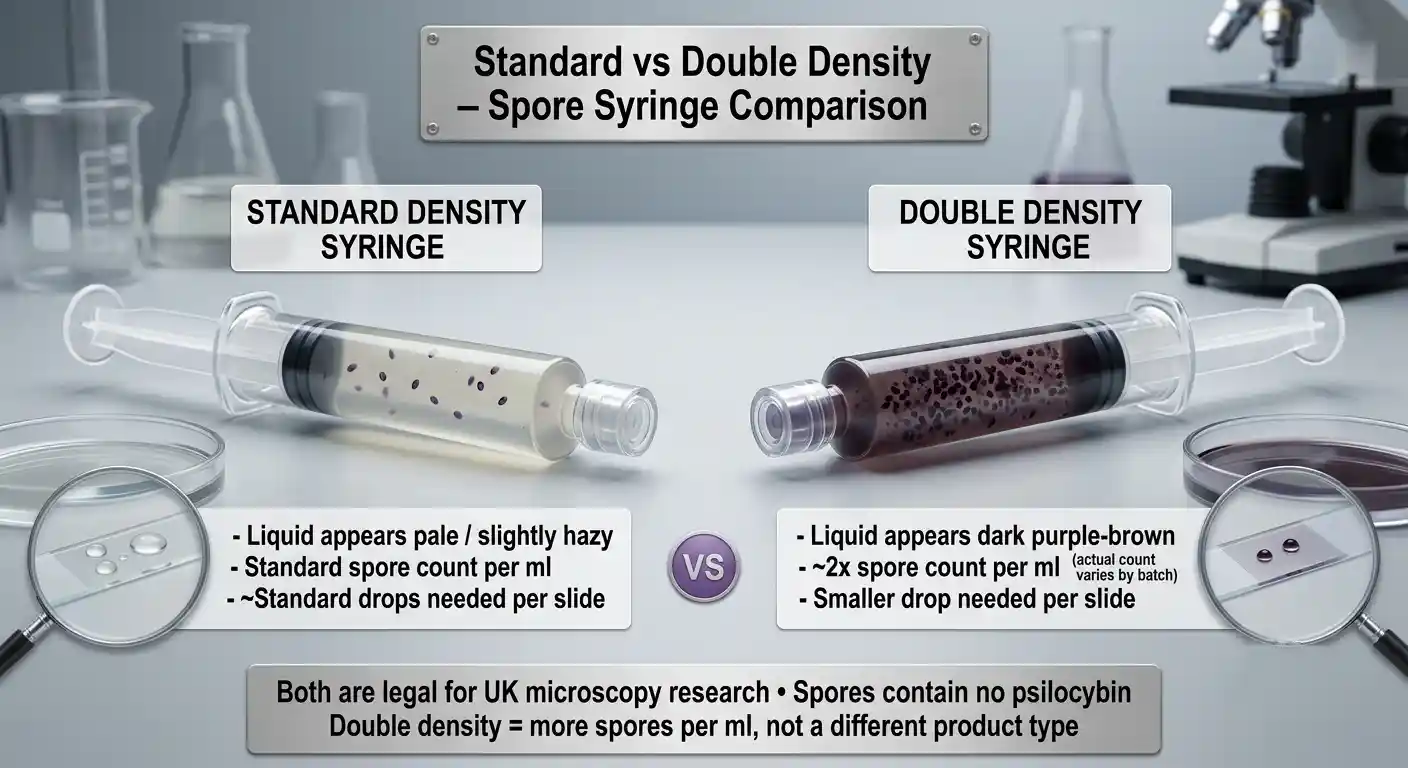
You can usually spot the difference just by looking. Hold a standard syringe up to the light and you'll often see a faintly cloudy liquid, sometimes with visible specks. Hold a double density syringe up to the same light and the liquid is noticeably darker — often deep purple-brown or nearly black — because there's so much more pigmented spore material in the water.
In this context, density just means concentration — how many spores per millilitre of liquid. A double density syringe has approximately twice the spore count per ml. The spores themselves are exactly the same size and shape as in a standard syringe — there's just more of them.
2. Double Density vs Standard Syringe — What's Actually Different
Here's a side-by-side breakdown of what changes and what stays the same:
- Standard spore concentration — lighter coloured liquid
- Fewer spores per drop placed on a slide
- May need to use more liquid per slide to get a good sample
- Still perfectly usable for microscopy research
- Slightly more forgiving if you over-deposit on a slide
- Usually lower price point
- Twice the spore concentration — visibly darker liquid
- More spores per drop — less liquid needed per slide
- Makes more slides from the same syringe volume
- Easier to locate spores quickly at 400x magnification
- Better for high-volume slide work or group research sessions
- Better value per observation session overall
The key thing to understand is that the spores themselves are identical — the morphology, the germ pore, the wall structure, the pigmentation — all the same. What changes is simply how many you're getting per millilitre of suspension.
Double density does not affect spore viability, spore size, genetic characteristics, or any biological property of the spores. It also doesn't affect the UK legal status — spores remain legal for microscopy research regardless of density. A denser syringe is purely a quantity difference, not a quality difference in the biological sense.
3. Why Double Density Matters for Microscopy Research
When you're doing microscopy, the biggest practical frustration for beginners is spending time hunting for spores on a slide. You've prepared your slide carefully, you've focused the microscope, and then you're scanning around a mostly empty field of view trying to find something to look at. It can be discouraging.
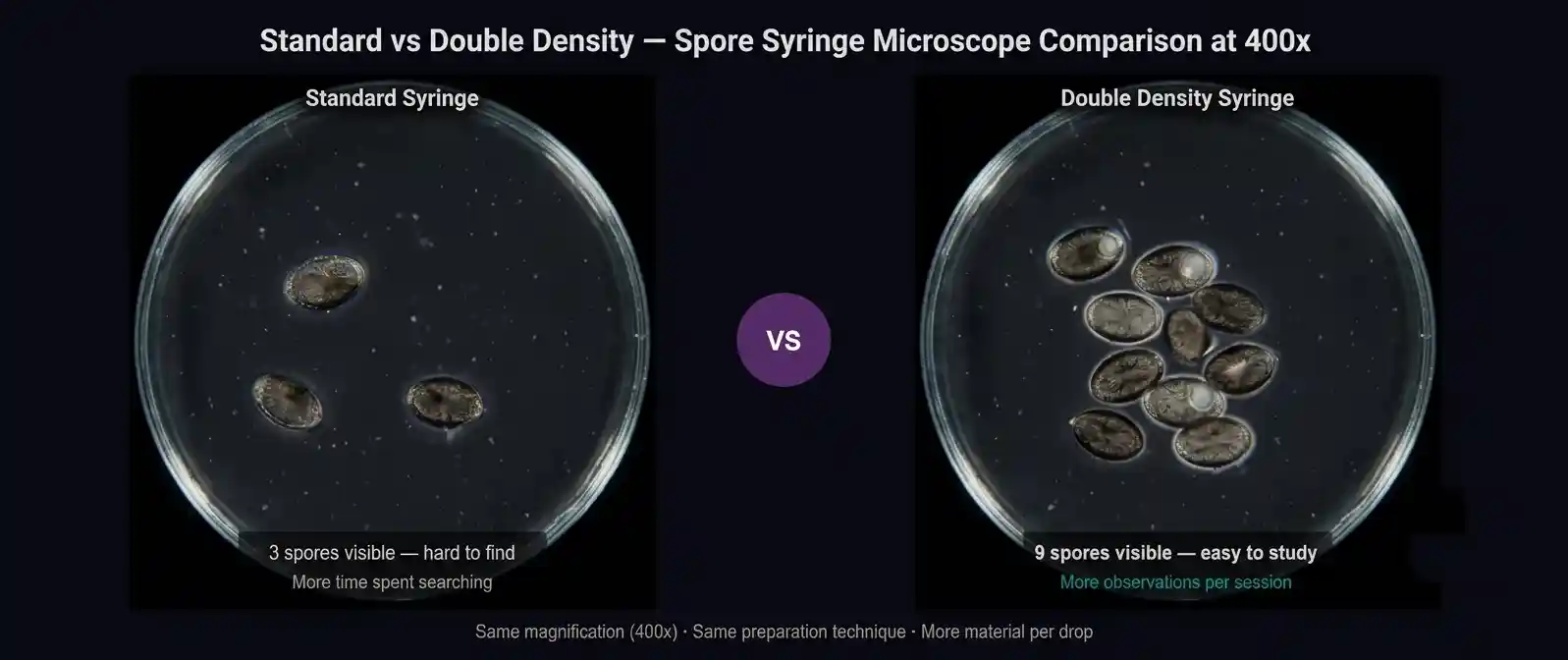
Double density syringes help with this directly. More spores in the suspension means more spores on the slide — which means a more populated field of view at 400x, less time spent searching, and more time actually observing.
Denser Fields of View
At 400x magnification, a slide made from a double density syringe typically shows a noticeably more populated field of view. You can find, observe, and measure multiple spores without constantly repositioning the stage.
Better for Statistical Measurement
Good microscopy involves measuring at least 15–20 spores to get a reliable average size. With a denser suspension, finding 20 measurable spores per slide is much quicker — which matters when you're running multiple comparisons.
More Slides Per Syringe
Because you get results with a smaller drop of liquid, you use less per slide. A 10ml double density syringe effectively stretches further than a 10ml standard syringe in terms of how many usable slide preparations you can make.
Visible Quality Check
The dark colour of a genuine double density suspension is a visible indicator of quality. If your syringe looks pale or watery, that's a sign of low spore count. A truly dense suspension should be visibly dark when you hold it up to the light.
Ideal for Beginners
If you're new to spore microscopy, a denser syringe means you're more likely to have a successful first observation session. Finding spores quickly and getting clear views builds confidence — whereas sparse slides can feel discouraging early on.
Group Research Sessions
If you're running a microscopy workshop or teaching session with multiple participants each making slides, a double density syringe means there's enough material for everyone to get a well-populated slide without burning through your supply.
4. How Double Density Spore Syringes Are Made
Making a double density syringe isn't complicated in principle — but it requires clean technique at every step, because the higher spore concentration also means any contamination that gets in has more material to spread through.
The Process
- Spore collection: Spores are collected from a mature mushroom cap — either via a spore print (dropping spores onto foil or paper) or directly from the gills. Mature caps with fully open veils produce the most spores.
- Suspension preparation: Sterile water is prepared — usually distilled water that has been pressure-sterilised. Everything that touches the spores at this point must be sterile.
- Loading the syringe: The spore material is introduced to the sterile water in higher quantity than a standard preparation — roughly double the amount of spore material per volume of water. This is what creates the denser suspension.
- Quality check: The finished syringe should appear visibly dark — deep purple-brown — when held up to the light. A light or watery appearance at this stage would indicate insufficient spore material.
- Sealing and labelling: The syringe is capped with a sterile needle cover and labelled with strain name and preparation date.
At Tripping Store, all spore syringes are prepared under sterile conditions in the UK. Syringes are labelled with strain name and are available across all major Psilocybe cubensis varieties.
5. Which Strains Are Available as Double Density?
Tripping Store's full range of spore syringes is prepared to double density standard. Here's how the main strains compare for microscopy research:
| Strain | Spore Size | Deposit Density | Difficulty | Best For |
|---|---|---|---|---|
| Golden Teacher | 11–17 × 7–12µm | Very High | Beginner | First strain, reference slides |
| B+ | 11–16 × 7–11µm | Very High | Beginner | High-volume preparation |
| Blue Meanies | 10–14 × 6–10µm | Moderate | Intermediate | Pigmentation contrast study |
| Jedi Mind Fuck | 11–16 × 7–11µm | Moderate | Intermediate | Phenotypic variation research |
| Penis Envy | 11–17 × 7–12µm | Low — rare | Advanced | Genetic mutation study |
| Albino A+ | 11–15 × 7–11µm | Moderate | Advanced | Pigmentation genetics |
If you're buying a double density syringe for the first time, Golden Teacher is the right choice. It produces the most abundant spores of any common cubensis strain, so the double density effect is most noticeable — and the spore characteristics (size, colour, germ pore) are well documented for easy comparison. See our Complete Golden Teacher Guide.
6. How to Use a Double Density Spore Syringe for Microscopy
The technique is the same as a standard syringe — the only adjustment is that you can use a slightly smaller drop, because there's already more material in each drop.
- Bring to room temperature first. Take the syringe out of the fridge and let it warm up for 15–20 minutes before use. Cold liquid from the fridge can cause condensation on your slide.
- Agitate well. Spores settle during storage. Roll the syringe between your palms for 15 seconds, then shake gently for 10 more. This redistributes spores evenly.
- Use a smaller drop than usual. With a standard syringe you'd typically use around 0.05ml. With double density, start with slightly less — maybe 0.03ml. The slide will still be well-populated because of the higher concentration.
- Apply coverslip at 45 degrees — lower it slowly to push air out and avoid bubbles.
- Start at 100x to get an overview, then move to 400x for observation. At 400x you should see a well-populated field with plenty of spores to work with.
- If the slide is too crowded — spores overlapping and hard to distinguish individually — you used slightly too much. Next time use an even smaller drop. This is rare with standard-sized drops but can happen with double density if you're not careful.
Always cap the needle immediately after each use. Never leave it uncapped. Each second the needle is open to the air is a chance for contamination to enter the syringe — which would compromise all future slides from that syringe.
7. How to Store Your Double Density Syringe
Storage is identical to any spore syringe — the higher density doesn't change the requirements.
| Factor | Correct Storage | Why It Matters |
|---|---|---|
| Temperature | 2–8°C (standard fridge) | Slows microbial activity without damaging spores |
| Freezing | Never freeze | Ice crystals permanently rupture spore walls |
| Light | Complete darkness | UV and ambient light degrade viability over time |
| Position | Upright, needle cap on | Prevents spores clumping at the plunger end |
| Shelf life | 12–18 months under ideal conditions | After this, wall structure degrades and clumping increases |
Shop Tripping Store's Double Density Spore Syringes
Prepared in the UK under sterile conditions. All major Psilocybe cubensis strains available. Discreet delivery across the UK.
Frequently Asked Questions
Double density means the syringe contains approximately twice the concentration of spores per millilitre compared to a standard syringe — suspended in the same volume of sterile water. The liquid looks visibly darker as a result, often appearing deep purple-brown or near-black. The spores themselves are biologically identical to those in a standard syringe — there are just more of them.
Yes — the UK legal status of spore syringes is the same regardless of density. Psilocybe cubensis spores do not contain psilocybin or psilocin and are legal to buy, own, and use for microscopy and taxonomic research. "Double density" refers only to spore concentration, not to any controlled compound. See our full UK legal guide for details.
Hold the syringe up to a light source. A genuine double density syringe should appear visibly dark — deep purple-brown to near-black — because of the concentrated spore material. A standard or low-density syringe will look pale, slightly hazy, or nearly clear. If your "double density" syringe looks pale when held to the light, it probably isn't as concentrated as advertised.
No. Double density is purely a quantity difference — more spores per millilitre of water. It does not affect spore morphology, wall structure, germ pore characteristics, pigmentation, or viability. All those biological properties are determined by the genetics of the strain, not the concentration of the suspension. Storage conditions (2–8°C, darkness, upright) affect viability; density does not.
Yes, slightly. With a standard syringe, a typical starting drop is around 0.05ml. With a double density syringe, you can start with a slightly smaller drop — around 0.03ml — because you'll still get a well-populated slide. If you use the same sized drop as a standard syringe, the slide may be too crowded, making it hard to observe individual spores clearly. Start small and adjust based on how populated your first slide looks at 400x.
Golden Teacher is the best starting point. It naturally produces the most abundant spore deposits of any common Psilocybe cubensis strain, so the double density effect is most noticeable — you'll get very dense, well-populated slides. The spore characteristics (11–17µm, subellipsoid, dark purple-brown, clear germ pore) are also very well documented, making it easy to compare your observations against published references. See our Complete Golden Teacher Guide.
Under correct storage conditions — 2–8°C, complete darkness, needle cap on, stored upright — a double density syringe remains viable for 12–18 months or longer. The higher spore density doesn't change shelf life. Never freeze the syringe; ice crystals permanently damage spore wall structure. Always bring to room temperature and shake gently before each use.
Yes, for most beginners. The main challenge when starting spore microscopy is locating and observing spores — which is much easier when your slide has plenty of them. A denser syringe makes the first few sessions less frustrating, because you're not spending time hunting for spores in a sparse field of view. The trade-off is that slides can become too crowded if you use too much liquid, so start with a slightly smaller drop than you would with a standard syringe.